• Fri frakt över 249 kr
  • •
  • Snabba leveranser
  • •
  • Billiga böcker
Kundservice

Du är på sajten för privatpersoner.

Företag, bibliotek eller offentlig verksamhet?

Du handlar på classic.bokus.com, där alla dina funktioner finns intakta.
Till classic.bokus.com
Bokus logotyp. Gå till startsidan.
  • Erbjudanden
  • Nyheter
  • Student
  • Topplistor
  • Barn & ungdom
  • Bokus Play
  • E-böcker
  • Pocketböcker
  • Spel & pussel

10% studentrabatt med kod TERM26

Sidfot

Mina sidor

    Hjälp

    • Kundservice
    • Vanliga frågor och svar
    • Frakt och leverans
    • Retur vid ångerrätt
    • Reklamera vara
    • Betalning
    • Köpvillkor
    • Allmänna villkor
    • Information om webbplatsens tillgänglighet

    Om Bokus

    • Om oss
    • Pressrum
    • För studenter
    • För företag
    • För bibliotek och offentlig verksamhet
    • För leverantörer
    • Hållbarhet

    Populärt

    • Aktuella erbjudanden
    • Presentkort
    • Studentlitteratur
    • Nya böcker
    • Topplistor
    • Signerade böcker
    • Engelska böcker

    Inspiration

    • Boktips
    • BookTok
    • Populära bokserier
    • Barnbokskaraktärer
    • Populära författare
    Logotyp för Bokus
    Följ oss på Facebook (extern länk)Följ oss på Instagram (extern länk)Följ oss på YouTube (extern länk)Följ oss på TikTok (extern länk)
    bokus @ CookiesAnpassa cookiesIntegritetspolicyKöpvillkor
    Till Citymail hemsida (extern länk)Till Budbee hemsida (extern länk)Till Postnord hemsida (extern länk)Till Schenker hemsida (extern länk)Till Early Bird hemsida (extern länk)Till Walleys hemsida (extern länk)
    1. Naturvetenskap och teknik
    2. Geovetenskap
    3. Miljövetenskap och miljöpolitik

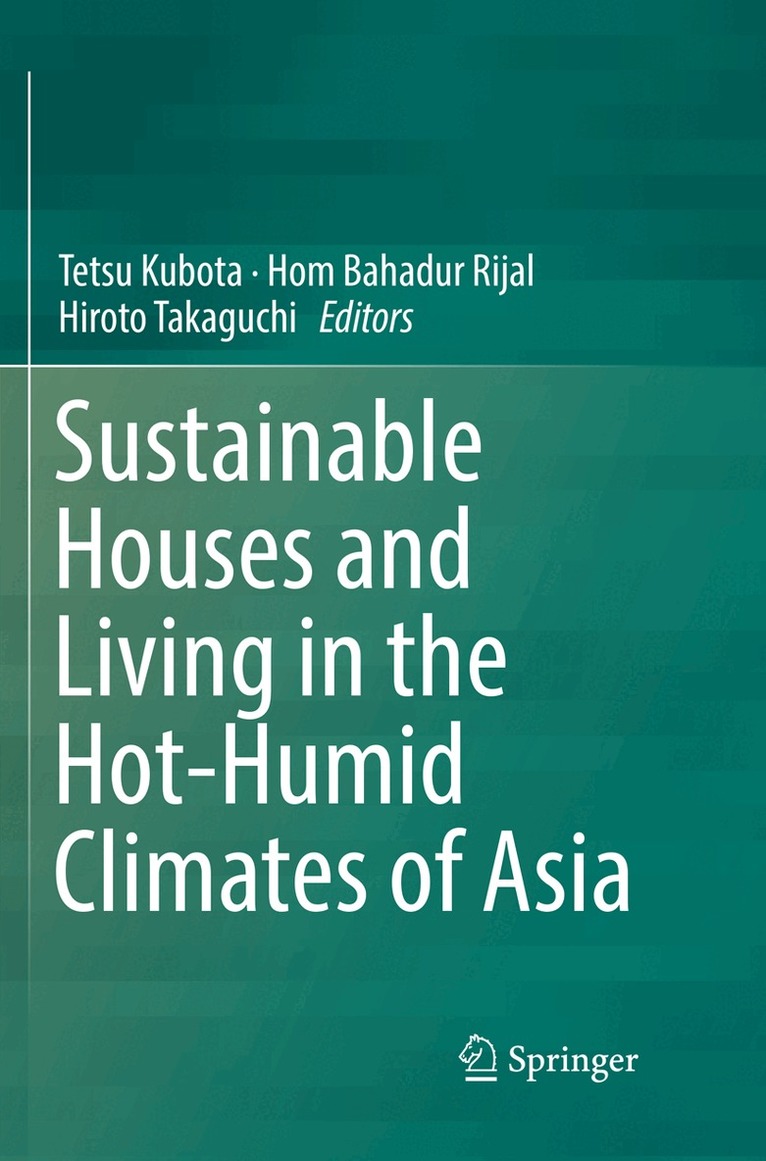
    Sustainable Houses and Living in the Hot-Humid Climates of Asia

    AvTetsu Kubota,Hom Bahadur Rijal

    Häftad, Engelska, 2019

    2 394 kr

    Beställningsvara. Skickas inom 10-15 vardagar. Fri frakt över 249 kr.

    Beskrivning

    This book provides information on the latest research findings that are useful in the context of designing sustainable houses and living in rapidly growing Asian cities. The book is composed of seven parts, comprising a total of 50 chapters written by 53 authors from various countries, mainly in the Asian region. Part I introduces vernacular houses in different Asian countries such as Indonesia, Malaysia, India, Nepal, China, Thailand and Laos. Parts II and III then explore in depth indoor adaptive thermal comfort and occupants’ adaptive behavior, focusing especially on those in hot-humid climates. Part IV presents detailed survey results on household energy consumption in various tropical Asian cities, while Part V analyses the indoor thermal conditions in both traditional houses and modern houses in these countries. Several real-world sustainable housing practices in Asian cities are reviewed in the following part. The final part then discusses the vulnerability of expanding Asian cities to climate change and urban heat island. Today, approximately 35-40% of global energy is consumed in Asia, and this percentage is expected to rise further. Energy consumption has increased, particularly in the residential sector, in line with the rapid rise of the middle class. The majority of growing Asian cities are located in hot and humid climate regions, and as such there is an urgent need for designers to provide healthy and comfortable indoor environments that do not consume non-renewable energy or resources excessively. This book is essential reading for anyone with an interest in sustainable house design in the growing cities of Asia.

    Produktinformation

    • Utgivningsdatum:2019-02-11
    • Mått:155 x 235 x 30 mm
    • Vikt:989 g
    • Format:Häftad
    • Språk:Engelska
    • Antal sidor:559
    • Förlag:Springer Verlag, Singapore
    • ISBN:9789811341595

    Utforska kategorier

    • Miljövetenskap och miljöpolitik inom Naturvetenskap och teknik
    • Meteorologi och klimatologi inom Naturvetenskap och teknik

    Mer om författaren

    Dr. Tetsu KubotaHiroshima University, Higashi-Hiroshima, JapanProf. Dr. Hom B. RijalTokyo City University, Yokohama, JapanProf. Dr. Hiroto TakaguchiWaseda University, Tokyo, Japan

    Innehållsförteckning

    • Preface.- 1. Introduction.- Part I Vernacular Architecture.- 2. Indonesia: Dutch Colonial Buildings.- 3. Malaysia: Malay House.- 4. Malaysia: Longhouse of Sarawak.- 5. India: Bio-Climatism in Vernacular Architecture.- 6. Nepal: Traditional Houses.- 7. China: Houses for Ethnic Minorities in Yunnan Province.- 8. Thailand: The Houses of a Khun Village in Chaing Mai.- 9. Laos: Indigenous Houses of a Lue Village in Luang Prabang.- Part II Adaptive Thermal Comfort.- 10. Principles of Adaptive Thermal Comfort.- 11. Thermal Comfort in Indonesia.- 12. Exergetic Aspect of Human Thermal Comfort and Adaptation.- 13. Thermal Sensation and Comfort in Hot and Humid Climate of Indonesia.- 14. Development of an Adaptive Thermal Comfort Equation for Naturally Ventilated Buildings in Hot and Humid Climates.- 15. Comfort Temperature and Preferred Temperature in Taiwan.- 16. Thermal Comfort in Indian Apartments.- 17. Comfort Temperature and Adaptive Model in Traditional Houses of Nepal.- 18. Comfort Temperature and Adaptive Model in Japanese Dwellings.- 19. Thermal Comfort Survey in Japan.- [Box] Thermal Comfort in Japanese and Indian Offices.- Part III Adaptive Behavior.- 20. Principles of Adaptive Behaviours.- 21. Behavioural Changes May Affect Changes in Comfort Temperature of Indonesian People.- 22. Window-Opening Behaviour in Hot and Humid Climates of Southeast Asia.- 23. Survey of Thermal Environment of Residences Using Air Conditioners in Surabaya, Indonesia.- 24. Occupants’ Behaviour in Taiwan.- 25. Occupant Behavior in Indian Apartments.- 26. Occupant Behaviour in the Various Climates of Nepal.- 27. Window Opening Behaviour in Japanese Dwellings.- 28. Occupants’ Climate-controlling Behavior in Japanese Residences.- [Box] Occupant Adaptation in Japanese and Indian offices.- Part IV Energy Consumption.- 29. The Use of Energy Consumption Data.- 30. Overview of Energy Consumption in Hot-Humid Climates of Asia.- 31. Energy Consumption and Indoor Temperature in Cambodian Houses.- 32.Analysis of household energy consumption and CO2 emissions for residential buildings in Jakarta and Bandung; A study of Indonesia.- 33. Firewood Consumption in Nepal.- 34.Thermal Environment and Energy Use of Houses in Bangkok, Thailand.- 35. Energy consumption of residential buildings in China.- 36. Household energy consumption in slum areas: A case study of Tacloban City, Philippines.- Part V Indoor Thermal Environment.- 37. Thermal Function of Internal Courtyards in Traditional Chinese Shophouses in Malaysia.- 38. Passive Cooling of the Traditional Houses of Nepal.- 39. Passive Cooling Strategies to Reduce Energy Consumption of Cooling in Hot and Humid Climate in Indonesia.- 40. Indoor Thermal Environments in Apartments of Surabaya, Indonesia.- 41. Indoor Thermal Environments from Vernacular to Modern Houses in Cambodia .- 42. Actual Condition of the Indoor Environment of Houses in Nine Chinese Cities.- Part VI Sustainable Houses in Asian Cities.- 43. Energy-Saving Experimental Houses in Malaysia.- 44. S-PRH in Kitakyushu, Japan.- 45. Eco-House in Kyusyu, Japan.- 46. Sustainable Houses in Japan: An Overview.- [Box] An example in Thailand: Floating in the Sky School for Orphans.- Part VII Climate Change and Urbanization.- 47. Climate Vulnerability in Tropical Asia.- 48. Urban Climate Challenges in Hanoi: Urban Heat Islands and Global Warming.- 49. Assessment of Future Urban Climate after Implementation of the City Master Plan in Vinh City, Vietnam.- 50. Urban Heat Island of Putrajaya City in Malaysia.