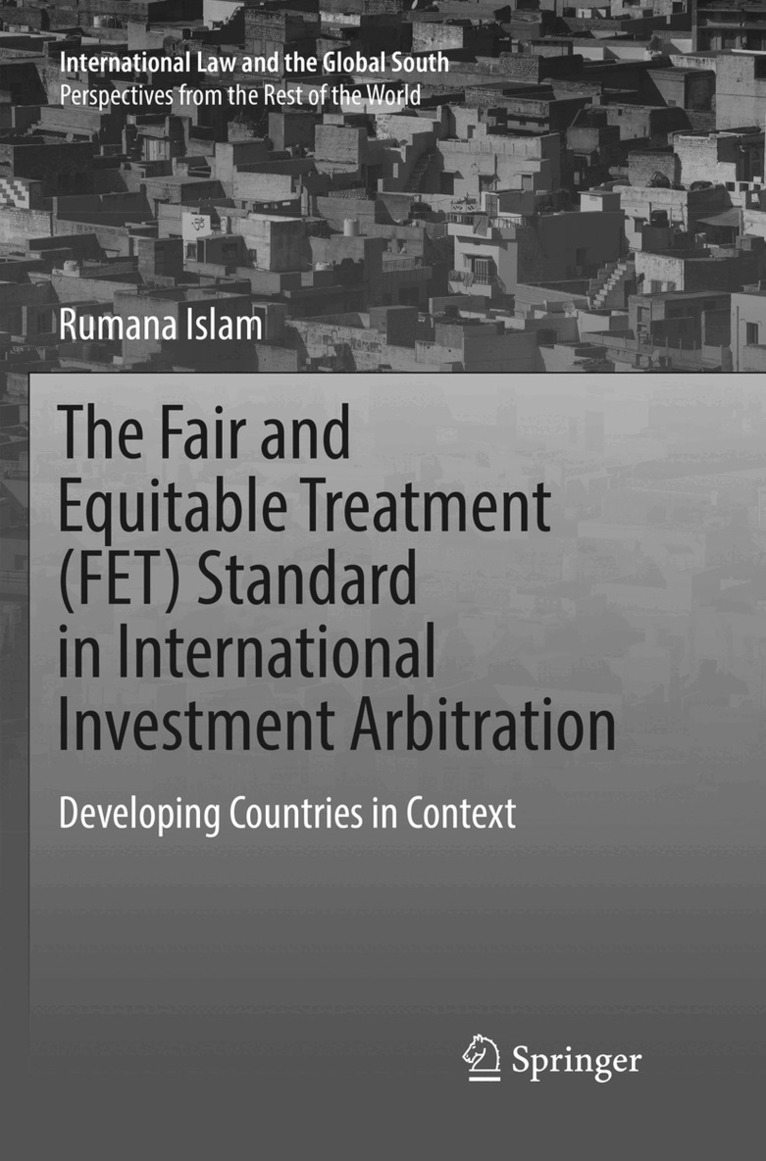
Häftad, Engelska, 2019
Fair and Equitable Treatment (FET) Standard in International Investment Arbitration
Developing Countries in Context
Av Rumana Islam
Del i serien International Law and the Global South
847 kr
Beställningsvara. Skickas inom 10-15 vardagar. Fri frakt över 249 kr.
Beskrivning
Produktinformation
- Utgivningsdatum: 2019-02-01
- Mått: 155 x 235 x 15 mm
- Vikt: 366 g
- Format: Häftad
- Språk: Engelska
- Serie: International Law and the Global South
- Antal sidor: 202
- Förlag: Springer Verlag, Singapore
- ISBN: 9789811347344
Utforska kategorier
Mer om författaren
Dr. Rumana Islam is an Associate Professor at the Department of Law, University of Dhaka, Bangladesh. At present she also holds the position of Assistant Director (part-time) of the law research wing of Bangladesh Institute of Law and International Affairs (BILIA). After completing her LLB and LLM degrees from the University of Dhaka, she earned an LLM with a specialization in commercial law from the University of Cambridge (UK) in 2006. She completed her doctoral work at the University of Warwick (UK) with a Commonwealth Scholarship in 2015. Her research interests include international investment law, investment arbitration, commercial arbitration, public international law, banking and securities laws, corporate law and human rights.
Recensioner i media
“It would seem that works like the one by Professor Islam in analysing the perils of the elastic nature of the FET standard and the way arbitral tribunals interpret it, would encourage some soul-searching among many policymakers in the global South. Anyone with interest in international investment law would do well to consult this work of Professor Islam, and this is even more so for those in the global South.” (Md. Rizwanul Islam, afronomicslaw.org, March 3, 2021)“The book flees from a Manichean vision of international investment law. It is not written against foreign investors and in favor of developing States. With a scientific caution, the author reflects on how bridges can be built between these two actors with the aim of upholding development priorities without undermining investors’ protection — thereby hinting at a fair and equitable treatment for host developing States.” (Nitish Monebhurrun, afronomicslaw.org, March 2, 2021)
Betyg & recensioner
0 recensioner
Inga recensioner tillgängliga.