• Fri frakt över 249 kr
  • •
  • Snabba leveranser
  • •
  • Billiga böcker
Kundservice

Du är på sajten för privatpersoner.

Företag, bibliotek eller offentlig verksamhet?

Du handlar på classic.bokus.com, där alla dina funktioner finns intakta.
Till classic.bokus.com
Bokus logotyp. Gå till startsidan.
  • Erbjudanden
  • Nyheter
  • Student
  • Topplistor
  • Barn & ungdom
  • Bokus Play
  • E-böcker
  • Pocketböcker
  • Spel & pussel

10% rabatt på allt med kod: NYSTART10 →

Sidfot

Mina sidor

    Hjälp

    • Kundservice
    • Vanliga frågor och svar
    • Frakt och leverans
    • Retur vid ångerrätt
    • Reklamera vara
    • Betalning
    • Köpvillkor
    • Allmänna villkor
    • Information om webbplatsens tillgänglighet

    Om Bokus

    • Om oss
    • Pressrum
    • För studenter
    • För företag
    • För bibliotek och offentlig verksamhet
    • För leverantörer
    • Hållbarhet

    Populärt

    • Aktuella erbjudanden
    • Presentkort
    • Studentlitteratur
    • Nya böcker
    • Topplistor
    • Signerade böcker
    • Engelska böcker

    Inspiration

    • Boktips
    • BookTok
    • Populära bokserier
    • Barnbokskaraktärer
    • Populära författare
    Logotyp för Bokus
    Följ oss på Facebook (extern länk)Följ oss på Instagram (extern länk)Följ oss på YouTube (extern länk)Följ oss på TikTok (extern länk)
    bokus @ CookiesAnpassa cookiesIntegritetspolicyKöpvillkor
    Till Citymail hemsida (extern länk)Till Budbee hemsida (extern länk)Till Postnord hemsida (extern länk)Till Schenker hemsida (extern länk)Till Early Bird hemsida (extern länk)Till Walleys hemsida (extern länk)
    1. Djur och Natur
    2. Naturböcker
    3. Växtböcker

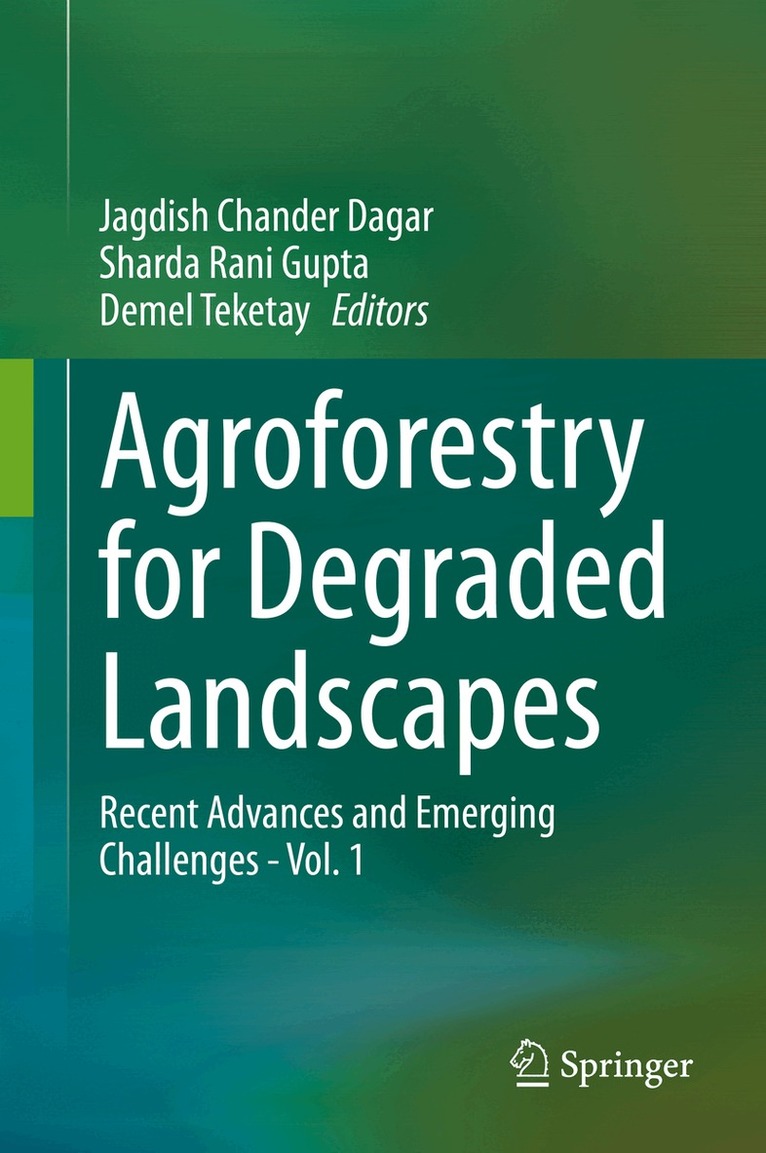
    Agroforestry for Degraded Landscapes

    Recent Advances and Emerging Challenges - Vol.1

    AvJagdish Chander Dagar,Sharda Rani Gupta

    Inbunden, Engelska, 2020

    2 164 kr

    Beställningsvara. Skickas inom 10-15 vardagar. Fri frakt över 249 kr.

    Beskrivning

    This book presents various aspects of agroforestry research and development, as well as the latest trends in degraded landscape management. Over the last four decades, agroforestry research (particularly on degraded landscapes) has evolved into an essential problem-solving science, e.g. in terms of sustaining agricultural productivity, improving soil health and biodiversity, enhancing ecosystem services, supporting carbon sequestration and mitigating climate change. This book examines temperate and tropical agroforestry systems around the world, focusing on traditional and modern practices and technologies used to rehabilitate degraded lands. It covers the latest research advances, trends and challenges in the utilization and reclamation of degraded lands, e.g. urban and peri-urban agroforestry, reclamation of degraded landscapes, tree-based multi-enterprise agriculture, domestication of high-value halophytes, afforestation of coastal areas, preserving mangroves and much more. Given its scope, the book offers a valuable asset for a broad range of stakeholders including farmers, scientists, researchers, educators, students, development/extension agents, environmentalists, policy/decision makers, and government and non-government organizations.

    Produktinformation

    • Utgivningsdatum:2020-10-06
    • Mått:155 x 235 x 36 mm
    • Vikt:1 016 g
    • Format:Inbunden
    • Språk:Engelska
    • Antal sidor:554
    • Förlag:Springer Verlag, Singapore
    • ISBN:9789811541353

    Utforska kategorier

    • Växtböcker inom Djur och Natur
    • Botanik inom Naturvetenskap och teknik
    • Miljövetenskap och miljöpolitik inom Naturvetenskap och teknik

    Mer om författaren

    Jagdish Chander Dagar, Former Assistant Director General and Emeritus Scientist at ICAR, has long been actively involved in the areas of agroforestry, natural resources management, biosaline agriculture, rehabilitation of degraded lands, ethnobotany, plant ecology, environmental sciences, biodiversity, climate change and sustainable agriculture, as can be seen in his more than 300 research papers, published in peer-reviewed journals, book chapters and conference proceedings. He has been conferred with several awards and honours and is a Fellow of the National Academy of Agricultural Sciences and several other professional societies. He has also been a consultant to the UN, CIMMYT, and Haryana Forest Department. Dr Dagar is also Chief Editor of the Journal Soil Salinity & Water Quality.S. R. Gupta, former Professor of Botany, Dean of Life Sciences, and Emeritus Fellow of the UGC, is a nationally and internationally recognised ecologist who has taught at the Department of Botany and at the Institute of Environmental Studies at Kurukshetra University, India. She has made significant contributions to better understanding the biodiversity and ecosystem functions of grasslands, forest ecosystems, soil biodiversity, ecological rehabilitation of salt-affected soils, carbon sequestration in agroforestry systems, and the sustainability of conservation agricultural systems. The author of 98 research papers published in national and international journals, she is also a Fellow of the National Institute of Ecology and is affiliated with the Institute of Environmental Studies.Demel Teketay Fanta received his MSc in Plant Taxonomy from Reading University (UK) and PhD in Forest Vegetation Ecology from the Swedish University of Agricultural Sciences. He is currently serving as a Professor of Forest Sciences and founding Dean of the Faculty of Natural Resources at Botswana University of Agriculture and Natural Resources (BUAN). He has published over 250 scientific articles and technical reports, including more than 150 peer-reviewed articles in national and international scientific journals. He is a Fellow of The World Academy of Sciences (TWAS), International Fellow of the Royal Swedish Academy of Agriculture and Forestry (KSLA), Fellow of the African Academy of Sciences (AAS), Associate Fellow of the Ethiopian Academy of Sciences (EAS), and a Member of the Botswana Academy of Science (BAS).

    Innehållsförteckning

    • Chapter 1. Introduction.- Chapter 2. Agroforestry for Rehabilitation of Degraded Landscapes: Achieving Livelihood and Environmental Security.- Chapter 3. Agroforestry to Enhance Livelihood Security in Africa:  Research Trends and Emerging Challenges.- Chapter 4. Potential of Agroforestry to Enhance Livelihood Security in Africa.- Chapter 5. Agroforestry Systems for Arid Ecologies in India.- Chapter 6. Land Use Management by Small Holders’ Households as a Promising Way for Synergies Between the Rio Conventions: Case Study in Semi-arid Areas of Cameroon.- Chapter 7. Impacts of Climate Change on Ecosystem Services of Agroforestry Systems in the West African Sahel: A Review.- Chapter 8. Agroforestry Systems for Improving Nutrient Recycling and Soil Fertility on Degraded Lands.- Chapter 9. Sustainability of Faidherbia albida-based Agroforestry in Crop Production and Maintaining Soil Health.- Chapter 10. Characterization of Faidherbia albida and Prosopis africana Trees Wood Anatomy and Response to Climate Variability Using Dendrochronology in the Sahelian Agroforestry Parklands.- Chapter 11. Potential of Gliricidia-based Agroforestry Systems for Resource Limited Agro-ecosystems.- Chapter 12. Lac-based Agroforestry System for Degraded Land.- Chapter 13. The Role of Insects in Enhancing Ecosystem Services of Tree-based Systems on Degraded Lands.- Chapter 14. Socio-economic and Policy Issues in Relation to Adoption of Agroforestry in Africa.- Chapter 15. Agroforestry Options for Degraded Landscapes in Southeast Asia.- Chapter 16. Community-based Peat Swamp Restoration through Agroforestry in Indonesia.- Chapter 17. Agroforestry to Sustain Island and Coastal Agriculture in Scenario of Climate Change: Indian Perspective.- Chapter 18. Incentivizing Hill Farmers for Promoting Agroforestry as an Alternative to Shifting Cultivation in North-East India.- Chapter 19. Promoting Bamboo-based Agroforestry for Enhancing Ecosystem Services from Degraded Lands.- Chapter 20. The Contribution of Agroforestry to Restoration and Conservation:  Biodiversity Islands in Degraded Landscapes.- Chapter 21. Soil Micro-arthropods as Indicators of Soil Health of Tropical Homegardens in Kerala,  India.- Chapter 22. Biomass Production Potentials under Temperate Agroforestry Systems as Influenced by Selected Sustainability Indicators: A Case Study Approach with Supportive Evidence.- Chapter 23. Management Practices vis-a-vis Agroforestry for the Improvement of Rangelands of Jammu and Kashmir in Northwestern Himalaya.- Chapter 24. The influence of Over-mature, Degraded Nothofagus Forests with Strong Anthropic Disturbance on the Quality of an Andisol, and Its Gradual Recovery with Silvopasture in Southwestern South America.- Chapter 25. Assessment of Trees Outside Forests (TOF) with emphasis on agroforestry systems.- Chapter 26. Agroforestry Interventions for Rehabilitating Salt-affected and Waterlogged Marginal Landscapes.- Chapter 27. Silvopasture Options for Enhanced Biological Productivity of Degraded Pasture/Grazing Lands: An Overview.- Chapter 28. Potential of Agroforestry for Rehabilitation of Degraded Ravine Lands.- Chapter 29. Halophytes for Utilizing and Restoring Coastal Saline Soils of India: Emphasis on Agroforestry Mode.- Chapter 30. Urban and Peri-urban Agroforestry: Utilization of Waste Water and Degraded Landscapes for Environmental and Livelihood Security.- Chapter 31. Agroforestry Approach for Rehabilitation of Mine Spoils.- Chapter 32. Tree Plantations for Improving Soil Fertility and Carbon Sequestration on Mine Spoils.- Chapter 33. Carbon Sequestration Potential of Agroforestry Systems for Rehabilitating Degraded Lands of India.- Chapter 34. Agroforestry Developments for Degraded Landscapes: A Synthesis.