• Fri frakt över 249 kr
  • •
  • Snabba leveranser
  • •
  • Billiga böcker
Kundservice

Du är på sajten för privatpersoner.

Företag, bibliotek eller offentlig verksamhet?

Du handlar på classic.bokus.com, där alla dina funktioner finns intakta.
Till classic.bokus.com
Bokus logotyp. Gå till startsidan.
  • Erbjudanden
  • Nyheter
  • Student
  • Topplistor
  • Barn & ungdom
  • Bokus Play
  • E-böcker
  • Pocketböcker
  • Spel & pussel

10% rabatt på allt med kod: NYSTART10 →

Sidfot

Mina sidor

    Hjälp

    • Kundservice
    • Vanliga frågor och svar
    • Frakt och leverans
    • Retur vid ångerrätt
    • Reklamera vara
    • Betalning
    • Köpvillkor
    • Allmänna villkor
    • Information om webbplatsens tillgänglighet

    Om Bokus

    • Om oss
    • Pressrum
    • För studenter
    • För företag
    • För bibliotek och offentlig verksamhet
    • För leverantörer
    • Hållbarhet

    Populärt

    • Aktuella erbjudanden
    • Presentkort
    • Studentlitteratur
    • Nya böcker
    • Topplistor
    • Signerade böcker
    • Engelska böcker

    Inspiration

    • Boktips
    • BookTok
    • Populära bokserier
    • Barnbokskaraktärer
    • Populära författare
    Logotyp för Bokus
    Följ oss på Facebook (extern länk)Följ oss på Instagram (extern länk)Följ oss på YouTube (extern länk)Följ oss på TikTok (extern länk)
    bokus @ CookiesAnpassa cookiesIntegritetspolicyKöpvillkor
    Till Citymail hemsida (extern länk)Till Budbee hemsida (extern länk)Till Postnord hemsida (extern länk)Till Schenker hemsida (extern länk)Till Early Bird hemsida (extern länk)Till Walleys hemsida (extern länk)
    1. Kultur
    2. Arkitektur
    3. Landskapsarkitektur

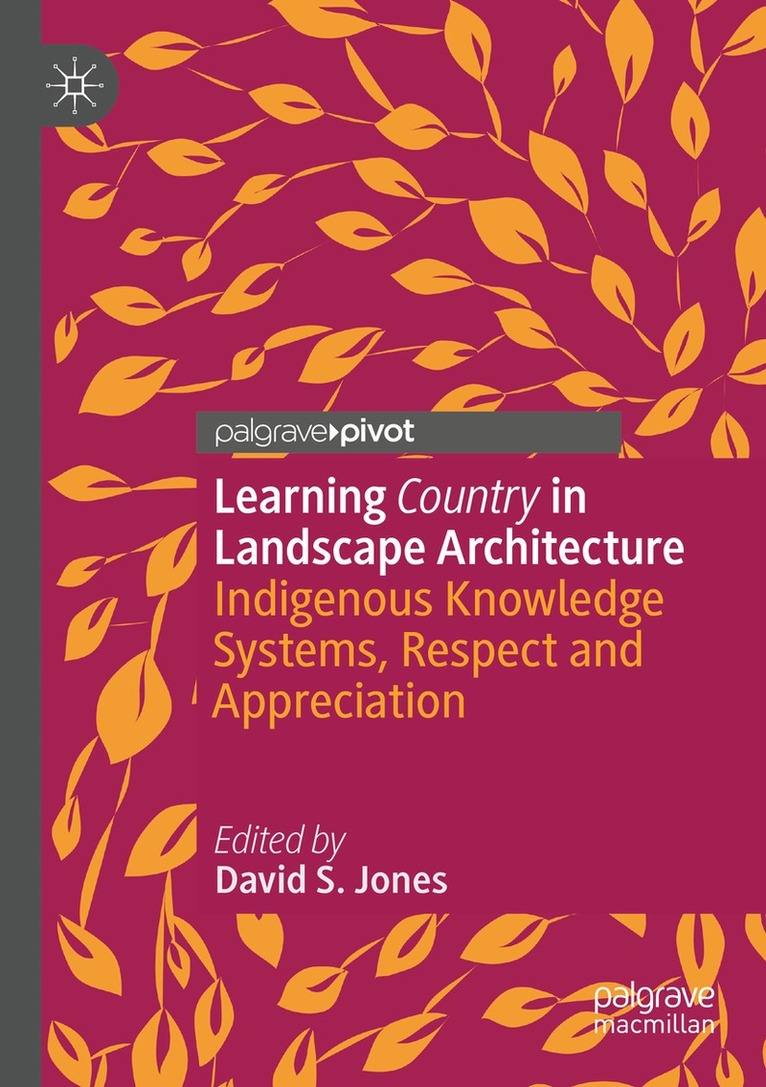
    Learning Country in Landscape Architecture

    Indigenous Knowledge Systems, Respect and Appreciation

    AvDavid S. Jones

    Häftad, Engelska, 2022

    674 kr

    Beställningsvara. Skickas inom 10-15 vardagar. Fri frakt över 249 kr.

    Beskrivning

    This book strategically focuses upon the feasibility of positioning Indigenous Knowledge Systems into tertiary built environment education and research in Australia. Australian tertiary education has little engaged with Indigenous peoples and their Indigenous Knowledge Systems, and the respectful translation of their Indigenous Knowledge Systems into tertiary education learning. In contrast, while there has been a dearth of discussion and research on this topic pertaining to the tertiary sector, the secondary school sector has passionately pursued this topic. There is an uneasiness by the tertiary sector to engage in this realm, overwhelmed already by the imperatives of the Commonwealth’s ‘Closing the Gap’ initiative to advance Aboriginal and Torres Strait Islander tertiary education successes and appointments of Indigenous academics. As a consequence, the teaching of Indigenous Knowledge Systems relevant to professional disciplines, particularly landscape architecture where it ismost apt, is overlooked and similarly little addressed in the relevant professional institute education accreditation standards.

    Produktinformation

    • Utgivningsdatum:2022-03-01
    • Mått:148 x 210 x 9 mm
    • Vikt:202 g
    • Format:Häftad
    • Språk:Engelska
    • Antal sidor:122
    • Förlag:Springer Verlag, Singapore
    • ISBN:9789811588785

    Utforska kategorier

    • Landskapsarkitektur inom Kultur
    • Pedagogik inom Psykologi och pedagogik
    • Geografi inom Naturvetenskap och teknik

    Mer om författaren

    David S. Jones oversights Strategic Planning and Urban Design with the Wadawurrung Traditional Owners Aboriginal Corporation, and is Adjunct Professor at Griffith University and Professor (Research) with Monash University. With academic and professional qualifications in urban planning, landscape architecture and cultural heritage, he has taught, researched and published extensively across these areas over the last 30 years, including in Indigenous Knowledge Systems. He has been involved with the Victoria Square / Tarntanyangga Regeneration Project (2017), the Adelaide Park Lands and Squares Cultural Landscape Assessment Study (2007), the Museum Victoria’s Forest Gallery (1995-1996), the North Gardens Indigenous Sculpture Landscape Master Plan (2019), Geelong’s Changing Landscape (2019), Re-casting Terra Nullius Blindness (2017), and has co-contributed chapters to The Handbook of Contemporary Indigenous Architecture (2018), and Heal theScar – Regenerative Futures of Damaged Landscapes (2020).Kate Alder, a MLArch graduate of Deakin University, is working as a strategic planner at the Maribyrnong City Council in Melbourne.Shivani Bhatnagar, a MLArch graduate of Deakin University, is working as a landscape architect at the practice of Moir Landscape Architecture in Newcastle.Christine Cooke, a MPlan(Prof) graduate of Deakin University, and a doctoral candidate there researching ‘Indigenous Knowledge awareness guidance provision and fluency in Australian planning education’.Jennifer Dearnaley, a MLArch and PhD graduate of Deakin University, her PhD thesis is entitled Wadawurrung Ethnobotany as synthesised from the research of Louis Lane, co-author of the refereed article Aboriginal uses of seaweeds in temperate Australia, and she is Director of practice of Balyang Consulting in Geelong.Marcelo Diaz, a MLArch graduate of Deakin University, is working as a landscape architect at the practice of MINT Pool and Landscape Design in Melbourne.Hitomi Iida, a MLArch graduate of Deakin University, is working as a landscape architect at the practice of Kihara Landscapes in Melbourne.Anjali Madhavan Nair, a MLArch graduate of Deakin University, is working as a landscape architect at the practices of Ground Ink in Sydney.Shay-lish McMahon, an Awakabal woman, a MLArch graduate of Deakin University, is working as the Indigenous Services Advisor for the practice of GHD Woodhead in Melbourne, and is co-author of a refereed conference paper entitled Aboriginal voices and inclusivity in Australian land use Country planning.Mandy Nicholson, a Wurundjeri women, a PhD candidate at Monash University researching ‘Being on Country off Country’, is co-author of several refereed publications including Wurundjeri-al Biik-u (Wurundjeri Country), Mag-golee (Place), Murrup (Spirit) and Ker-up-non (People): Aboriginal living heritage in Australia’s urban landscapes, and works at Tharangalk Art-Bunjil's Country.Gavin Pocock, is a sessional teacher at Deakin University, and is author of a refereed conference paper entitled Redeeming Fire: The use of fire as a design tool in the Australian landscape.Uncle Bryon Powell, a Wadawurrung Elder, formerly Chief Executive Officer and Chair of the Wadawurrung Traditional Owners Aboriginal Corporation Board, a sessional teacher at Deakin University, and co-authored the refereed chapter entitled Welcome to Wadawurrung Country.Gareth Powell, a Wadawurrung man, an ACT-based barrister, is a Board member of the Wadawurrung Traditional Owners Aboriginal Corporation,and co-author of the refereed article Kim-barne Wadawurrung Tabayl: You are in Wadawurrung Country.Sayali G Rahurkar is a MLArch graduate of Deakin University, and is working as a landscape architect at the practice of Inspiring Place in Hobart.Susan Ryan, a MPlan(Prof) graduate of Deakin University, and a doctoral candidate there researching ‘Deconstructing the colonial view of Wadawurrung Country; knowledge drawn from John Wedge’s Field Books of 1835-1836’, and author of a refereed conference paper entitled Wadawurrung Landscapes in the Victoria Planning Processes.Nitika Sharma, a MLArch graduate of Deakin University, and is working as a landscape architect at the practice of Mexted Rimmer in Geelong.Yang Su, a MLArch graduate of Deakin University, and is working as a landscape architect at Melbourne practice.Saurabh V Wagh, a MLArch graduateof Deakin University, is working as a landscape architect at the practice of Moir Landscape Architecture in Newcastle.Oshadi L Yapa Appuhamillage is a MLArch graduate of Deakin University, and is working as a landscape architect at Thomson Hay Landscape Architects in Ballarat.

    Innehållsförteckning

    • 1. Introduction – Surveying the Australian Landscape.- 2. Country.- 3. Indigenous Knowledge Systems and Education in Australia.- 4. Professional Accreditation Knowledge and Policy Context.- 5. Learning Environments and Contexts.- 6. Student and Graduate Voices.- 7. Respecting Country and People: Pathways Forward.