• Fri frakt över 249 kr
  • •
  • Snabba leveranser
  • •
  • Billiga böcker
Kundservice

Du är på sajten för privatpersoner.

Företag, bibliotek eller offentlig verksamhet?

Du handlar på classic.bokus.com, där alla dina funktioner finns intakta.
Till classic.bokus.com
Bokus logotyp. Gå till startsidan.
  • Erbjudanden
  • Nyheter
  • Student
  • Topplistor
  • Barn & ungdom
  • Bokus Play
  • E-böcker
  • Pocketböcker
  • Spel & pussel

10% rabatt på allt med kod NYSTART10 →

Sidfot

Mina sidor

    Hjälp

    • Kundservice
    • Vanliga frågor och svar
    • Frakt och leverans
    • Retur vid ångerrätt
    • Reklamera vara
    • Betalning
    • Köpvillkor
    • Allmänna villkor
    • Information om webbplatsens tillgänglighet

    Om Bokus

    • Om oss
    • Pressrum
    • För studenter
    • För företag
    • För bibliotek och offentlig verksamhet
    • För leverantörer
    • Hållbarhet

    Populärt

    • Aktuella erbjudanden
    • Presentkort
    • Studentlitteratur
    • Nya böcker
    • Topplistor
    • Signerade böcker
    • Engelska böcker

    Inspiration

    • Boktips
    • BookTok
    • Populära bokserier
    • Barnbokskaraktärer
    • Populära författare
    Logotyp för Bokus
    Följ oss på Facebook (extern länk)Följ oss på Instagram (extern länk)Följ oss på YouTube (extern länk)Följ oss på TikTok (extern länk)
    bokus @ CookiesAnpassa cookiesIntegritetspolicyKöpvillkor
    Till Citymail hemsida (extern länk)Till Budbee hemsida (extern länk)Till Postnord hemsida (extern länk)Till Schenker hemsida (extern länk)Till Early Bird hemsida (extern länk)Till Walleys hemsida (extern länk)
    1. Data och IT
    2. Systemvetenskap och AI

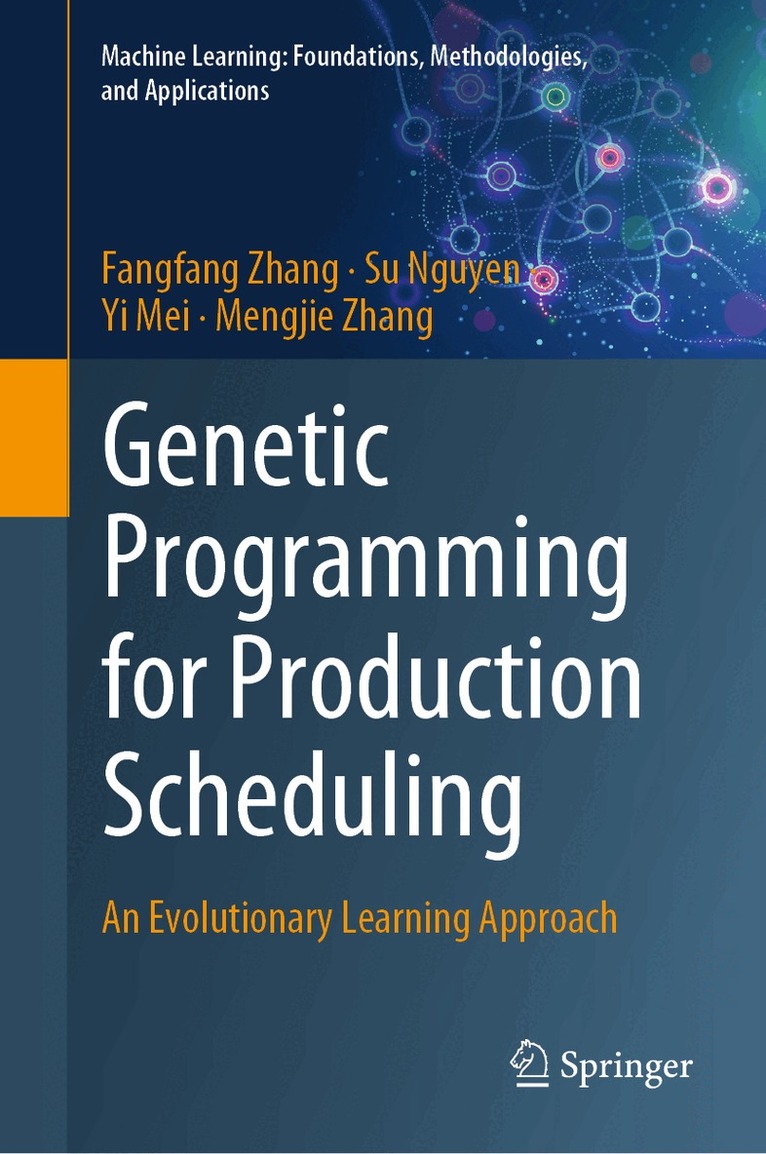
    Genetic Programming for Production Scheduling

    An Evolutionary Learning Approach

    AvFangfang Zhang,Su Nguyen

    Inbunden, Engelska, 2021

    Del i serien Machine Learning: Foundations, Methodologies, and Applications

    1 623 kr

    Beställningsvara. Skickas inom 10-15 vardagar. Fri frakt över 249 kr.

    Fler format och utgåvor

    Häftad

    1 623 kr

    Beskrivning

    This book introduces readers to an evolutionary learning approach, specifically genetic programming (GP), for production scheduling. The book is divided into six parts. In Part I, it provides an introduction to production scheduling, existing solution methods, and the GP approach to production scheduling. Characteristics of production environments, problem formulations, an abstract GP framework for production scheduling, and evaluation criteria are also presented. Part II shows various ways that GP can be employed to solve static production scheduling problems and their connections with conventional operation research methods. In turn, Part III shows how to design GP algorithms for dynamic production scheduling problems and describes advanced techniques for enhancing GP’s performance, including feature selection, surrogate modeling, and specialized genetic operators. In Part IV, the book addresses how to use heuristics to deal with multiple, potentially conflicting objectives in production scheduling problems, and presents an advanced multi-objective approach with cooperative coevolution techniques or multi-tree representations. Part V demonstrates how to use multitask learning techniques in the hyper-heuristics space for production scheduling. It also shows how surrogate techniques and assisted task selection strategies can benefit multitask learning with GP for learning heuristics in the context of production scheduling. Part VI rounds out the text with an outlook on the future.Given its scope, the book benefits scientists, engineers, researchers, practitioners, postgraduates, and undergraduates in the areas of machine learning, artificial intelligence, evolutionary computation, operations research, and industrial engineering.

    Produktinformation

    • Utgivningsdatum:2021-11-13
    • Mått:155 x 235 x 26 mm
    • Vikt:723 g
    • Format:Inbunden
    • Språk:Engelska
    • Serie:Machine Learning: Foundations, Methodologies, and Applications
    • Antal sidor:336
    • Förlag:Springer Verlag, Singapore
    • ISBN:9789811648588

    Utforska kategorier

    • Systemvetenskap och AI inom Data och IT
    • Företagsekonomi inom Ekonomi och Ledarskap
    • Maskinteknik och material inom Naturvetenskap och teknik

    Mer om författaren

    Fangfang Zhang is a Postdoctoral Research Fellow at the School of Engineering and Computer Science, Victoria University of Wellington, New Zealand. Her current research interests include evolutionary computation, hyper-heuristics learning/optimization, job shop scheduling, and multitask optimization.Su Nguyen is a Senior Research Fellow and Algorithm Lead at the Centre for Data Analytics and Cognition, La Trobe University, Melbourne, Australia. His expertise includes evolutionary computation, simulation optimization, automated algorithm design, interfaces of artificial intelligence/operations research, and their applications in logistics, energy, and transportation. Dr. Nguyen chaired the IEEE Task Force on Evolutionary Scheduling and Combinatorial Optimisation from 2014 to 2018. He gave technical tutorials on evolutionary computation and artificial intelligence-based visualization at the Parallel Problem Solving from Nature Conference in 2018 and the IEEE World Congress on Computational Intelligence in 2020.Yi Mei is a Senior Lecturer at the School of Engineering and Computer Science, Victoria University of Wellington, New Zealand. He has published more than 100 articles in prominent journals for Evolutionary Computation and Operations Research, including IEEE Transactions on Evolutionary Computation, IEEE Transactions on Cybernetics, Evolutionary Computation, European Journal of Operational Research, and ACM Transactions on Mathematical Software. His research interests include evolutionary scheduling and combinatorial optimization, machine learning, genetic programming, and hyper-heuristics.Mengjie Zhang is a Professor of Computer Science, Head of the Evolutionary Computation Research Group, and Associate Dean (Research and Innovation) of the Faculty of Engineering, Victoria University of Wellington, New Zealand. His current research interests include artificial intelligence and machine learning, particularly genetic programming, image analysis, feature selection and reduction, job shop scheduling, and transfer learning. He has published over 600 research papers in international journals and conference proceedings. Prof. Zhang is a Fellow of the Royal Society of New Zealand, Fellow of the IEEE, and an IEEE Distinguished Lecturer. He has previously chaired the IEEE CIS Intelligent Systems and Applications Technical Committee, the IEEE CIS Emergent Technologies Technical Committee, and the Evolutionary Computation Technical Committee, and served on the IEEE CIS Award Committee. He is a Vice-Chair of the Task Force on Evolutionary Computer Vision and Image Processing, and the Founding Chair of the IEEE Computational Intelligence Chapter in New Zealand. He is a Fellow of the Royal Society of New Zealand, a Fellow of the IEEE, and an IEEE Distinguished Lecturer.

    Innehållsförteckning

    • Part I Introduction.- 1 Introduction.- 2 Preliminaries.- Part II Genetic Programming for Static Production Scheduling Problems.- 3 Learning Schedule Construction Heuristics.- 4 Learning Schedule Improvement Heuristics.- 5 Learning to Augment Operations Research Algorithms.- Part III Genetic Programming for Dynamic Production Scheduling Problems.- 6 Representations with Multi-tree and Cooperative Coevolution.- 7 Efficiency Improvement with Multi-fidelity Surrogates.- 8 Search Space Reduction with Feature Selection.- 9 Search Mechanism with Specialised Genetic Operators.- Part IV Genetic Programming for Multi-objective Production Scheduling Problems.- 10 Learning Heuristics for Multi-objective Dynamic Production Scheduling Problems.- 11 Cooperative Coevolutionary for Multi-objective Production Scheduling Problems.- 12 Learning Scheduling Heuristics for Multi-objective Dynamic Flexible Job Shop Scheduling.- Part V Multitask Genetic Programming for Production Scheduling Problems.- 13 Multitask Learning in Hyper-heuristic Domain with Dynamic Production Scheduling.- 14 Adaptive Multitask Genetic Programming for Dynamic Job Shop Scheduling.- 15 Surrogate-Assisted Multitask Genetic Programming for Learning Scheduling Heuristics.- Part VI Conclusions and Prospects.- 16 Conclusions and Prospects.