• Fri frakt över 249 kr
  • •
  • Snabba leveranser
  • •
  • Billiga böcker
Kundservice

Du är på sajten för privatpersoner.

Företag, bibliotek eller offentlig verksamhet?

Du handlar på classic.bokus.com, där alla dina funktioner finns intakta.
Till classic.bokus.com
Bokus logotyp. Gå till startsidan.
  • Erbjudanden
  • Nyheter
  • Student
  • Topplistor
  • Barn & ungdom
  • Bokus Play
  • E-böcker
  • Pocketböcker
  • Spel & pussel

10% rabatt på allt med kod NYSTART10 →

Sidfot

Mina sidor

    Hjälp

    • Kundservice
    • Vanliga frågor och svar
    • Frakt och leverans
    • Retur vid ångerrätt
    • Reklamera vara
    • Betalning
    • Köpvillkor
    • Allmänna villkor
    • Information om webbplatsens tillgänglighet

    Om Bokus

    • Om oss
    • Pressrum
    • För studenter
    • För företag
    • För bibliotek och offentlig verksamhet
    • För leverantörer
    • Hållbarhet

    Populärt

    • Aktuella erbjudanden
    • Presentkort
    • Studentlitteratur
    • Nya böcker
    • Topplistor
    • Signerade böcker
    • Engelska böcker

    Inspiration

    • Boktips
    • BookTok
    • Populära bokserier
    • Barnbokskaraktärer
    • Populära författare
    Logotyp för Bokus
    Följ oss på Facebook (extern länk)Följ oss på Instagram (extern länk)Följ oss på YouTube (extern länk)Följ oss på TikTok (extern länk)
    bokus @ CookiesAnpassa cookiesIntegritetspolicyKöpvillkor
    Till Citymail hemsida (extern länk)Till Budbee hemsida (extern länk)Till Postnord hemsida (extern länk)Till Schenker hemsida (extern länk)Till Early Bird hemsida (extern länk)Till Walleys hemsida (extern länk)
    1. Naturvetenskap och teknik
    2. Matematik och naturvetenskap
    3. Kemi
    4. Organisk kemi

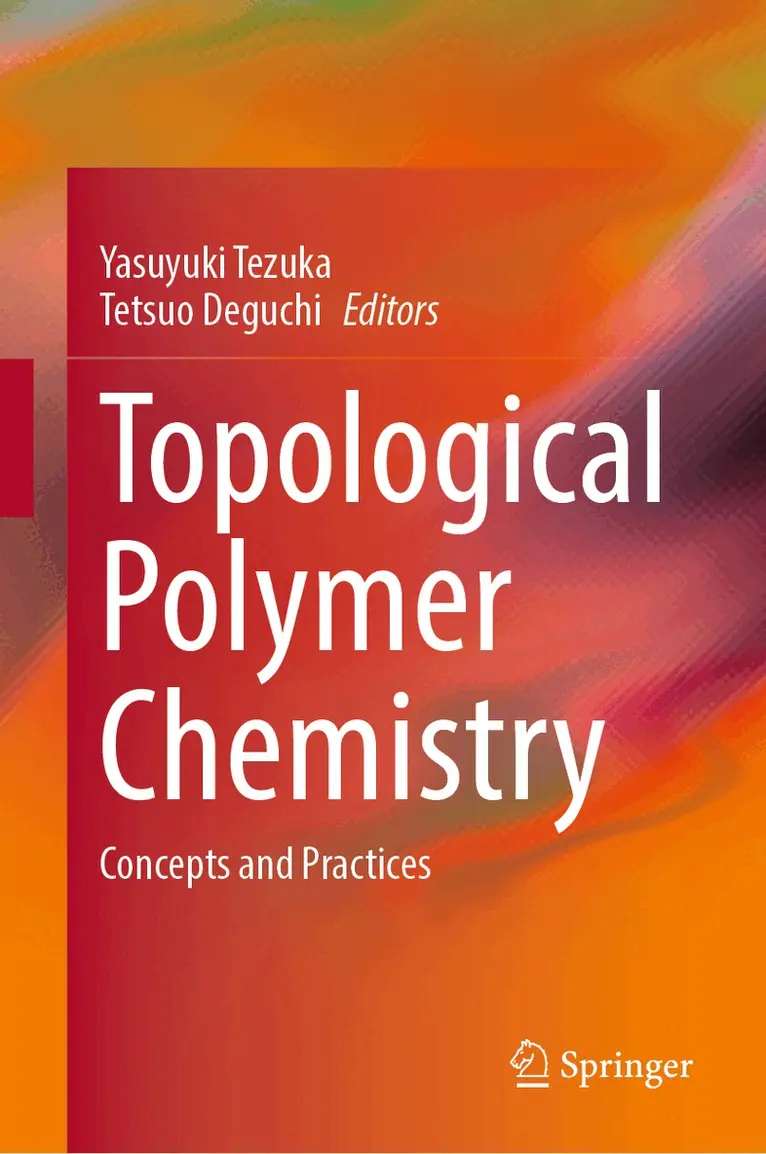
    Topological Polymer Chemistry

    Concepts and Practices

    AvYasuyuki Tezuka,Tetsuo Deguchi

    Häftad, Engelska, 2023

    1 947 kr

    Beställningsvara. Skickas inom 10-15 vardagar. Fri frakt över 249 kr.

    Beskrivning

    This book provides a comprehensive description of topological polymers, an emerging research area in polymer science and polymer materials engineering. The precision polymer topology designing is critical to realizing the unique polymer properties and functions leading to their eventual applications. The prominent contributors are led by Principal Editor Yasuyuki Tezuka and Co-Editor Tetsuo Deguchi. Important ongoing achievements and anticipated breakthroughs in topological polymers are presented with an emphasis on the spectacular diversification of polymer constructions. The book serves readers collectively to acquire comprehensive insights over exciting innovations ongoing in topological polymer chemistry, encompassing topological geometry analysis, classification, physical characterization by simulation and the eventual chemical syntheses, with the supplementary focus on the polymer folding, invoked with the ongoing breakthrough of the precision AI prediction of protein folding.  The current revolutionary developments in synthetic approaches specifically for single cyclic (ring) polymers and the topology-directed properties/functions uncovered thereby are outlined as a showcase example. This book is especially beneficial to academic personnel in universities and to researchers working in relevant institutions and companies. Although the level of the book is advanced, it can serve as a good reference book for graduate students and postdocs as a source of valuable knowledge of cutting-edge topics and progress in polymer chemistry.

    Produktinformation

    • Utgivningsdatum:2023-02-27
    • Mått:155 x 235 x 25 mm
    • Vikt:674 g
    • Format:Häftad
    • Språk:Engelska
    • Antal sidor:436
    • Förlag:Springer Verlag, Singapore
    • ISBN:9789811668098

    Utforska kategorier

    • Organisk kemi inom Naturvetenskap och teknik
    • Fysik inom Naturvetenskap och teknik
    • Maskinteknik och material inom Naturvetenskap och teknik

    Mer om författaren

    Yasuyuki Tezuka is a professor emeritus of the Tokyo Institute of Technology. He served as the Asian editor (2006–2011) for Reactive and Functional Polymers and continued as the editor-in-chief (2012–2018).  He currently holds the position of honorary editor of the journal.  He completed his B.S. (1976) and M.S. (1978) degrees in synthetic chemistry at The University of Tokyo.  Subsequently, he moved to Ghent University (Belgium) in 1979 as a fellowship student of the Belgian (Flemish) government, and completed his doctorate there in 1982. Returning to Japan, he began his academic career as an assistant professor at the Nagaoka University of Technology and was promoted to associate professor in 1991.  In 1994, he moved to the Tokyo Institute of Technology, Department of Organic and Polymeric Materials, where he served as a full professor from 2003 until his retirement in 2019.  He received the Tokyo Tech Award for Best Teacher, 2004; the Award of the Society of Polymer Science (SPSJ), Japan (2010); and the SPSJ Award for Outstanding Achievement in Polymer Science and Technology (2018).  His research activities have focused on topological polymer chemistry, designing topologically unique macromolecular architectures, and uncovering their topology effects.   Tetsuo Deguchi is a professor in the Department of Physics, Ochanomizu University.  He received his B.S. (1987) and M.S. (1989) degrees in physics at The University of Tokyo.  He began his academic career as an assistant professor at The University of Tokyo in 1990, where he was awarded his Ph.D. degree (“Multivariable Invariants of Colored Links and Related Solvable Models in Statistical Mechanics”) in 1992.  He moved to the Department of Physics in Ochanomizu University as an associate professor in 1994 and has served as a full professor since 2001.  His research activities have focused on 1) statistical physics of polymers, in particular, that of topological polymers such as ring polymers, multiple-ring polymers, polymers of theta graphs, and complete bipartite graphs, 2) molecular dynamic simulation of topological polymers in solution and in melt, 3) non-equilibrium dynamics of quantum many-body systems, thermalization, and equilibration of isolated quantum systems, 4) mathematical physics of exactly solvable models in statistical physics and quantum dynamics, and 5) integrable quantum spin chains solved by the Bethe ansatz method.

    Innehållsförteckning

    • Part I: Introduction.- 1. Polymers meet topology.- Part II: Fundamentals of topological polymers.- 2. Classification and notation by graph theory.- 3. Statistic physics and computational analyses.- Part III: Synthetic chemistry of topological polymers.- 4. Electrostatic self-assembly and covalent fixation (ESA-CF).- 5. Synthesis of spiro-polycyclic topological polymers.- 6. Synthesis of bridged-polycyclic topological polymers.- 7. Synthesis of fused-polycyclic topological polymers.- 8.  Synthesis of hybrid-polycyclic topological polymers.- Part IV: Topological polymer chemistry of macromoleclar chain folding.- Chapter 9. Programmed folding of linear polymers.- 10. Cyclic polypeptide (Cyclotide) by chain folding.- 11. Chemical construction of a K3,3 graph polymer topology.- Part V: Topological polymer chemistry of macromolecular networks.- 12. Topological polymer chemistry of macromolecular networks.- Part VI: Topological polymer chemistry of macromolecular knots and catenanes.- 13. Knots and links by DNAs and proteins.- 14. Chemical synthesis of macromolecular knots and catenanes.- Part VII: Innovations with cyclic polymers: Syntheses.- 15. Ring-closure of polymer precursors (RC).- 16. Ring-expansion of cycloalkenes and alkynes by transition metal catalysts (RE).- 17. Ring-expansion of heterocyclic and vinyl monomers by zwitterionic propagation (RE).- 18. Electrostatic self-assembly and covalent fixation (ESA-CF).- Part VIII: Innovations with cyclic polymers: Topology effects.- 19. Computational and experimental analyses in solution and bulk states.- 20. Dynamic properties and response behaviors.- 21. Amplifying topology effects by self-assemblies.- 22. Transforming cyclic/linear polymer topologies.- 23.  Advanced applications of tailored cyclic polymers.- Part IX: Conclusion.- 24. Ongoing innovations and future perspectives.