• Fri frakt över 249 kr
  • •
  • Snabba leveranser
  • •
  • Billiga böcker
Kundservice

Du är på sajten för privatpersoner.

Företag, bibliotek eller offentlig verksamhet?

Du handlar på classic.bokus.com, där alla dina funktioner finns intakta.
Till classic.bokus.com
Bokus logotyp. Gå till startsidan.
  • Erbjudanden
  • Student
  • Topplistor
  • Barn & ungdom
  • Bokus Play
  • E-böcker
  • Ljudböcker
  • Pocketböcker
  • Spel & pussel

Upp till 25% på utvalda nyheter →

Sidfot

Mina sidor

    Hjälp

    • Kundservice
    • Vanliga frågor och svar
    • Frakt och leverans
    • Retur vid ångerrätt
    • Reklamera vara
    • Betalning
    • Köpvillkor
    • Allmänna villkor
    • Information om webbplatsens tillgänglighet

    Om Bokus

    • Om oss
    • Pressrum
    • För studenter
    • För företag
    • För bibliotek och offentlig verksamhet
    • För leverantörer
    • Hållbarhet

    Populärt

    • Aktuella erbjudanden
    • Presentkort
    • Studentlitteratur
    • Nya böcker
    • Topplistor
    • Signerade böcker
    • Engelska böcker

    Inspiration

    • Boktips
    • BookTok
    • Populära bokserier
    • Barnbokskaraktärer
    • Populära författare
    Logotyp för Bokus
    Följ oss på Facebook (extern länk)Följ oss på Instagram (extern länk)Följ oss på YouTube (extern länk)Följ oss på TikTok (extern länk)
    bokus @ CookiesAnpassa cookiesIntegritetspolicyKöpvillkor
    Till Citymail hemsida (extern länk)Till Budbee hemsida (extern länk)Till Postnord hemsida (extern länk)Till Schenker hemsida (extern länk)Till Early Bird hemsida (extern länk)Till Walleys hemsida (extern länk)
    1. Ekonomi och Ledarskap
    2. Nationalekonomi
    3. Mikroekonomi

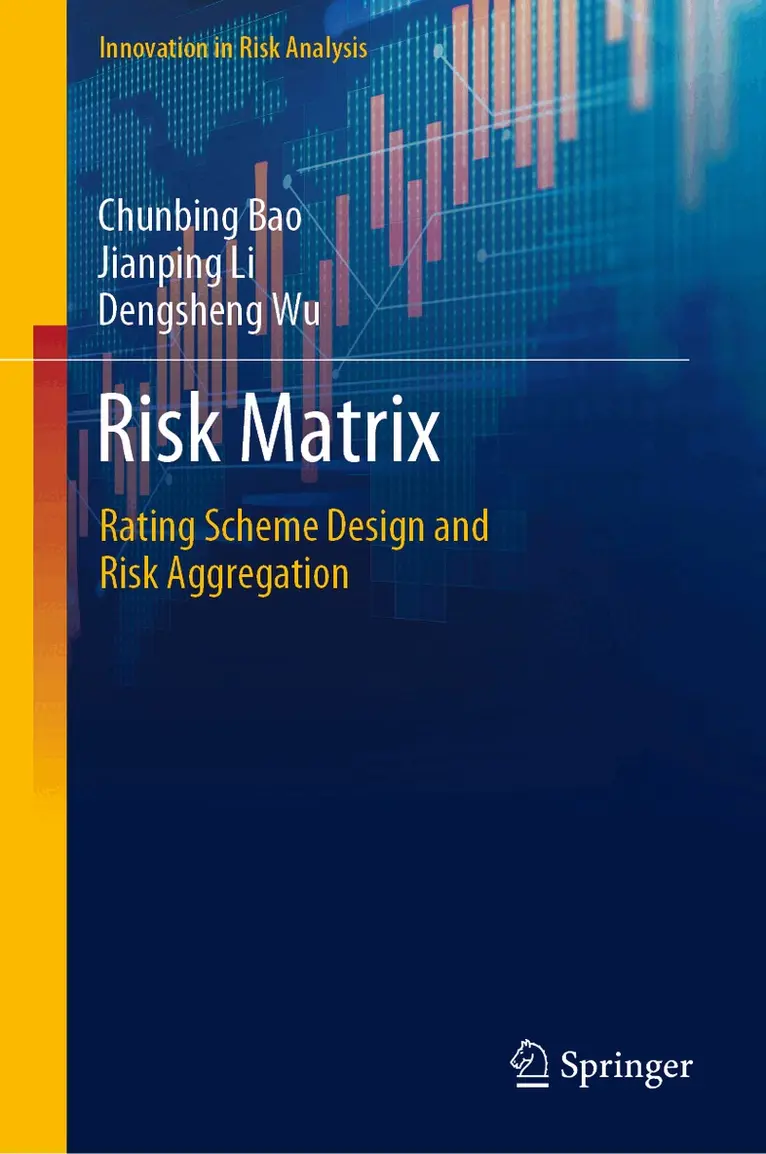
    Risk Matrix

    Rating Scheme Design and Risk Aggregation

    AvChunbing Bao,Jianping Li

    Inbunden, Engelska, 2022

    Del i serien Innovation in Risk Analysis

    1 778 kr

    Beställningsvara. Skickas inom 10-15 vardagar. Fri frakt över 249 kr.

    Fler format och utgåvor

    Häftad

    1 778 kr

    Beskrivning

    This book focuses on discussing the issues of rating scheme design and risk aggregation of risk matrix, which is a popular risk assessment tool in many fields. Although risk matrix is usually treated as qualitative tool, this book conducts the analysis from the quantitative perspective. The discussed content belongs to the scope of risk management, and to be more specific, it is related to quick risk assessment. This book is suitable for the researchers and practitioners related to qualitative or quick risk assessment and highly helps readers understanding how to design more convincing risk assessment tools and do more accurate risk assessment in a uncertain context.

    Produktinformation

    • Utgivningsdatum:2022-06-13
    • Mått:155 x 235 x 18 mm
    • Vikt:438 g
    • Format:Inbunden
    • Språk:Engelska
    • Serie:Innovation in Risk Analysis
    • Antal sidor:173
    • Förlag:Springer Verlag, Singapore
    • ISBN:9789811914799
    • Originaltitel:How to design rating schemes of risk matrices: A sequential updating approach. Risk Analysis

    Utforska kategorier

    • Mikroekonomi inom Ekonomi och Ledarskap
    • Ledarskapsböcker inom Ekonomi och Ledarskap
    • Referensverk och tvärvetenskap inom Samhälle och politik

    Mer om författaren

    Chunbing Bao is an associate professor working in the Department of Information System and Supply Chain Management, Shandong University, China. He received his bachelor's degree from the University of Science and Technology of China, and he received his Ph.D. from the University of Chinese Academy of Sciences. His researches interests include risk management, supply chain management. Jianping Li is a distinguished professor at the University of Chinese Academy of Sciences (UCAS). He is also the executive vice dean of the School of Economics and Management at the UCAS and the executive member and secretary-general of the International Academy on Information Technology and Quantitative Management (IAITQM). His research interests include risk management and big data analysis. He has published more than 130 papers and 6 monographs, including Risk Analysis, Annals of Tourism Research, and European Journal of Operational Research. He has been awarded "2020Elsevier Highly Cited Chinese Researchers", "China Youth Science and Technology Award", "National Outstanding Science and Technology Worker of China", "Excellent Tutor Award of Chinese Academy of Sciences", and won 2 first prizes and 4 second prizes of provincial and ministerial Natural Science/Technology Progress Awards in China. Dengsheng Wu is an associate professor at the Institutes of Science and Development Chinese Academy of Sciences. He is a member of the Youth Innovation Promotion Association of Chinese Academy of Sciences and severs as the academic editor of the Innovation, associate editor of the Chinese Journal of Management Science. He has published 50 articles, among which more than 20 articles are indexed by the FMS journal rating guide, such as the important journal Risk Analysis, European Journal of Operational Research. His researches interests include risk management, Scientometrics.

    Recensioner i media

    “This book is concerned with risk, in all of its forms, its modeling, formalization and handling. … this book can serve for a diverse variety of audiences, nearly to anyone of them. … the book is written and illustrated in such a pleasant way. … Based on this remarkable book, many future scientific, applied and real-world illustrations and usages can be explored and pursued in the vast and quickly expanding universe of modern research … .” (Gerhard-Wilhelm Weber, Ismail Özcan and Jinal Parikh, zbMATH 1503.91005, 2023)

    Innehållsförteckning

    • Chapter 1. Risk matrix: Foundations and Overview.- Chapter 2. Different types of risk matrices and typical applications.- Chapter 3. Rating scheme design methods.- Chapter 4. Risk perceptions in risk matrix: sources and impact to risk matrix design.- Chapter 5. Risk matrix design assessment: criteria and quantitative indicators.- Chapter 6. Risk matrix aggregation: A general framework.- Chapter 7. Risk matrix aggregation methods: introduction and comparative analysis.- Chapter 8. Three dimensional risk matrix: theoretical basis and construction. Chapter 9. Conclusion.