• Fri frakt över 249 kr
  • •
  • Snabba leveranser
  • •
  • Billiga böcker
Kundservice

Du är på sajten för privatpersoner.

Företag, bibliotek eller offentlig verksamhet?

Du handlar på classic.bokus.com, där alla dina funktioner finns intakta.
Till classic.bokus.com
Bokus logotyp. Gå till startsidan.
  • Erbjudanden
  • Nyheter
  • Student
  • Topplistor
  • Barn & ungdom
  • Bokus Play
  • E-böcker
  • Pocketböcker
  • Spel & pussel

10% studentrabatt med kod TERM26

Sidfot

Mina sidor

    Hjälp

    • Kundservice
    • Vanliga frågor och svar
    • Frakt och leverans
    • Retur vid ångerrätt
    • Reklamera vara
    • Betalning
    • Köpvillkor
    • Allmänna villkor
    • Information om webbplatsens tillgänglighet

    Om Bokus

    • Om oss
    • Pressrum
    • För studenter
    • För företag
    • För bibliotek och offentlig verksamhet
    • För leverantörer
    • Hållbarhet

    Populärt

    • Aktuella erbjudanden
    • Presentkort
    • Studentlitteratur
    • Nya böcker
    • Topplistor
    • Signerade böcker
    • Engelska böcker

    Inspiration

    • Boktips
    • BookTok
    • Populära bokserier
    • Barnbokskaraktärer
    • Populära författare
    Logotyp för Bokus
    Följ oss på Facebook (extern länk)Följ oss på Instagram (extern länk)Följ oss på YouTube (extern länk)Följ oss på TikTok (extern länk)
    bokus @ CookiesAnpassa cookiesIntegritetspolicyKöpvillkor
    Till Citymail hemsida (extern länk)Till Budbee hemsida (extern länk)Till Postnord hemsida (extern länk)Till Schenker hemsida (extern länk)Till Early Bird hemsida (extern länk)Till Walleys hemsida (extern länk)
    1. Medicin
    2. Klinisk medicin och internmedicin
    3. Sjukdomar och rubbningar
    4. Onkologi

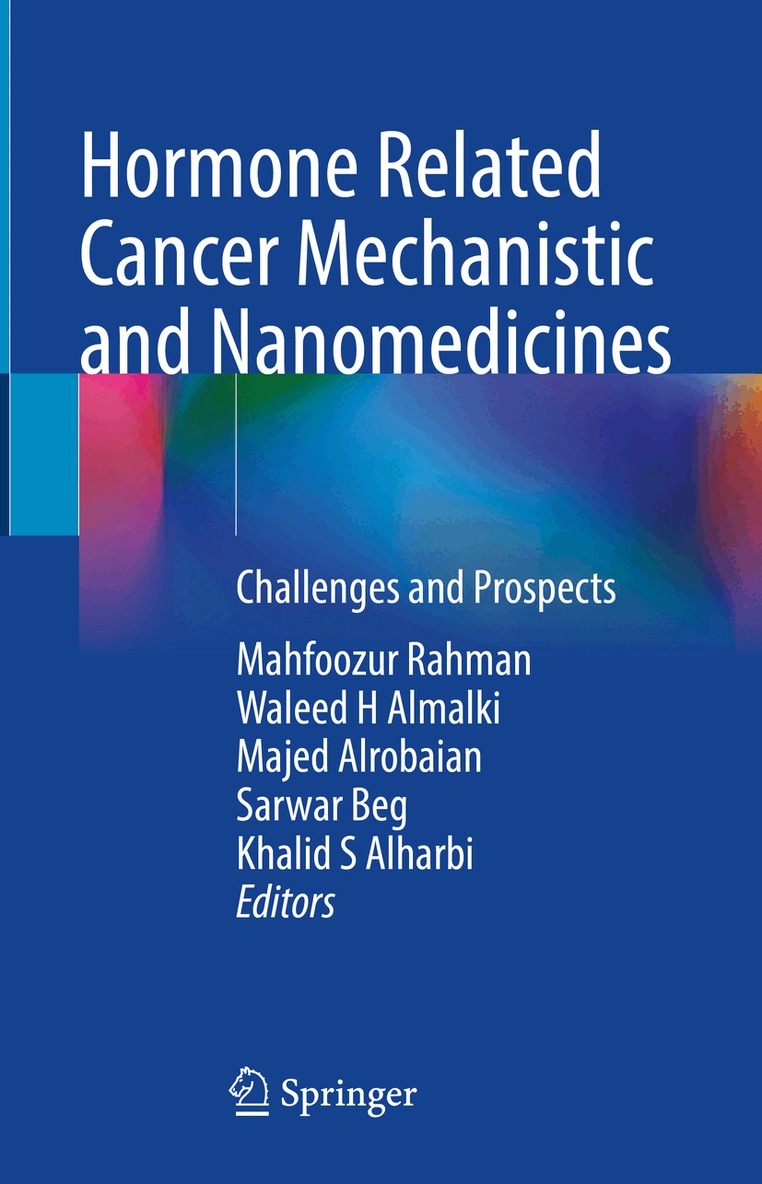
    Hormone Related Cancer Mechanistic and Nanomedicines

    Challenges and Prospects

    AvMahfoozur Rahman,Waleed H Almalki

    Inbunden, Engelska, 2023

    1 674 kr

    Beställningsvara. Skickas inom 10-15 vardagar. Fri frakt över 249 kr.

    Beskrivning

    The nanotheranostics sector provides a very promising strategy for monitoring drug biodistribution and pathology longitudinal processes by integrating the imaging and drug delivery functions in one single nanoformulation, providing vital insights into the identification of tumour and predicting the efficacy of nanomedicine. For its unique properties, which include their small size and biocompatibility and ability to permeate the cellular membrane with carrying drugs, nanomaterials have been used for various biomedical applications. This book covers the progress made in hormone-related cancer and their management by nonmedicinal therapy for targeting the hormone regulated cancer with their clinical progress and clinical hurdles.

    Produktinformation

    • Utgivningsdatum:2023-01-09
    • Mått:155 x 235 x 26 mm
    • Vikt:711 g
    • Format:Inbunden
    • Språk:Engelska
    • Antal sidor:347
    • Förlag:Springer Verlag, Singapore
    • ISBN:9789811955570

    Utforska kategorier

    • Onkologi inom Medicin
    • Biovetenskap inom Naturvetenskap och teknik

    Mer om författaren

    Mahfoozur Rahman, Ph.D. is serving as Assistant Professor at the Department of Pharmaceutical Sciences, Faculty of Health Science, Sam Higginbottom University of Agriculture, Technology & Sciences (SHUATS), Allahabad, India. His major areas of research interest include development and characterization of nanosized drug delivery systems for cancer and inflammatory disorders including psoriasis, arthritis, and neurodegenerative disorders, etc. To date, he has published over 150 publications in peer-reviewed journals, 50 book chapters, 07 International books, and 04 articles in international magazine. He has Google Scholar H-index of 32 and over 3200 citations to his credit. Dr Rahman also served as Guest Editor of several journals including Seminar in cancer Biology. Besides, Dr Rahman got travel grant from various international congress such as IAPRD, MDS, Nano Today Conference, KSN, WCN, on the basis of his research work and contribution in thefield.Waleed Hassan Almalki, PhD, is a Professor of Pharmacology at the College of Pharmacy, Umm Al-Qura University, Makkah, Saudi Arabia. He earned his doctoral degree at the University of Glasgow, United Kingdom, having a dissertation on ocular pharmacology. His current research is focused on the broad areas of host-virus networks in hepacivirus C disease progression as well as host- virus genes expression during oxidative stress, hepatic steatosis, fibrosis, and hepatocellular carcinoma. He is also enthusiastically involved in the studies of tyrosine kinase inhibitors for the treatment of breast and colon cancer, in the Saudi population. Dr. Almalki has published many research and review articles in peer-reviewed international journals on HCV pathogenesis, treatment, and drug designing, as well as edited various book chapters about angiogenesis, pharmacological assays, and infectious disease epidemiology.Majed Al Robaian, Ph.D., Dean, Faculty of Pharmacy, Taif University in Saudi Arabia Majed Al Robaian, PhD, is the Dean of the Faculty of Pharmacy at Taif University in Saudi Arabia. He obtained his BSc from King Saud University in Riyadh, Saudi Arabia, and his MSc in Pharmaceutical Sciences from Strathclyde University in the United Kingdom in 2010, and his PhD from the same university in 2014. His research interests focus on drug delivery and, in particular, the delivery of therapeutic genes for the treatment of cancer. Before obtaining his PhD, he worked as Director of Pharmacy at King Abdul-Aziz Hospital. Currently, he is appointed as the Science Faculty Ambassador for Strathclyde University. He is a member of a number of committees in the Saudi Commission for Health Specialties. Sarwar Beg, Ph.D, is currently serving as Assistant Professor at Department of Pharmaceutics, School of Pharmaceutical Education and Research, Jamia Hamdard, New Delhi. He has over a decade of teaching and research experience in the field of pharmaceutics and biopharmaceutics, especially in the development of novel and nanostructured drug delivery systems using Quality-by-Design paradigms. Before joining Jamia Hamdard, Dr Beg worked as a Research Scientist at Jubilant Generics Limited, Noida, India. He has authored over 160 publications, 48 book chapters, 12 books, 03 Indian patent applications and served as Guest Editors of the various international journals. He has a Google Scholar H-Index of 29 and over 3200 citations to his credit.Khalid S. Alharbi, PhD, is an Assistant Professor in department of Pharmacology and Toxicology, College of Pharmacy, Jouf University, Sakaka, Saudi Arabia. He obtained both his BSc (Pharmaceutical Sciences, 2002) and MSc (Toxicology, 2009) at the College of Pharmacy at King Saud University (KSU), Riyadh, Saudi Arabia. He was awarded his PhD (Pharmacy and Biomedical Sciences, 2016) from Strathclyde University, United Kingdom. Dr. Alharbi’s major area of research is cancer, including drug discovery, nanomedicine, and preclinical pharmacological and toxicological studies of anticancer agents. He has published several articles in peer-reviewed journals and presented papers at numerous international conferences.

    Innehållsförteckning

    • Chapter 1. Conventional Treatment Approaches in Hormonal Cancer Treatment and Challenges.- Chapter 2. Concept of Nanomedicine in Endocrine Hormone Cancer Treatment.- Chapter 3. Progress of Cancer Nanomedicine, Clinical Hurdles and Opportunities.- Chapter 4. Emergence of Nanohybrids in Hormonal Cancer Targeted Therapy.- Chapter 5. Conventional to Nanoscale-Based Carrier System in Management of Ovarian Cancer.- Chapter 6. Pancreatic Cancer Nanoparticles Targeted Therapy via Epidermal Growth Factor Receptor.- Chapter 7. Nanocarriers Based Targeted Therapies for Pancreatic Cancer and Challenges Ahead.- Chapter 8. Pancreatic Cancer Treatment by Using of Theranostics Nanoparticles.- Chapter 9. Nanomedicine Based Combinational Therapy for Breast Cancer.- Chapter 10. Nano-Liposomal System for Breast Cancer Therapy.- Chapter 11. Conventional to Nanotherapeutic Strategies against Triple-Negative Breast Cancer.- Chapter 12. Effect of Thymoquinone and Its Delivery Through Using of Nanomedicine inBenign Prostatic Hyperplasia.- Chapter 13. Concept of Nanotechnology in Management of Neuroendocrine Tumours.- Chapter 14. Neurocognitive Underpinning of Neurological Disorders: The Role of Default Mode Network.- Chapter 15. Neuroendocrine Carcinoma of The Endometrium: Conventional Treatment Approach to Nanomedicine.- Chapter 16. Effective Luteinizing Hormone Drug Delivery by Gold Nanoparticles in Hormonal Cancer Treatment.- Chapter 17. Regulatory Landscapes in Approval of Cancer Vaccines.