• Fri frakt över 249 kr
  • •
  • Snabba leveranser
  • •
  • Billiga böcker
Kundservice

Du är på sajten för privatpersoner.

Företag, bibliotek eller offentlig verksamhet?

Du handlar på classic.bokus.com, där alla dina funktioner finns intakta.
Till classic.bokus.com
Bokus logotyp. Gå till startsidan.
  • Erbjudanden
  • Student
  • Topplistor
  • Barn & ungdom
  • Bokus Play
  • E-böcker
  • Ljudböcker
  • Pocketböcker
  • Spel och pussel

Pocketfynda! Hundratals böcker för 49 kr/st →

Sidfot

Mina sidor

    Hjälp

    • Kundservice
    • Vanliga frågor och svar
    • Frakt och leverans
    • Retur vid ångerrätt
    • Reklamera vara
    • Betalning
    • Köpvillkor
    • Allmänna villkor
    • Information om webbplatsens tillgänglighet

    Om Bokus

    • Om oss
    • Pressrum
    • För studenter
    • För företag
    • För bibliotek och offentlig verksamhet
    • För leverantörer
    • Hållbarhet

    Populärt

    • Aktuella erbjudanden
    • Presentkort
    • Studentlitteratur
    • Nya böcker
    • Topplistor
    • Signerade böcker
    • Engelska böcker

    Inspiration

    • Boktips
    • BookTok
    • Barnbokskaraktärer
    • Populära författare
    Logotyp för Bokus
    Följ oss på Facebook (extern länk)Följ oss på Instagram (extern länk)Följ oss på YouTube (extern länk)Följ oss på TikTok (extern länk)
    bokus @ CookiesAnpassa cookiesIntegritetspolicyKöpvillkor
    Till Citymail hemsida (extern länk)Till Budbee hemsida (extern länk)Till Postnord hemsida (extern länk)Till Schenker hemsida (extern länk)Till Early Bird hemsida (extern länk)Till Walleys hemsida (extern länk)
    1. Data och IT
    2. Systemvetenskap och AI

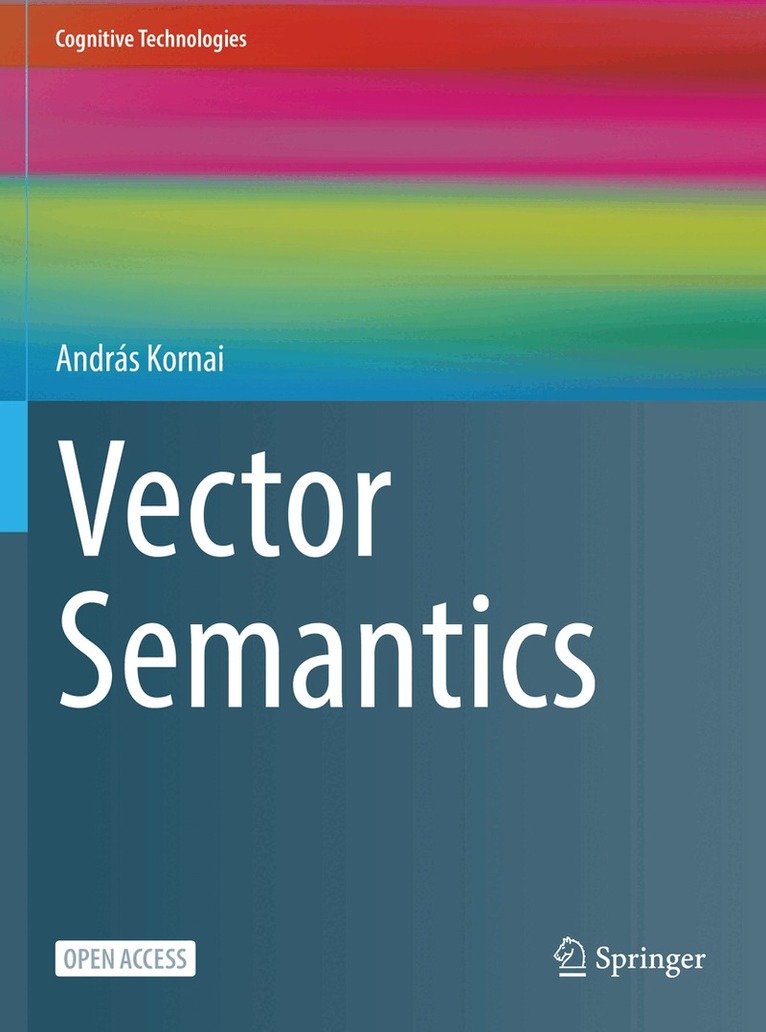
    Vector Semantics

    AvAndrás Kornai

    Häftad, Engelska, 2022

    Del i serien Cognitive Technologies

    448 kr

    Beställningsvara. Skickas inom 10-15 vardagar. Fri frakt över 249 kr.

    Fler format och utgåvor

    Inbunden

    559 kr

    Beskrivning

    This open access book introduces Vector semantics, which links the formal theory of word vectors to the cognitive theory of linguistics. The computational linguists and deep learning researchers who developed word vectors have relied primarily on the ever-increasing availability of large corpora and of computers with highly parallel GPU and TPU compute engines, and their focus is with endowing computers with natural language capabilities for practical applications such as machine translation or question answering. Cognitive linguists investigate natural language from the perspective of human cognition, the relation between language and thought, and questions about conceptual universals, relying primarily on in-depth investigation of language in use. In spite of the fact that these two schools both have ‘linguistics’ in their name, so far there has been very limited communication between them, as their historical origins, data collection methods, and conceptual apparatuses are quite different. Vector semantics bridges the gap by presenting a formal theory, cast in terms of linear polytopes, that generalizes both word vectors and conceptual structures, by treating each dictionary definition as an equation, and the entire lexicon as a set of equations mutually constraining all meanings.

    Produktinformation

    • Utgivningsdatum:2022-12-07
    • Mått:193 x 260 x 16 mm
    • Vikt:615 g
    • Format:Häftad
    • Språk:Engelska
    • Serie:Cognitive Technologies
    • Antal sidor:273
    • Förlag:Springer Verlag, Singapore
    • ISBN:9789811956096

    Utforska kategorier

    • Systemvetenskap och AI inom Data och IT
    • Artificiell intelligens inom Data och IT
    • Språkvetenskap och lingvistik inom Språk och ordböcker

    Mer om författaren

    András Kornai is Senior Research Advisor at SZTAKI Institute of Computer Science and full professor at the Department of Algebra, Budapest University of Technology and Economics (BME).  He was educated at Eotvos Lorand University (mathematics) and Stanford (linguistics). He wrote the standard textbook Mathematical Linguistics (Springer 2007) and is past president of the Mathematics of Language SIG of ACL. He is author or co-author of over a hundred refereed publications, four monographs (the last one being Semantics, Springer 2019), and five edited volumes. He is senior member of the IEEE, winner of the ACM Distinguished Scientist award, and member of Academia Europaea. Kornai has broad experience in industrial research (Xerox, IBM, BBN) and at startups (MAD, Calera, Belmont, Northern Light, MetaCarta, MindSpeak) working as chief scientist at the last three. Several of these startups were purchased by industry leaders (Nuance, PPD, Microsoft) and muchof the technology developed under his leadership is still in use. He held various visiting and research positions at Rice University, Boston University, and Harvard. He currently leads the SZTAKI/BME Human Language Technology group.MindSpeak), working as chief scientist at the last three. Several of these startups were purchased by industry leaders (Nuance, PPD, Microsoft) and much of the technology developed under his leadership is still in use. He held various visiting and research positions at Rice University, Boston University, and Harvard. He currently leads the SZTAKI/BME Human Language Technology group.MindSpeak), working as chief scientist at the last three. Several of these startups were purchased by industry leaders (Nuance, PPD, Microsoft) and much of the technology developed under his leadership is still in use. He held various visiting and research positions at Rice University, Boston University, and Harvard. He currently leads the SZTAKI/BME Human Language Technology group. MindSpeak), working as chief scientist at the last three. Several of these startups were purchased by industry leaders (Nuance, PPD, Microsoft) and much of the technology developed under his leadership is still in use. He held various visiting and research positions at Rice University, Boston University, and Harvard. He currently leads the SZTAKI/BME Human Language Technology group

    Innehållsförteckning

    • Chapter 1.Foundations of non-compositionality.- Chapter 2. From morphology to syntax.- Chapter 3.Time and space.- Chapter 4. Negation.- Chapter 5.Valuations and learnability.- Chapter 6.Modality.- Chapter 7.Adjectives, gradience, implicature.- Chapter 8.Trainability and real-world knowledge.- Chapter 9. Applications.