• Fri frakt över 249 kr
  • •
  • Snabba leveranser
  • •
  • Billiga böcker
Kundservice

Du är på sajten för privatpersoner.

Företag, bibliotek eller offentlig verksamhet?

Du handlar på classic.bokus.com, där alla dina funktioner finns intakta.
Till classic.bokus.com
Bokus logotyp. Gå till startsidan.
  • Erbjudanden
  • Nyheter
  • Student
  • Topplistor
  • Barn & ungdom
  • Bokus Play
  • E-böcker
  • Pocketböcker
  • Spel & pussel

Må bättre, för mindre! Upp till 50% rabatt på hälsoböcker

Sidfot

Mina sidor

    Hjälp

    • Kundservice
    • Vanliga frågor och svar
    • Frakt och leverans
    • Retur vid ångerrätt
    • Reklamera vara
    • Betalning
    • Köpvillkor
    • Allmänna villkor
    • Information om webbplatsens tillgänglighet

    Om Bokus

    • Om oss
    • Pressrum
    • För studenter
    • För företag
    • För bibliotek och offentlig verksamhet
    • För leverantörer
    • Hållbarhet

    Populärt

    • Aktuella erbjudanden
    • Presentkort
    • Studentlitteratur
    • Nya böcker
    • Topplistor
    • Signerade böcker
    • Engelska böcker

    Inspiration

    • Boktips
    • BookTok
    • Populära bokserier
    • Barnbokskaraktärer
    • Populära författare
    Logotyp för Bokus
    Följ oss på Facebook (extern länk)Följ oss på Instagram (extern länk)Följ oss på YouTube (extern länk)Följ oss på TikTok (extern länk)
    bokus @ CookiesAnpassa cookiesIntegritetspolicyKöpvillkor
    Till Citymail hemsida (extern länk)Till Budbee hemsida (extern länk)Till Postnord hemsida (extern länk)Till Schenker hemsida (extern länk)Till Early Bird hemsida (extern länk)Till Walleys hemsida (extern länk)
    1. Naturvetenskap och teknik
    2. Geovetenskap
    3. Geovetenskap
    4. Meteorologi och klimatologi

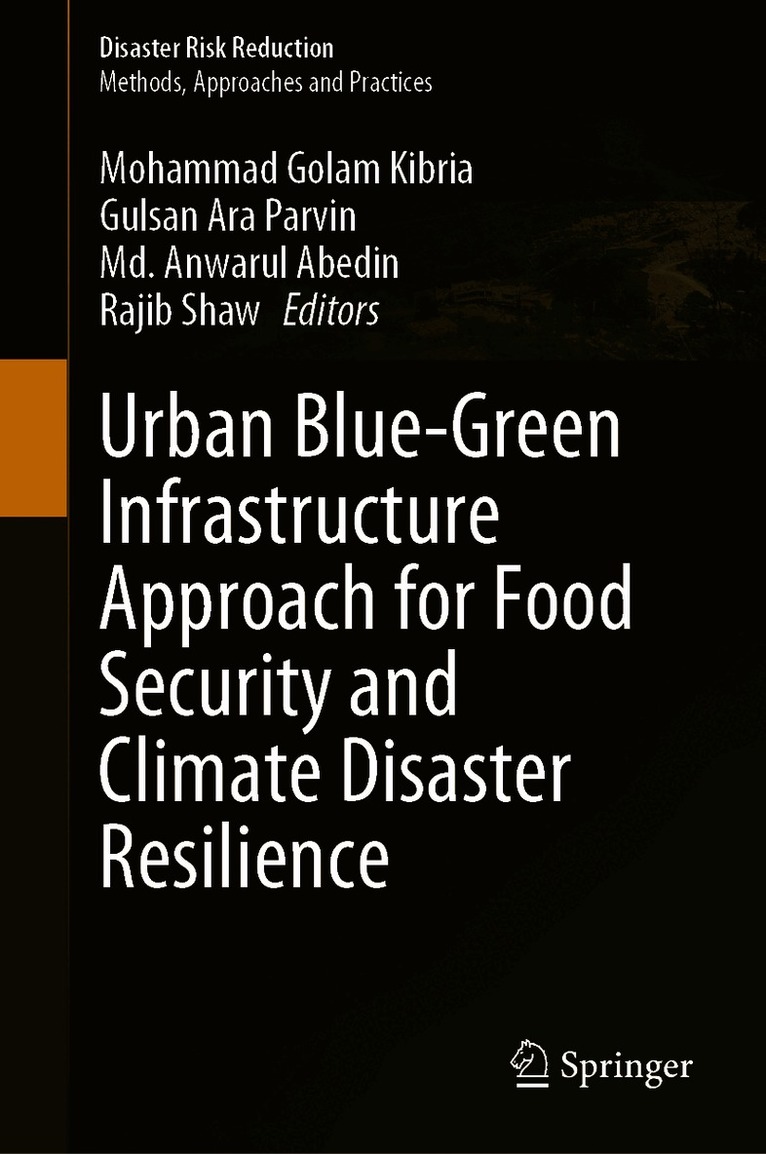
    Urban Blue-Green Infrastructure Approach for Food Security and Climate Disaster Resilience

    AvMohammad Golam Kibria,Gulsan Ara Parvin

    Inbunden, Engelska, 2025

    Del i serien Disaster Risk Reduction

    1 734 kr

    Beställningsvara. Skickas inom 10-15 vardagar. Fri frakt över 249 kr.

    Beskrivning

    This book deliberates the trends, challenges and potential strategies including urban blue-green infrastructure (BGI) approaches to ensure food security and disaster resilience across the globe. Furthermore, the book explores urban planning (both engineering and social aspects), resource management and financing the BGI approaches in developed and developing countries. Urbanization can have both positive and negative impacts on agriculture and aquaculture. It often leads to changes in land use, increased competition for resources and shifts in market dynamics. Due to the increasing urbanization across the globe, the cultivable agricultural land is decreasing, which threatens the food supply for the growing global population and increases the disaster occurrence in urban areas. The city dwellers are the most vulnerable in terms of food security and climate disaster resilience due to the rapid urbanization across the globe. However, the impact of urbanization is not the same for the urban areas in developed and developing countries. Although food security and climate disaster resilience are critical issues facing urban areas, an urban blue-green infrastructure approach can help address these challenges. This approach combines elements of both natural and built environments to create more sustainable and resilient cities. Adopting such an approach can enhance food security and climate disaster resilience by integrating nature-based solutions into urban planning and design. This book is a valuable resource for students, researchers, academia, policymakers and development practitioners.

    Produktinformation

    • Utgivningsdatum:2025-09-27
    • Mått:155 x 235 x 24 mm
    • Vikt:651 g
    • Format:Inbunden
    • Språk:Engelska
    • Serie:Disaster Risk Reduction
    • Antal sidor:308
    • Förlag:Springer Nature Switzerland AG
    • ISBN:9789819687459

    Utforska kategorier

    • Meteorologi och klimatologi inom Naturvetenskap och teknik
    • Miljövetenskap och miljöpolitik inom Naturvetenskap och teknik

    Mer om författaren

    Dr. Mohammad Golam Kibria is an associate professor in the Department of Soil Science in Bangladesh Agricultural University, Bangladesh. He received his Ph.D. in soil fertility and plant nutrition from the University of Western Australia, Australia. After completing his Ph.D., his research focuses on urban agriculture, disaster risk reduction, climate change adaptation, integrated social aspects and soil health assessment under changing global environment. Dr. Kibria has also worked for the International Union for Conservation of Nature, Coalition for Disaster Resilient Infrastructure, Food and Agriculture Organization and Asia-Pacific Network for Global Change Research in different research projects focusing on climate disaster resilience. He is currently working in two different collaborative projects funded by the United States Agency for International Development and Asia-Pacific Network for Global Change Research, which focus on urban horticulture and climate induced loss assessment in rice production. Dr. Gulsan Ara Parvin is a researcher and instructor at the Collage of Policy Science, Ritsumeikan University, Japan. She worked for different graduate schools and research centers of Kyoto University, Japan, for about 12 years. She was also an associate professor at the Urban and Regional Planning Department, Bangladesh University of Engineering and Technology. She conducted her Ph.D. research at the Urban Engineering Department, the University of Tokyo. Her expertise includes disaster risk reduction and community resilience, social capital, women empowerment and microfinance in Bangladesh. She has published about 50 research papers in different journals and books. She has research and teaching experiences in Bangladesh, Japan, Malaysia, Thailand and USA. Dr. Md Anwarul Abedin is a professor and leader of Laboratory of Environment and Sustainable Development in the Department of Soil Science, Bangladesh Agricultural University, Bangladesh. He received his Ph.D. from Kyoto University, Japan. He was a postdoctoral researcher in Kyoto University and Northumbria University, UK. Dr. Abedin was awarded the esteemed Pan Asia Risk Reduction Fellowship by START. He has 19 years of teaching and research experiences in the field of agriculture, food safety and security, water resource management, solid waste management, environmental impact assessment, community-based adaptations and resilience mapping, climate change, disaster risk reduction, land use change and community participation. He has worked as a consultant with Food and Agriculture Organization, Japan International Cooperation Agency and International Union for Conservation of Nature, among others. He has served as an editorial board member and reviewer in many journals. Professor Rajib Shaw is a professor in the Graduate School of Media and Governance in Keio University, Japan. He is also a senior fellow of the Institute of Global Environmental Strategies (IGES) Japan, and the chairperson of the Sustainable Environment and Ecological Development Society (SEEDS) Asia and the Church World Service (CWS) Japan, two Japanese NGOs. He is a co-founder of a Delhi (India)-based social entrepreneur startup, the Resilience Innovation Knowledge Academy (RIKA). Earlier, he was the executive director of the Integrated Research on Disaster Risk (IRDR) and was a professor in Kyoto University. His expertise includes disaster governance, community-based disaster risk management, climate change adaptation, urban risk management and disaster and environmental education. Professor Shaw was the chair of the United Nations Science Technology Advisory Group (STAG) for disaster risk reduction and currently is the co-chair of the AsiaPacific Science Technology Academic Advisory Group (APSTAAG).

    Innehållsförteckning

    • Chapter 1. Triple Nexus of Urbanization, Food Security and Climate Disaster resilience: Present trend, necessity and challenges.- Chapter 2. Urbanization and Environmental Degradation in Khulna, Bangladesh: An Analysis of Land Use, Land Cover, and Microclimate Dynamics.- Chapter 3. Urban agriculture: current developments and importance in food security and climate resilience.- Chapter 4. Urban Agriculture as an approach of Urban BGI and climate disaster resilience.- Chapter 5. Blue-green infrastructure for landslide risk reduction: a scenario in Uttarakhand, India.- Chapter 6. Blue-green infrastructure (BGI) in Bangladesh: Present scenario and possible strategies.- Chapter 7. Global actions for climate resilient blue green infrastructure.- Chapter 8. Urban Housing, Poverty, and Informal Sector: Asian Dilemma towards Livable Blue Green Cities.- Chapter 9. Land Use Management, Planning, and Control for BGI, Food Security, and Climate Disaster Resilience.- Chapter 10. Assessing Urban resilience for climate disasters in Phnom Penh, Cambodia.- Chapter 11. Urban energy and waste management for BGI, food security and Climate Disaster resilience.- Chapter 12. Smart agriculture in smart cities across the globe.- Chapter 13. Cost and benefit of green infrastructures in urban heat island mitigation.- Chapter 14. Financing Urban BGI-Approaches and Challenges.