• Fri frakt över 249 kr
  • •
  • Snabba leveranser
  • •
  • Billiga böcker
Kundservice

Du är på sajten för privatpersoner.

Företag, bibliotek eller offentlig verksamhet?

Du handlar på classic.bokus.com, där alla dina funktioner finns intakta.
Till classic.bokus.com
Bokus logotyp. Gå till startsidan.
  • Erbjudanden
  • Nyheter
  • Student
  • Topplistor
  • Barn & ungdom
  • Bokus Play
  • E-böcker
  • Pocketböcker
  • Spel & pussel

10% rabatt på allt med kod: NYSTART10 →

Sidfot

Mina sidor

    Hjälp

    • Kundservice
    • Vanliga frågor och svar
    • Frakt och leverans
    • Retur vid ångerrätt
    • Reklamera vara
    • Betalning
    • Köpvillkor
    • Allmänna villkor
    • Information om webbplatsens tillgänglighet

    Om Bokus

    • Om oss
    • Pressrum
    • För studenter
    • För företag
    • För bibliotek och offentlig verksamhet
    • För leverantörer
    • Hållbarhet

    Populärt

    • Aktuella erbjudanden
    • Presentkort
    • Studentlitteratur
    • Nya böcker
    • Topplistor
    • Signerade böcker
    • Engelska böcker

    Inspiration

    • Boktips
    • BookTok
    • Populära bokserier
    • Barnbokskaraktärer
    • Populära författare
    Logotyp för Bokus
    Följ oss på Facebook (extern länk)Följ oss på Instagram (extern länk)Följ oss på YouTube (extern länk)Följ oss på TikTok (extern länk)
    bokus @ CookiesAnpassa cookiesIntegritetspolicyKöpvillkor
    Till Citymail hemsida (extern länk)Till Budbee hemsida (extern länk)Till Postnord hemsida (extern länk)Till Schenker hemsida (extern länk)Till Early Bird hemsida (extern länk)Till Walleys hemsida (extern länk)
    1. Naturvetenskap och teknik
    2. Teknik och industri
    3. Övrig teknik och tillämpad vetenskap

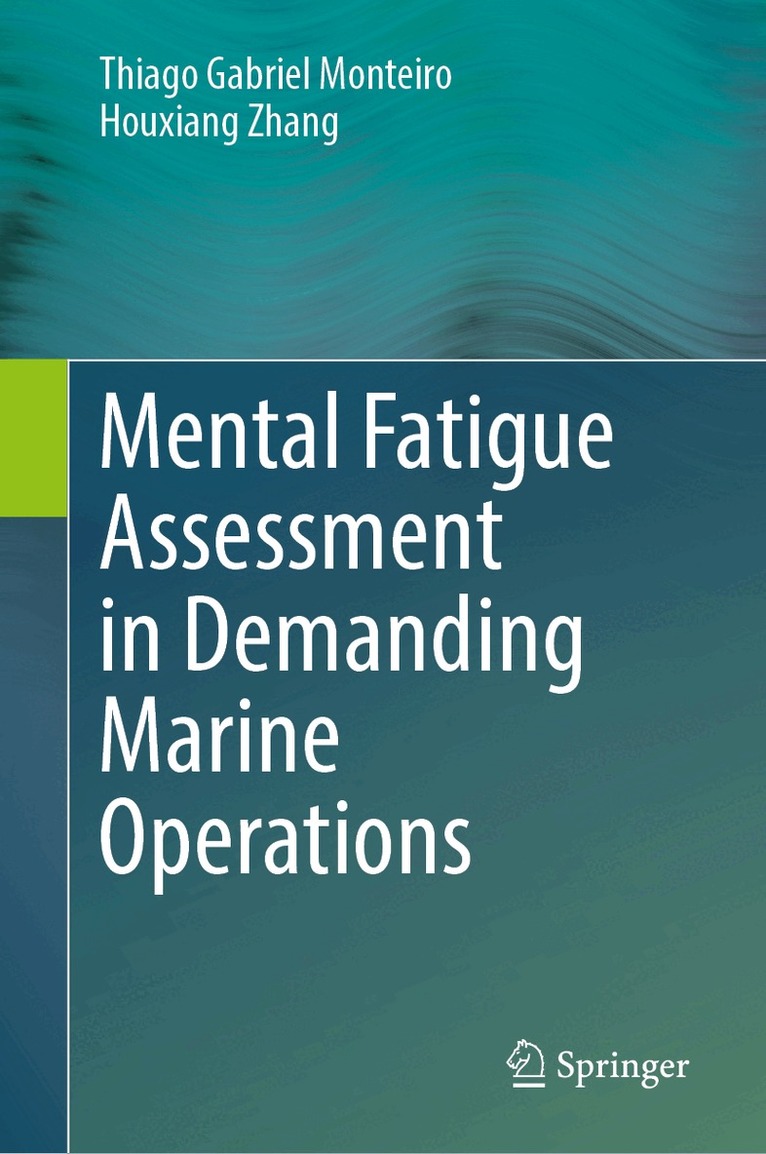
    Mental Fatigue Assessment in Demanding Marine Operations

    AvThiago Gabriel Monteiro,Houxiang Zhang

    Inbunden, Engelska, 2024

    1 626 kr

    Beställningsvara. Skickas inom 10-15 vardagar. Fri frakt över 249 kr.

    Fler format och utgåvor

    Häftad

    1 626 kr

    Beskrivning

    This book investigates how human mental fatigue (MF) can be objectively measured during demanding maritime operations. The maritime domain is characterized by demanding operations. These operations can be especially complex and dangerous when they require coordination between different maritime vessels and several maritime operators. The best approach to quantify MF is through the use of physiological sensors including electroencephalogram (EEG), electrocardiogram, electromyogram, temperature sensor, and eye tracker can be applied, individually or in conjunction, in order to collect relevant data that can be mapped to an MF scale. More than simpler sensor fusion, this book bridges the gap between relevant sensor data and a quantifiable MF level using both data-driven and model-based approaches.Data-driven part investigates the use of different NNs combined for the MF assessment (MFA) task. Among the different architectures tested, convolutional neural networks (CNN) showed the best performance when dealing with multiple physiological data channels. Optimization was used to improve the performance of CNN in the cross-subject MFA task. Testing different combinations of physiological sensors indicated a setup consisting of EEG sensor only was the best option, due to the trade-off between assessment precision and sensor framework complexity. These two factors are of great importance when considering an MFA system that could be implemented in real-life scenarios. The model-based discussion applies the current knowledge about the use of EEG data to characterize MF to develop an MF approach to quantify the progression of MF in maritime operators.In the research presented in this book, realistic vessel simulators  were used as a platform for experimenting with different operational scenarios and sensor setups.

    Produktinformation

    • Utgivningsdatum:2024-06-14
    • Mått:155 x 235 x 14 mm
    • Vikt:377 g
    • Format:Inbunden
    • Språk:Engelska
    • Antal sidor:115
    • Upplaga:2024
    • Förlag:Springer Verlag, Singapore
    • ISBN:9789819730711

    Utforska kategorier

    • Övrig teknik och tillämpad vetenskap inom Naturvetenskap och teknik
    • Systemvetenskap och AI inom Data och IT
    • Artificiell intelligens inom Data och IT

    Mer om författaren

    Thiago Gabriel Monteiro received B.Sc. degree in naval architecture and maritime engineering from the University of São Paulo, Brazil, in 2013 and M.Sc. degree in Ship Design from the Norwegian University of Science and Technology (NTNU), Norway, in 2016. He worked as a member of the Ship Design and Operations Laboratory, NTNU Ålesund, from 2014 to 2016. He was also a collaborator in the SFI MOVE project, from 2017 to 2020. From 2017 to 2021, he worked in the Intelligent Systems lab as a Ph.D. candidate. He received his Ph.D. degree in Engineering from NTNU in 2021 in the field of physiological sensor fusion in the maritime domain. He currently works as a software engineer at Dipai AS.Houxiang Zhang is a full professor and director of Intelligent Systems Laboratory at the Department of Ocean Operations and Civil Engineering, Faculty of Engineering, Norwegian University of Science and Technology. He received his Ph.D. degree on Mechanical and Electronic Engineering in 2003. From 2004, he worked as a postdoctoral fellow and senior researcher at the Institute of Technical Aspects of Multimodal Systems (TAMS), Department of Informatics, Faculty of Mathematics, Informatics, and Natural Sciences, University of Hamburg, Germany. In Feb. 2011, he finished the Habilitation on Informatics at the University of Hamburg. Dr. Zhang joined the NTNU, Norway, in April 2011 where he is a full professor on Mechatronics. From 2011 to 2016, Dr. Zhang also hold a Norwegian national GIFT Professorship on product and system design funded by Norwegian Maritime Centre of Expertise. He was nominated and selected as a member of the Norwegian Academy of Technological Sciences in 2019, and a member of Academy of the Royal Norwegian Society of Sciences and Letters in 2024.

    Innehållsförteckning

    • Preface.- Introduction.- Handling Fatigue.- Mental Fatigue Assessment Sensor Framework.- Mental Fatigue Assessment Using Artificial Intelligence.- Model-based Assessment for Multi-subject and Multi-task Scenarios.- Mental Fatigue Prediction.- Research Challenges.