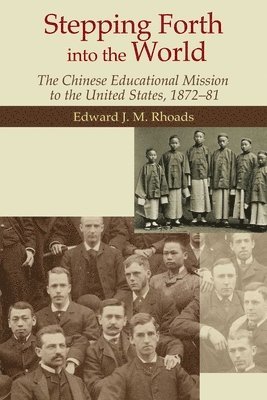
The book contrasts the experiences of the Chinese Educational Mission students with those of other Chinese in the United States during a period of anti-Chinese sentiment, which was to culminate in the enactment of Chinese Exclusion in 1882.
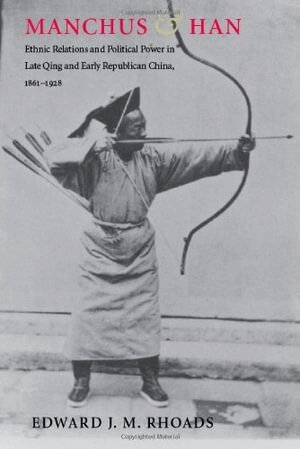
Edward J. M. Rhoads is a historian of late nineteenth-early twentieth century China. He is the author of China's Republican Revolution: The Case of Kwangtung, 1895-1913 and Manchus and Han: Ethnic Relations and Political Power in Late Qing and Early Republican China, 1861-1928. The latter work was awarded the Joseph R. Levenson prize in 2002 as the best book on twentieth-century China by the Association for Asian Studies. Rhoads is also interested in the history of the Chinese in the United States. He has published articles on the Chinese in Texas and on a group of Chinese workers in a cutlery factory in southwestern Pennsylvania in the 1870s. His next research project is a history of the bicycle in China. He retired in 2003, after thirty-seven years, from the history department at the University of Texas at Austin. He is currently living in New York City.
Recensioner i media
Professor Rhoads has meticulously constructed the individual and collective histories of the 120 young men and boys sent by a beleaguered late Qing government to live and acquire English and Western knowledge in white New England families, schools and universities. As the vanguard of legions of Chinese students who have studied in the U.S. since, and as contemporaries of the far more numerous Chinese coolies whose paths they never crossed, this compelling study adds a surprising new chapter to early Asian American history. -- Evelyn Hu-DeHart, director, Center for the Study of Race and Ethnicity in America, Brown University