Inbunden, Engelska, 1992
13 829 kr
Skickas inom 5-8 vardagar
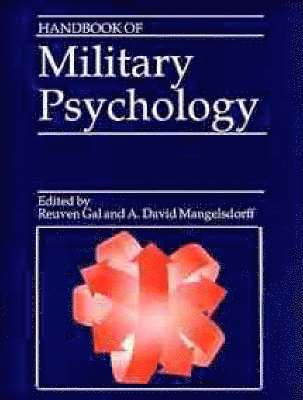
Handbook of Military Psychology Edited by Reuven Gal, The Israeli Institute for Military Studies, Zikhron, Ya'akov, Israel, and A. David Mangelsdorff, Health Services Command, Fort Sam Houston, USA With a Foreword by Edgar M. Johnson Section editors Friedrich W. Steege Paul R. Chatelier and Earl A. Alluisi Gerald P. Krueger T. O. Jacobs A. David Mangelsdorff Robert S. Nichols Reuven Gal The Handbook of Military Psychology describes the scope of military psychology and how the branches of psychology are applied in military settings, the similarities and differences within multinational and multi-service settings, the historical basis for the development and application of psychological principles in multi-service military settings, and the ongoing research and applications of military psychology. The volume editors have brought together a distinguished team of authors, under the leadership of section editors, who examine all areas in the field of military psychology--assessment; leadership; human factors; environmental factors; individual and group behavior; clinical and organizational applications; and special groups and special issues. The chapters include an up-to-date overview of the given subject, a historical review of the field, a critical analysis of the applications, and an extensive bibliography. The military must evaluate large numbers of people, screen out the unfit, select individuals with needed abilities, and place people in the jobs most appropriate both to their skills and to military needs. Military personnel, of all sorts, must be trained and prepared for warfare. Individuals have to be led and motivated and units must maintain high morale and cohesion in order to achieve their missions. Furthermore, military missions are frequently carried out under most stressful conditions and usually require strenuous adjustment between human capabilities and weapon-systems' peculiarities. These characteristics of military organization all have their psychological aspects. This comprehensive handbook will be an essential tool for military psychologists, trainers and leaders dealing with these aspects. It will also be of interest to both practitioners and researchers working in the field of occupational and industrial psychology, and for those working in personnel management. From a pre-publication review 'The Handbook of Military Psychology will be recognised as the standard work in this field.' John Keegan