A. Kohn - Böcker
Visar alla böcker från författaren A. Kohn. Handla med fri frakt och snabb leverans.
5 produkter
5 produkter
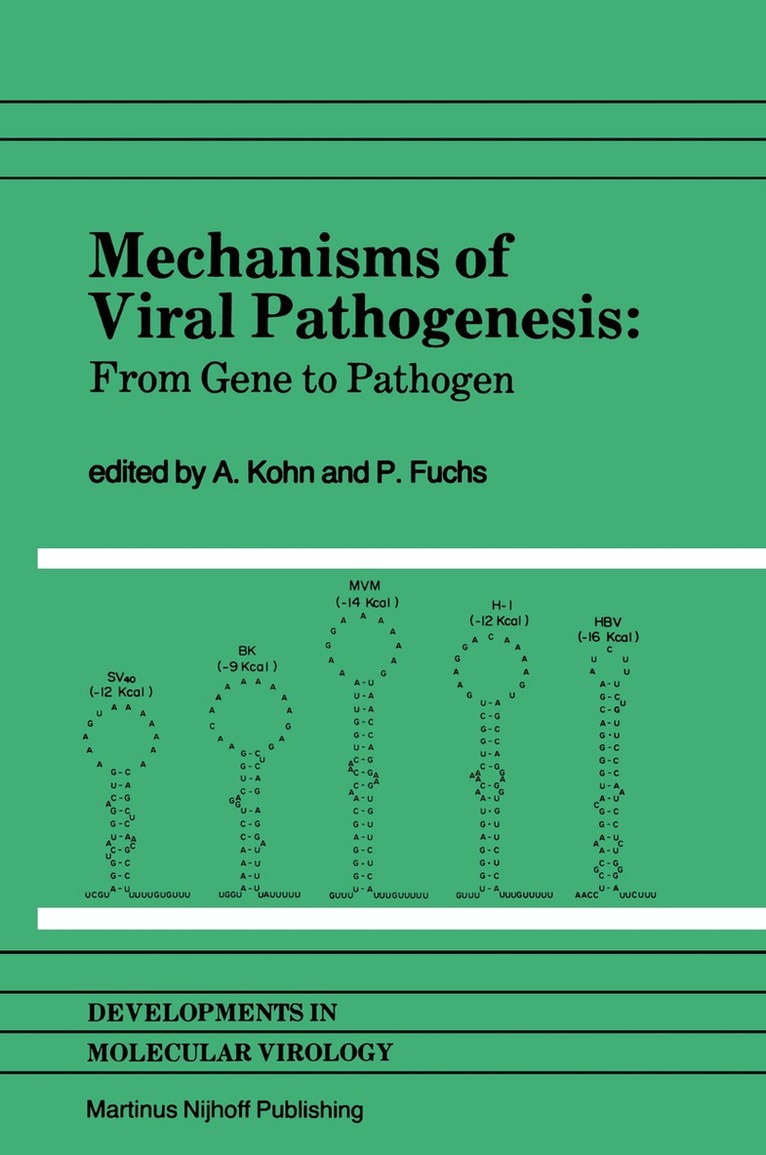
Mechanisms of Viral Pathogenesis
From Gene to Pathogen Proceedings of 28th OHOLO Conference, held at Zichron Ya’acov, Israel, March 20–23, 1983
Inbunden, Engelska, 1983
1 632 kr
Skickas inom 10-15 vardagar
Venezuelan equine encephalitis (VEE) virus was first isolated in 1938 by Kubes and Rios (1) from the brain of a horse which died during an epizootic of a previously unrecognized disease in Venezuela. VEE-related viruses were subsequently isolated during t~e period of 1943-1963 in Venezuela, Colombia, Peru, Trinidad, Brazil, Surinam, Argentina, Panama, Mexico, and the United States (2) * Shope et ~. (3) fi rst defi ned the vi ru ses in the VEE comp 1 ex t-y showing serological relationships between classical VEE, ~lucambo, and Pixuna viruses. Young and Johnson (2) serologically characterized a variety of VEE isolates and proposed that the complex t>e divided into four subtypes (I, II, III, and IV). Viruses in subtype I were divided into five variants designated IA through IE. During 1069-1~71 a VEE epizootic-epidemic occurred in South America, Central America, and the United States involving a subtype lAB virus which caused high mortality among equines and human d i sea se (4). Venezuelan equine encephalitis viruses are alpha-togaviruses w~ic~ contain a positive strand rit>onucleic acid genome enclosed in an icosa~edral nucleocapsid.The virion has an envelope which contains blO glycoproteins: E2 of 5F,000 daltons (gp56) and E1 of ~O,OOO daltons (gp50) (5,6). Viral neutralization (N) and hemagglutiration (HA) sites have been placed on E2 by the use of monospecific rabtdt antisera and monoclonal antibodies specific for purified viral structural proteins (7-10). Only anti-E2 antisera neutralized virus infectivity or blocked virus hemagglutination.
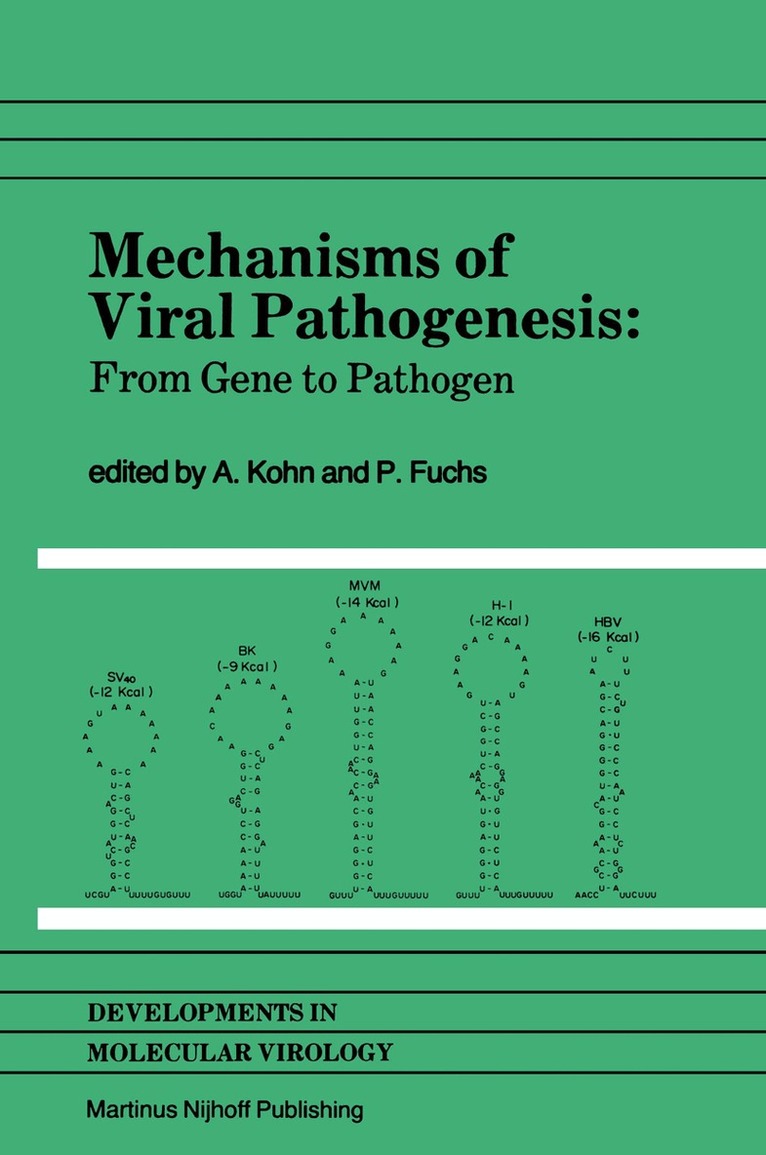
Mechanisms of Viral Pathogenesis
From Gene to Pathogen Proceedings of 28th OHOLO Conference, held at Zichron Ya’acov, Israel, March 20–23, 1983
Häftad, Engelska, 2011
1 585 kr
Skickas inom 10-15 vardagar
Venezuelan equine encephalitis (VEE) virus was first isolated in 1938 by Kubes and Rios (1) from the brain of a horse which died during an epizootic of a previously unrecognized disease in Venezuela. VEE-related viruses were subsequently isolated during t~e period of 1943-1963 in Venezuela, Colombia, Peru, Trinidad, Brazil, Surinam, Argentina, Panama, Mexico, and the United States (2) * Shope et ~. (3) fi rst defi ned the vi ru ses in the VEE comp 1 ex t-y showing serological relationships between classical VEE, ~lucambo, and Pixuna viruses. Young and Johnson (2) serologically characterized a variety of VEE isolates and proposed that the complex t>e divided into four subtypes (I, II, III, and IV). Viruses in subtype I were divided into five variants designated IA through IE. During 1069-1~71 a VEE epizootic-epidemic occurred in South America, Central America, and the United States involving a subtype lAB virus which caused high mortality among equines and human d i sea se (4). Venezuelan equine encephalitis viruses are alpha-togaviruses w~ic~ contain a positive strand rit>onucleic acid genome enclosed in an icosa~edral nucleocapsid.The virion has an envelope which contains blO glycoproteins: E2 of 5F,000 daltons (gp56) and E1 of ~O,OOO daltons (gp50) (5,6). Viral neutralization (N) and hemagglutiration (HA) sites have been placed on E2 by the use of monospecific rabtdt antisera and monoclonal antibodies specific for purified viral structural proteins (7-10). Only anti-E2 antisera neutralized virus infectivity or blocked virus hemagglutination.
653 kr
Skickas inom 5-8 vardagar
1 091 kr
Skickas inom 10-15 vardagar
The OHOLO conferences have been convened annually as from the spring of 1956; they have covered very wide areas from different and overlapping disciplines, as can be seen from the following list: 1956 Bacterial Genetics (not published) 1957 Tissue Cultures in Virological Research (not published) 1958 Inborn and Acquired Resistance to Infection in Animals (not published) 1959 Experimental Approach to Mental Diseases (not published) 1960 Cryptobiotic Stages in Biological Systems* 1961 Virus - Cell Relationships** 1962 Biological Synthesis and Function of Nucleic Acids** 1963 Cellular Control Mechanism of Macromolecular Synthesis** 1964 Molecular Aspects of Immunology** 1965 Cell Surfaces** 1966 Chemistry and Biology of Psychotropic Agents (not published) 1967 Structure and Mode of Action of Enzymes** 1968 Growth and Differentiation of Cells in vitro** 1969 Behaviour of Animal Cells in Culture** 1970 Microbial Toxins** 1971 Interaction of Chemical Agents with Cholinergic Mechanisms** The participants at these meetings from the different scien tific institutions of Israel and from many countries, are engaged in fields of study which represent widely divergent approaches to biology. Thus, a characteristic feature of the OHOLO meetings has been their multi-disciplinary nature. These small international conferences are distinguished by the relaxed atmosphere in which they are held, with ample time for informal as weIl as formal discussions. *Published by Elsevier Publishing Co. , Amsterdam (1960). **Published by the Israel Institute for Biological Research, Ness Ziona.
1 059 kr
Skickas inom 10-15 vardagar