A. Matthews – författare
Visar alla böcker från författaren A. Matthews. Handla med fri frakt och snabb leverans.
7 produkter
7 produkter
E-bok
PDF, Engelska, 1994756 kr
Läs direkt efter köp
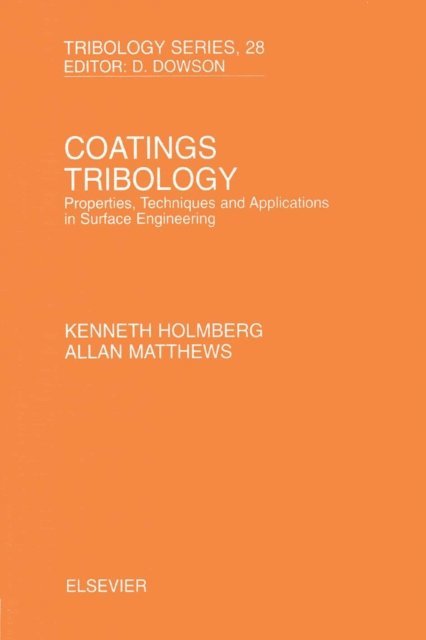
This book presents a general view on thin surface coatings used for tribological applications and it is based on the current state of understanding. The mechanisms of friction and wear in sliding and rolling contacts of coated surfaces are described. Basic information on coating techniques, tribology and surface mechanisms is given. Based on collected experimental works information is given on the properties of thin soft coatings, such as polymer, lamellar solid and soft metal coatings; thin hard coatings, such as nitride, carbide, oxide, boride and diamond and diamond-like coatings; and multi-component and multi-layer coatings. The influence of interface layers and lubricants is highlighted. The methods available for characterization of coated surfaces and for mechanical and chemical evaluation of their tribological properties are described. Tribological evaluation methods for accelerated and field testing and the need for standardization of quality assurance procedures are discussed. A methodology for the selection of thin coatings for tribological applications is presented and knowledge based expert system approaches for coating selection are reviewed. For different application examples, the basic tribological contact mechanisms are described and the possibilities for improving their tribological properties by using surface coatings are discussed. The application examples include sliding and rolling bearings, gears, tools for cutting and forming, erosion resistant applications, magnetic recording systems and bio-medical implants.
Inbunden, Engelska, 1992
1 742 kr
Skickas inom 10-15 vardagar
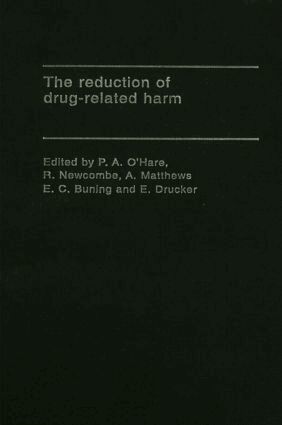
The War on Drugs' has traditionally had total abstinence as its target. The contributors to this book take a new and challenging approach to problem drug use, arguing that abstinence is not the only solution. They believe that existing methods of treatment and control have been inadequate in controlling or improving drug problems and they propose a radical alternative: reducing the harm associated with the use of illicit drugs. International in scope, the book covers a broad range of drugs, and of social and individual problems. The spread of HIV infection, which has been described as a greater threat to individual and public health than drug misuse is also considered. The contributors give an overview of the current theories and practices that have helped to minimise the harmful effects of drugs and describe national and city-level strategies towards drug problems. They also cover the drug policies of several agencies and organisations world-wide, including police, doctors, community groups and local authorities. Concentrating on reducing drug-related harm, this in an important contribtuion to the debate on the future shape of drug control systems. It questions the role and function of existing drug laws and discusses how harm reduction will shape day-to-day work with drug users. Provocative and persuasive, it should be read by all policy-makers and practitioners faced with drugs problems, and will do much to help establish new strategies for dealing with drug use, strategies that minimise rather than exacerbate drug-related harm.
E-bok
PDF, Engelska, 2013936 kr
Läs direkt efter köp
The War on Drugs'' has traditionally had total abstinence as its target. The contributors to this book take a new and challenging approach to problem drug use, arguing that abstinence is not the only solution. They believe that existing methods of treatment and control have been inadequate in controlling or improving drug problems and they propose a radical alternative: reducing the harm associated with the use of illicit drugs. International in scope, the book covers a broad range of drugs, and of social and individual problems. The spread of HIV infection, which has been described as a greater threat to individual and public health than drug misuse is also considered. The contributors give an overview of the current theories and practices that have helped to minimise the harmful effects of drugs and describe national and city-level strategies towards drug problems. They also cover the drug policies of several agencies and organisations world-wide, including police, doctors, community groups and local authorities. Concentrating on reducing drug-related harm, this in an important contribtuion to the debate on the future shape of drug control systems. It questions the role and function of existing drug laws and discusses how harm reduction will shape day-to-day work with drug users. Provocative and persuasive, it should be read by all policy-makers and practitioners faced with drugs problems, and will do much to help establish new strategies for dealing with drug use, strategies that minimise rather than exacerbate drug-related harm.
E-bok
Engelska, 2013936 kr
Läs direkt efter köp
The War on Drugs'' has traditionally had total abstinence as its target. The contributors to this book take a new and challenging approach to problem drug use, arguing that abstinence is not the only solution. They believe that existing methods of treatment and control have been inadequate in controlling or improving drug problems and they propose a radical alternative: reducing the harm associated with the use of illicit drugs. International in scope, the book covers a broad range of drugs, and of social and individual problems. The spread of HIV infection, which has been described as a greater threat to individual and public health than drug misuse is also considered. The contributors give an overview of the current theories and practices that have helped to minimise the harmful effects of drugs and describe national and city-level strategies towards drug problems. They also cover the drug policies of several agencies and organisations world-wide, including police, doctors, community groups and local authorities. Concentrating on reducing drug-related harm, this in an important contribtuion to the debate on the future shape of drug control systems. It questions the role and function of existing drug laws and discusses how harm reduction will shape day-to-day work with drug users. Provocative and persuasive, it should be read by all policy-makers and practitioners faced with drugs problems, and will do much to help establish new strategies for dealing with drug use, strategies that minimise rather than exacerbate drug-related harm.
E-bok
PDF, Engelska, 2016979 kr
Läs direkt efter köp
Surface & Coatings Technology, Volumes 59–60 presents the proceedings of the Third International Conference on Plasma Surface Engineering, held in Garmisch-Partenkirchen, Germany, on October 26–29, 1992. This book discusses the widespread applications of plasma and particle beam assisted methods in surface and thin film technology. Volume 59 is organized into 11 parts encompassing 69 chapters while Volume 60 is comprised of eight parts encompassing 49 chapters. This compilation of papers begins with an overview of the kinetic modelling of low pressure high frequency discharges. This text then examines the effect of various deposition parameters on the growth of chamber wall deposits. Other chapters consider the physiochemical behavior of ceramic materials for space applications. This book discusses as well the economic aspects of the application of plasma surface technologies. The reader is also introduced to the environmental aspects of physical vapor deposition coating technology. This book is a valuable resource for plasma surface engineers, technologists, and researchers.
E-bok
PDF, Engelska, 2016756 kr
Läs direkt efter köp
Surface & Coatings Technology, Volume 61 presents the proceeding of the 20th International Conference on Metallurgical Coatings and Thin Films, held in San Diego, California, on April 19–23, 1993. This book discusses a variety of topics related to surface and coatings technology, including coatings for use at high temperature, hard coatings, and vapor deposition technology. Organized into 141 chapters, this compilation of papers begins with an overview of the coating requirements for long-life bucket protection, how each of these coating systems has performed, and the advantages and disadvantages of each. This text then discusses the gradient-free transition step achieved in the element analysis of the depth profiles. Other chapters consider the metastable yttrium oxide films that are synthesized using reactive sputter deposition. This book discusses as well the use of appropriate copper-based alloy coatings on structural components. The final chapter deals with the particle mechanical and thermal behavior in the process of high velocity oxy-fuel spraying. This book is a valuable resource for chemical engineers and metallurgists.
Häftad, Engelska, 2012
1 499 kr
Skickas inom 10-15 vardagar
The past decade has seen a rapid development in the range of techniques which are available to modify the surfaces of engineering components. This in tum has led to the emergence of the new field of surface engineering the design of a composite system (coating plus substrate) that produces a performance which cannot be achieved by either the coating or substrate alone. With this expansion comes the problem of deciding on the correct surfacing technology for a given application. Clearly, to take full advantage of the benefits which surface engineering offers, there is a need to explain, in a structured way, the basic features and interrelationships of the most recently developed coatings and treatments. Advanced Surface Coatings satisfies this need by providing a concise and authoritative state-of-the art review of surface engineering. In chapter 1 the reader is provided with an insight into the surfacing technology appropriate for a given function. Chapter 2 reviews the principles of plasma generation (a theme which is central to many of the advanced surface treatments and coatings) and forms a solid foundation for the chap ters which follow. Chapters 3 to 10 each discuss the general principles on which the technology is based, followed by an appreciation of specific properties and application areas for materials treated by each particular method. These chapters cover ion implantation, ion-assisted coatings, evaporation, sputtering, physical vapour deposition, chemical vapour deposi tion, thermal spraying, and laser treatments.