A. Nordmann – författare
Visar alla böcker från författaren A. Nordmann. Handla med fri frakt och snabb leverans.
3 produkter
3 produkter
Del 198 - Boston Studies in the Philosophy and History of Science
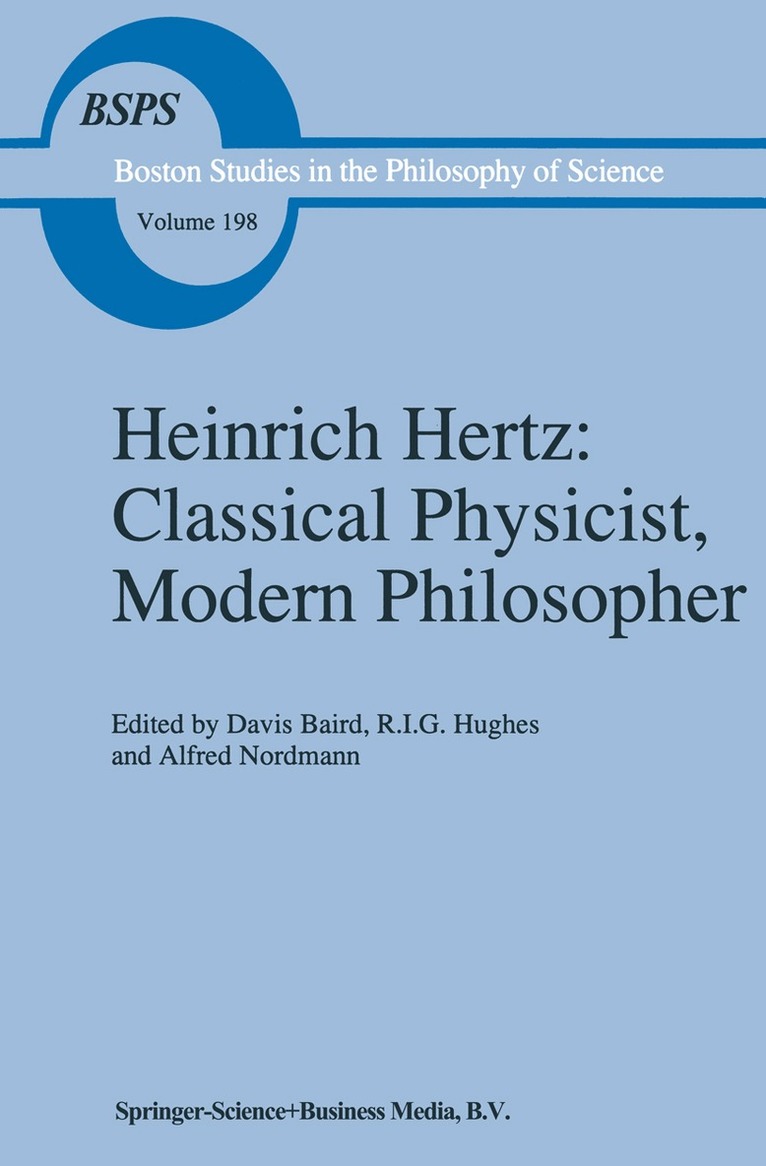
Heinrich Hertz: Classical Physicist, Modern Philosopher
Inbunden, Engelska, 1998
1 958 kr
Skickas inom 10-15 vardagar
The sub-title of this symposium is accurate and, in a curious way, promises more than it states: Classical Physicist, Modem Philosopher. Heinrich Hertz, as the con summate experimentalist of 19th century technique and as brilliant clarifying critic of physical theory of his time, achieved one of the fulfilments but at the same time opened one of the transition points of classical physics. Thus, in his 'popular' lecture 'On the Relations Between Light and Electricity' at Heidelberg in the Fall of 1889, Hertz identified the ether as henceforth the most fundamental problem of physics, as the conceptual mystery but also the key to understanding mass, electric ity, and gravity. Of Hertz's demonstration of electric waves, Helmholtz told the Physical Society of Berlin: "Gentlemen! I have to communicate to you today the most important physical discovery of the century. " Hertz, philosophizing in his direct, lucid, pithy style, once wrote "We have to imagine". Perhaps this is metaphysics on the horizon? In the early pages of his Principles of Mechanics, we read A doubt which makes an impression on our mind cannot be removed by calling it metaphysical: every thoughtful mind as such has needs which scientific men are accustomed to denote as metaphysical. (PM23) And at another place, concerning the terms 'force' and 'electricity' and the alleged mystery of their natures, Hertz wrote: We have an obscure feeling of this and want to have things cleared up.
Del 198 - Boston Studies in the Philosophy and History of Science
Heinrich Hertz: Classical Physicist, Modern Philosopher
Häftad, Engelska, 2010
2 019 kr
Skickas inom 10-15 vardagar
The sub-title of this symposium is accurate and, in a curious way, promises more than it states: Classical Physicist, Modem Philosopher. Heinrich Hertz, as the con summate experimentalist of 19th century technique and as brilliant clarifying critic of physical theory of his time, achieved one of the fulfilments but at the same time opened one of the transition points of classical physics. Thus, in his 'popular' lecture 'On the Relations Between Light and Electricity' at Heidelberg in the Fall of 1889, Hertz identified the ether as henceforth the most fundamental problem of physics, as the conceptual mystery but also the key to understanding mass, electric ity, and gravity. Of Hertz's demonstration of electric waves, Helmholtz told the Physical Society of Berlin: "Gentlemen! I have to communicate to you today the most important physical discovery of the century. " Hertz, philosophizing in his direct, lucid, pithy style, once wrote "We have to imagine". Perhaps this is metaphysics on the horizon? In the early pages of his Principles of Mechanics, we read A doubt which makes an impression on our mind cannot be removed by calling it metaphysical: every thoughtful mind as such has needs which scientific men are accustomed to denote as metaphysical. (PM23) And at another place, concerning the terms 'force' and 'electricity' and the alleged mystery of their natures, Hertz wrote: We have an obscure feeling of this and want to have things cleared up.
E-bok
PDF, Engelska, 20132 508 kr
Läs direkt efter köp
The sub-title of this symposium is accurate and, in a curious way, promises more than it states: Classical Physicist, Modem Philosopher. Heinrich Hertz, as the con summate experimentalist of 19th century technique and as brilliant clarifying critic of physical theory of his time, achieved one of the fulfilments but at the same time opened one of the transition points of classical physics. Thus, in his ''popular'' lecture ''On the Relations Between Light and Electricity'' at Heidelberg in the Fall of 1889, Hertz identified the ether as henceforth the most fundamental problem of physics, as the conceptual mystery but also the key to understanding mass, electric ity, and gravity. Of Hertz''s demonstration of electric waves, Helmholtz told the Physical Society of Berlin: "Gentlemen! I have to communicate to you today the most important physical discovery of the century. " Hertz, philosophizing in his direct, lucid, pithy style, once wrote "We have to imagine". Perhaps this is metaphysics on the horizon? In the early pages of his Principles of Mechanics, we read A doubt which makes an impression on our mind cannot be removed by calling it metaphysical: every thoughtful mind as such has needs which scientific men are accustomed to denote as metaphysical. (PM23) And at another place, concerning the terms ''force'' and ''electricity'' and the alleged mystery of their natures, Hertz wrote: We have an obscure feeling of this and want to have things cleared up.