A. Rushton – författare
Visar alla böcker från författaren A. Rushton. Handla med fri frakt och snabb leverans.
5 produkter
5 produkter
Häftad, Engelska, 1986
561 kr
Skickas inom 10-15 vardagar
This book should be of interest to rheumatologists.
E-bok
PDF, Engelska, 2013708 kr
Läs direkt efter köp
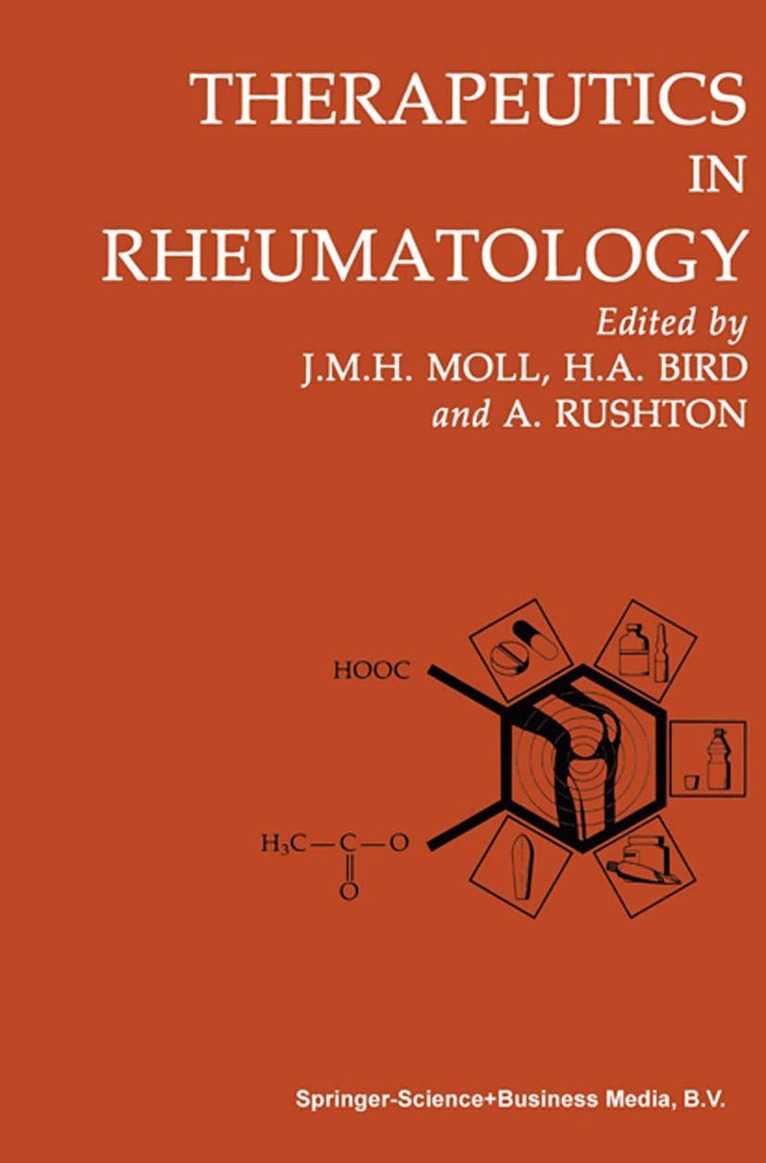
This book is about the drugs used in the treatment and management of rheumatic disorders. The term ''therapeutics'' used in the title is intended to mirror the relevance of drugs in the widest sense of the word. Thus, general principles underlying pharmaceutical and pharmacological study have been included together with more clinical matters concerned with applying specific rheumatic problems. The need for another work on rheumatological drugs in itself, as opposed to the different approach intended, was prompted by the ever continuing and bewildering plethora of antirheumatic drugs flooding the market at present. We believe that such a burgeoning of new preparations is welcome in an era when in general there are still no ''cures'' available. Moreover, we also feel that a continued update of this rapidly advancing field is essential, not only for its own sake, but also to place it in perspective with itself and with neighbouring fields.
Del 88 - NATO Science Series E:
Mathematical Models and Design Methods in Solid-Liquid Separation
Inbunden, Engelska, 1985
2 156 kr
Skickas inom 10-15 vardagar
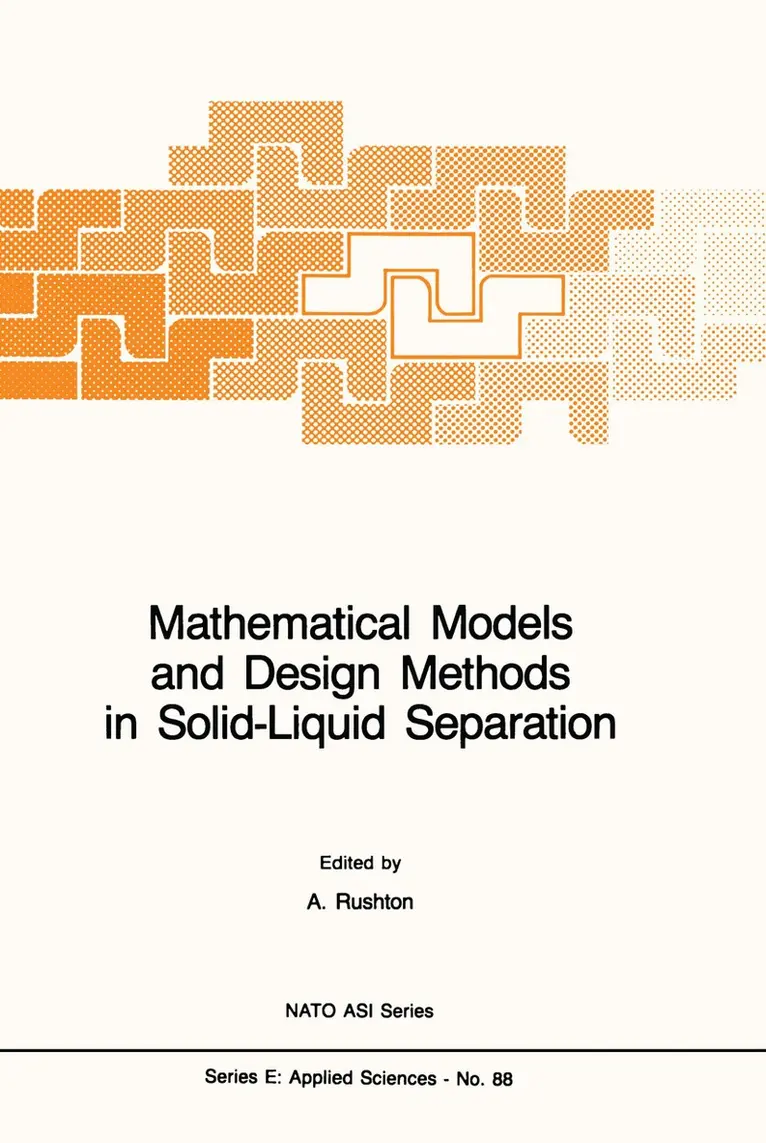
The separation of finely-divided solids from liquids constitutes an important stage in many industrial processes. Separation of mixtures ranging from highly concentrated slurries to slightly turbid liquids must be effected in circumstances where the solids, liquid or both phases may have value. Separations may be achieved by use of a membrane or filter medium which, positioned in the path of a flowing suspension, will allow passage of the fluid whilst retaining solids on the surface or within the medium. Alternatively the two phases may be separated by sedimentation processes involving gravitational or centrifugal force. In either mode, separation difficulties are sometimes experienced with the result that solid-liquid separation is often a bottleneck in commercial plants. Operational difficulties and plant failures are associated with the random nature of the particles being separated; variations in size, shape, states of aggregation, compressibility, etc. , produce a wide range of problems. Plugging of the filter medium or the collapse of the solids under applied stress lead to slow flowrates of liquid. The colloidal nature of some precipitates makes separation by settling virtually impossible without the use of chemical agents to enhance the size of basic units and to reduce repulsive surface forces. Unit operations such as filtration, comminution, etc. , involve a seemingly bewildering array of machines which makes plant selection a difficult step and reflects the uncer tainties attaching to operations involving the solid )hase. Many types of pressure, vacuum and centrifugal filter are available.
E-bok
PDF, Engelska, 20122 741 kr
Läs direkt efter köp
The separation of finely-divided solids from liquids constitutes an important stage in many industrial processes. Separation of mixtures ranging from highly concentrated slurries to slightly turbid liquids must be effected in circumstances where the solids, liquid or both phases may have value. Separations may be achieved by use of a membrane or filter medium which, positioned in the path of a flowing suspension, will allow passage of the fluid whilst retaining solids on the surface or within the medium. Alternatively the two phases may be separated by sedimentation processes involving gravitational or centrifugal force. In either mode, separation difficulties are sometimes experienced with the result that solid-liquid separation is often a bottleneck in commercial plants. Operational difficulties and plant failures are associated with the random nature of the particles being separated; variations in size, shape, states of aggregation, compressibility, etc. , produce a wide range of problems. Plugging of the filter medium or the collapse of the solids under applied stress lead to slow flowrates of liquid. The colloidal nature of some precipitates makes separation by settling virtually impossible without the use of chemical agents to enhance the size of basic units and to reduce repulsive surface forces. Unit operations such as filtration, comminution, etc. , involve a seemingly bewildering array of machines which makes plant selection a difficult step and reflects the uncer tainties attaching to operations involving the solid )hase. Many types of pressure, vacuum and centrifugal filter are available.
Häftad, Engelska, 2011
2 138 kr
Skickas inom 10-15 vardagar
The separation of finely-divided solids from liquids constitutes an important stage in many industrial processes. Separation of mixtures ranging from highly concentrated slurries to slightly turbid liquids must be effected in circumstances where the solids, liquid or both phases may have value. Separations may be achieved by use of a membrane or filter medium which, positioned in the path of a flowing suspension, will allow passage of the fluid whilst retaining solids on the surface or within the medium. Alternatively the two phases may be separated by sedimentation processes involving gravitational or centrifugal force. In either mode, separation difficulties are sometimes experienced with the result that solid-liquid separation is often a bottleneck in commercial plants. Operational difficulties and plant failures are associated with the random nature of the particles being separated; variations in size, shape, states of aggregation, compressibility, etc. , produce a wide range of problems. Plugging of the filter medium or the collapse of the solids under applied stress lead to slow flowrates of liquid. The colloidal nature of some precipitates makes separation by settling virtually impossible without the use of chemical agents to enhance the size of basic units and to reduce repulsive surface forces. Unit operations such as filtration, comminution, etc. , involve a seemingly bewildering array of machines which makes plant selection a difficult step and reflects the uncer tainties attaching to operations involving the solid )hase. Many types of pressure, vacuum and centrifugal filter are available.