A. S. Barwich - Böcker
Visar alla böcker från författaren A. S. Barwich. Handla med fri frakt och snabb leverans.
3 produkter
3 produkter
252 kr
Skickas inom 7-10 vardagar
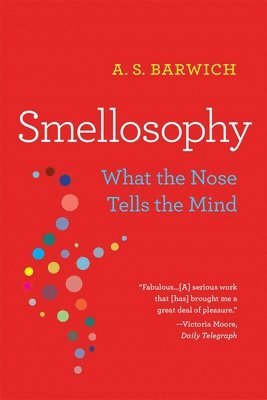
An NRC Handelsblad Book of the Year“Offers rich discussions of olfactory perception, the conscious and subconscious impacts of smell on behavior and emotion.”—ScienceDecades of cognition research have shown that external stimuli “spark” neural patterns in particular regions of the brain. We think of the brain as a space we can map: here it responds to faces, there it perceives a sensation. But the sense of smell—only recently attracting broader attention in neuroscience—doesn’t work this way. So what does the nose tell the brain, and how does the brain understand it?A. S. Barwich turned to experts in neuroscience, psychology, chemistry, and perfumery in an effort to understand the mechanics and meaning of odors. She discovered that scents are often fickle, and do not line up with well-defined neural regions. Upending existing theories of perception, Smellosophy offers a new model for understanding how the brain senses and processes odors.“A beguiling analysis of olfactory experience that is fast becoming a core reference work in the field.”—Irish Times“Lively, authoritative…Aims to rehabilitate smell’s neglected and marginalized status.”—Wall Street Journal“This is a special book…It teaches readers a lot about olfaction. It teaches us even more about what philosophy can be.”—Times Literary Supplement
269 kr
Kommande
This Element launches a broadside against the visual-centric approach that has dominated philosophical and scientific discourse about the senses. Considering the variety and breadth of sensory experiences, from the deceptively familiar territories of smell and taste to the frequently overlooked experience of touch and interoceptive processes, it challenges us to rethink the philosophical bedrock of our theories of mind. It advocates a shift towards a more multi-modal and embodied approach that values biological realities and cross-cultural insights. It analyses traditional criteria for classifying sensory modalities and examines how sensory augmentation technologies provide insight for theories of perception by virtue of sensorimotor learning. The Element also highlights the disconnect between current scientific advancements and philosophical inquiry, suggesting that refocusing on the senses more broadly defined, especially on kinesthetic experiences, illuminates new paths through the thorny 'hard problem' of consciousness. This title is also available as Open Access on Cambridge Core.
859 kr
Kommande
This Element launches a broadside against the visual-centric approach that has dominated philosophical and scientific discourse about the senses. Considering the variety and breadth of sensory experiences, from the deceptively familiar territories of smell and taste to the frequently overlooked experience of touch and interoceptive processes, it challenges us to rethink the philosophical bedrock of our theories of mind. It advocates a shift towards a more multi-modal and embodied approach that values biological realities and cross-cultural insights. It analyses traditional criteria for classifying sensory modalities and examines how sensory augmentation technologies provide insight for theories of perception by virtue of sensorimotor learning. The Element also highlights the disconnect between current scientific advancements and philosophical inquiry, suggesting that refocusing on the senses more broadly defined, especially on kinesthetic experiences, illuminates new paths through the thorny 'hard problem' of consciousness. This title is also available as Open Access on Cambridge Core.