A. Zaman – författare
Visar alla böcker från författaren A. Zaman. Handla med fri frakt och snabb leverans.
7 produkter
7 produkter
Inbunden, Engelska, 2022
1 730 kr
Skickas inom 10-15 vardagar
Sustainable Water Resource Development and Management is a comprehensive volume on this important topic. It broadly covers the sources, availability, demand, and supply of water and its uses in irrigation and crop production in agriculture. It then delves into many specific aspects of water resource development and management, includingIrrigation creation and utilizationWater storage efficiency, conveyance efficiency, distribution efficiency, and application efficiencyThe role of water in plant systems and soil-water-plant relationshipsEstimating the water need for irrigation along with management strategiesWater quality in agriculture as well as the impact of water quality on human healthWater pricingWetland management and water productivityWater pollution in agriculture and water contamination in urban and rural areasExamples and case studies are included to illustrate and reinforce the text, such as reviews of river linking projects, adopted water management technologies for agricultural farms, important irrigation projects (both minor and major), and more.Written by two eminent researchers and scientists in agricultural water management, this informative volume is designed for students of agriculture, researchers, policymakers, and teachers engaged in the field of water management.
Häftad, Engelska, 2024
1 160 kr
Skickas inom 10-15 vardagar
Sustainable Water Resource Development and Management is a comprehensive volume on this important topic. It broadly covers the sources, availability, demand, and supply of water and its uses in irrigation and crop production in agriculture. It then delves into many specific aspects of water resource development and management, includingIrrigation creation and utilizationWater storage efficiency, conveyance efficiency, distribution efficiency, and application efficiencyThe role of water in plant systems and soil-water-plant relationshipsEstimating the water need for irrigation along with management strategiesWater quality in agriculture as well as the impact of water quality on human healthWater pricingWetland management and water productivityWater pollution in agriculture and water contamination in urban and rural areasExamples and case studies are included to illustrate and reinforce the text, such as reviews of river linking projects, adopted water management technologies for agricultural farms, important irrigation projects (both minor and major), and more.Written by two eminent researchers and scientists in agricultural water management, this informative volume is designed for students of agriculture, researchers, policymakers, and teachers engaged in the field of water management.
Häftad, Engelska, 2018
1 597 kr
Skickas inom 5-8 vardagar
The book, which comprises 33 chapters, delves into various areas of agricultural science, including water resource management, irrigation water management, soil resource management, sustainability in agriculture, and crop management and productivity. These chapters have been authored by esteemed researchers from around the globe. The book is expected to be a significant addition to the field of agricultural technology, as it aims to provide researchers and policymakers with up-to-date scientific information.
Inbunden, Engelska, 2025
2 366 kr
Skickas inom 5-8 vardagar
Irrigation Management is essential to meet the growing demands of food production, ensure environmental health, and support socio-economic development in a water-stressed world. The textbook Irrigation Water Management presents a comprehensive and structured approach to understanding the principles, practices, and innovations that define modern water resource use in agriculture.Spanning 18 well-organized chapters, the book begins with foundational knowledge on global water challenges, soil properties, and soilplantwater relationships. It then progresses into the practical dimensions of irrigation scheduling, system design, water efficiency evaluation, and measurement techniques. Special attention is given to managing problematic water, conserving moisture, improving rainfed lowlands, and preventing waterlogging and salinization.The text moves beyond traditional approaches by incorporating participatory water management, virtual water concepts, and emerging technologies such as smart irrigation systems. Tailored water-use strategies for different crops, case studies, and real-world scenarios provide readers with applied knowledge for diverse agro-climatic zones.Designed as a core resource for undergraduate agricultural science students, this book also serves educators, extension professionals, and practitioners aiming to implement climate-resilient, water-efficient irrigation systems. The integrated perspective, blending ecological responsibility with technical precision, supports the development of skilled professionals ready to meet global water management challenges.With its clear explanations, practical insights, and forward-thinking focus, Irrigation Water Management equips future agricultural leaders to become stewards of water resources, helping secure food systems and sustainable livelihoods for generations to come.
Inbunden, Engelska, 2018
3 174 kr
Skickas inom 5-8 vardagar
The book, which includes 33 chapters covering topics such as water resource management, irrigation water management, soil resource management, sustainability in agriculture, and crop management and productivity, is an invaluable resource for researchers and policymakers in the field. The content of the book has been written by distinguished experts from around the world. The publication will play a significant role in providing the latest agricultural technology information to the relevant researchers and policy makers.
Häftad, Engelska, 2019
802 kr
Skickas inom 5-8 vardagar
The book is organized into sixteen chapters. A brief description of each of the chapters follows: Chapter 1 identifies the concept of importance and definition as basic requirement to know the challenges in the management of information security in the new millennium; Chapter 2 identifies the types of farming system and factors affecting farming system; Chapter 3 envisages sustainable agriculture, its problems and its impact in cropping system; Chapter 4 takes historical background of agriculture, its changing scenario and its resilience over the years. Chapter 5 delineated sustainable agriculture, its importance and its impact in cropping system; Chapter 6 describes the agro-climatic and agro-ecological zones that need for model of integrated farming system to be developed as a policy perspective to ensure the crop cultivation the highest level of protection against all sorts of threats. Chapter 7 takes history of agriculture, its changing scenario and its resilience over the years. Chapter 8 reviews the rejuvenation, modernization and mechanization of agriculture, its present bottlenecks on ethical elements of security such that trust could be promoted to outburst the explosive population; Chapter 9 reviews the information on soil resource in the context of problematic security threat; Chapter 10 reviews issues on external input based sustainable agriculture surrounding low land utilization as existing resource mobilization and utilization. Chapter 11 presents the importance of organic farming well as organic agriculture to get the best results in sustainable agriculture; Chapter 12 addresses the issue of water management and planning, with particular reference to irrigation management and judicious water application in crop cultivation. Chapter 13 presents gaps and problems in each of the current approaches in rainfed agriculture, rainwater harvesting as well as rainwater management in growing crops in best possible manner; Chapter 14 discusses management of lowland areas towards sustainable agriculture; Chapter 15 refers the land degradation and land treatments in the way of effective utilization of land resources through tillage, conservational tillage and other suitable measures; and Chapter 16 concludes the present principle of remedies, the economic equity, social security along the future task and presents pragmatic, formal, informal and technical principles necessary for managing food security in the new millennium.
Inbunden, Engelska, 2021
3 174 kr
Skickas inom 5-8 vardagar
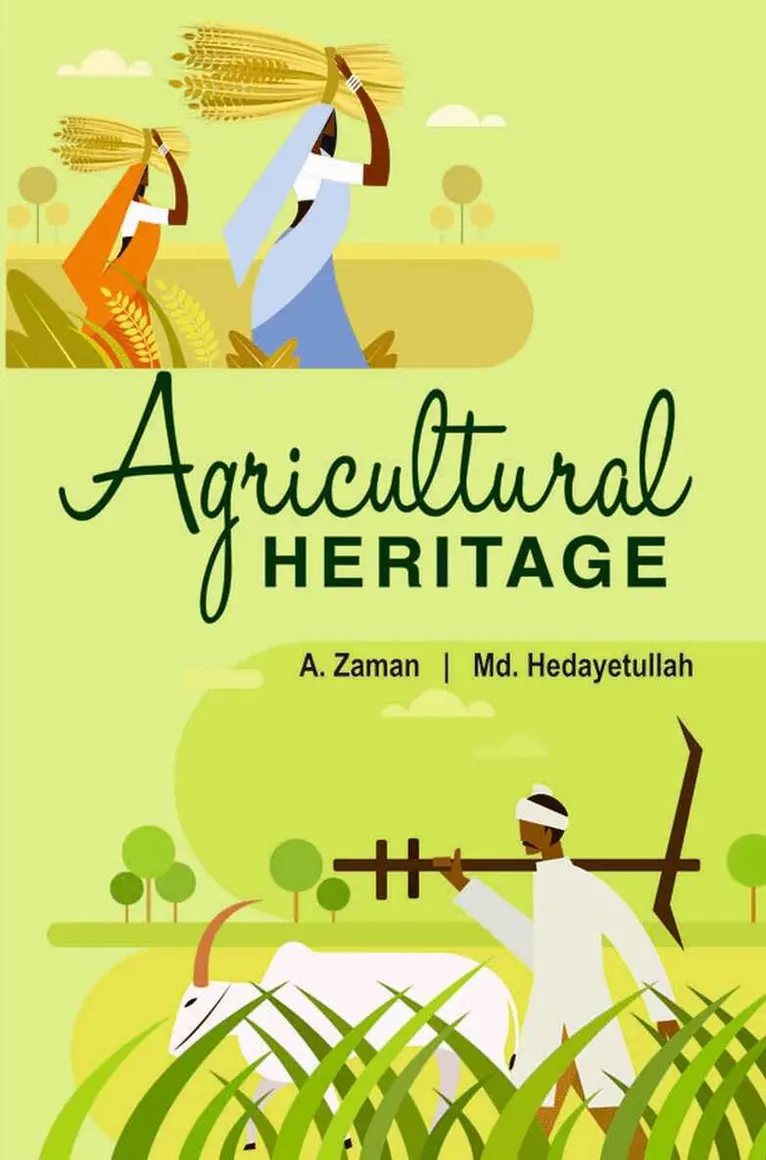
The textbook titled Agricultural Heritage is intended for undergraduate students majoring in agriculture at agricultural universities and colleges. It serves as a comprehensive resource for learning about the history and evolution of agriculture, which spans over a thousand years of civilization, social changes, and development. Despite the significant advancements in agricultural productivity achieved through intensive management practices and the introduction of high yielding varieties of cereal crops, it is crucial to understand the origins of agriculture in the ancient past.