A.A. Tuganbaev – författare
Visar alla böcker från författaren A.A. Tuganbaev. Handla med fri frakt och snabb leverans.
8 produkter
8 produkter
Del 545 - Mathematics and Its Applications
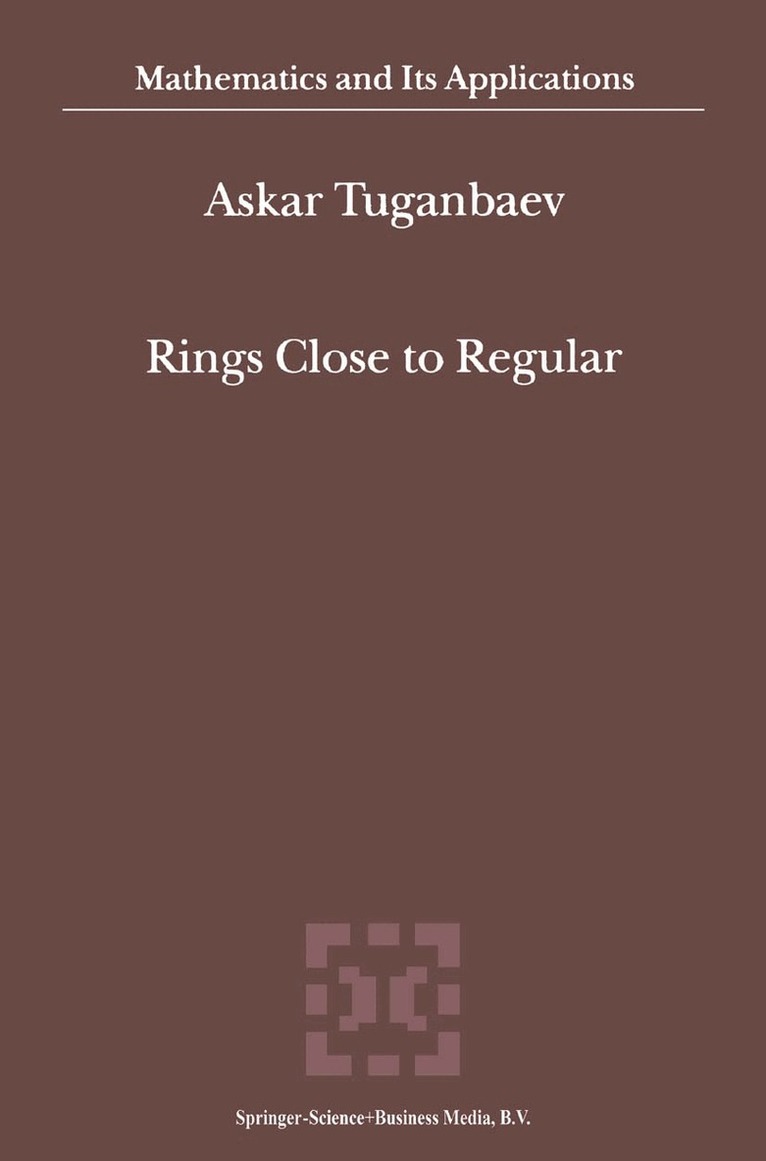
Rings Close to Regular
Inbunden, Engelska, 2002
549 kr
Skickas inom 10-15 vardagar
Preface All rings are assumed to be associative and (except for nilrings and some stipulated cases) to have nonzero identity elements. A ring A is said to be regular if for every element a E A, there exists an element b E A with a = aba. Regular rings are well studied. For example, [163] and [350] are devoted to regular rings. A ring A is said to be tr-regular if for every element a E A, there is an element n b E A such that an = anba for some positive integer n. A ring A is said to be strongly tr-regular if for every a E A, there is a positive integer n with n 1 n an E a + An Aa +1. It is proved in [128] that A is a strongly tr-regular ring if and only if for every element a E A, there is a positive integer m with m 1 am E a + A. Every strongly tr-regular ring is tr-regular [38]. If F is a division ring and M is a right vector F-space with infinite basis {ei}~l' then End(MF) is a regular (and tr-regular) ring that is not strongly tr-regular. The factor ring of the ring of integers with respect to the ideal generated by the integer 4 is a strongly tr-regular ring that is not regular.
Inbunden, Engelska, 2003
549 kr
Skickas inom 10-15 vardagar
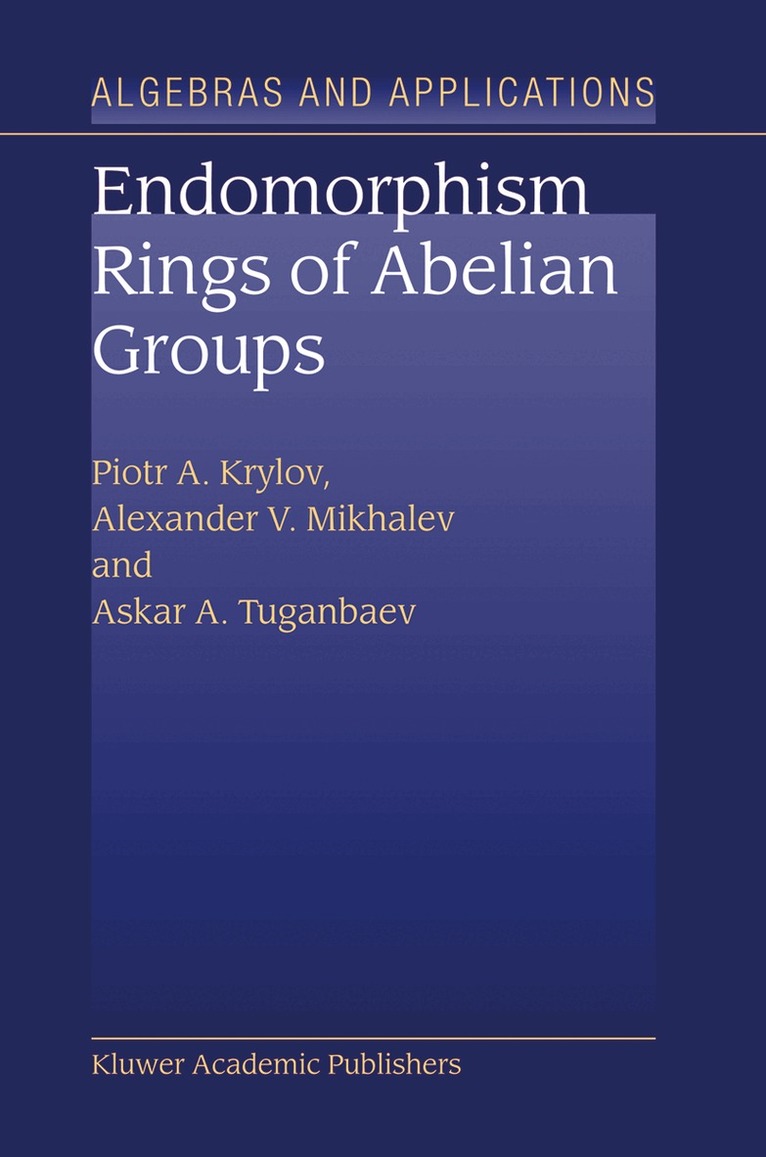
Every Abelian group can be related to an associative ring with an identity element, the ring of all its endomorphisms. Recently the theory of endomor phism rings of Abelian groups has become a rapidly developing area of algebra. On the one hand, it can be considered as a part of the theory of Abelian groups; on the other hand, the theory can be considered as a branch of the theory of endomorphism rings of modules and the representation theory of rings. There are several reasons for studying endomorphism rings of Abelian groups: first, it makes it possible to acquire additional information about Abelian groups themselves, to introduce new concepts and methods, and to find new interesting classes of groups; second, it stimulates further develop ment of the theory of modules and their endomorphism rings. The theory of endomorphism rings can also be useful for studies of the structure of additive groups of rings, E-modules, and homological properties of Abelian groups. The books of Baer [52] and Kaplansky [245] have played an important role in the early development of the theory of endomorphism rings of Abelian groups and modules. Endomorphism rings of Abelian groups are much stu died in monographs of Fuchs [170], [172], and [173]. Endomorphism rings are also studied in the works of Kurosh [287], Arnold [31], and Benabdallah [63].
Del 545 - Mathematics and Its Applications
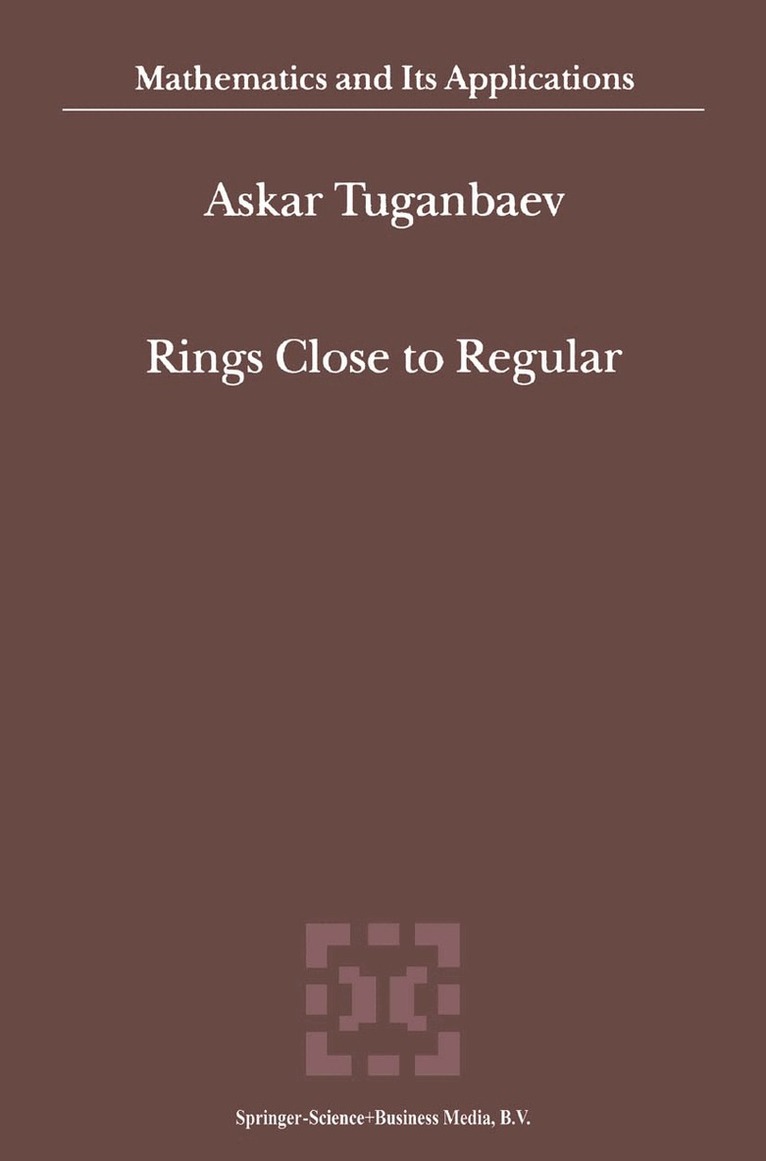
Rings Close to Regular
Häftad, Engelska, 2010
549 kr
Skickas inom 10-15 vardagar
Preface All rings are assumed to be associative and (except for nilrings and some stipulated cases) to have nonzero identity elements. A ring A is said to be regular if for every element a E A, there exists an element b E A with a = aba. Regular rings are well studied. For example, [163] and [350] are devoted to regular rings. A ring A is said to be tr-regular if for every element a E A, there is an element n b E A such that an = anba for some positive integer n. A ring A is said to be strongly tr-regular if for every a E A, there is a positive integer n with n 1 n an E a + An Aa +1. It is proved in [128] that A is a strongly tr-regular ring if and only if for every element a E A, there is a positive integer m with m 1 am E a + A. Every strongly tr-regular ring is tr-regular [38]. If F is a division ring and M is a right vector F-space with infinite basis {ei}~l' then End(MF) is a regular (and tr-regular) ring that is not strongly tr-regular. The factor ring of the ring of integers with respect to the ideal generated by the integer 4 is a strongly tr-regular ring that is not regular.
Häftad, Engelska, 2010
549 kr
Skickas inom 10-15 vardagar
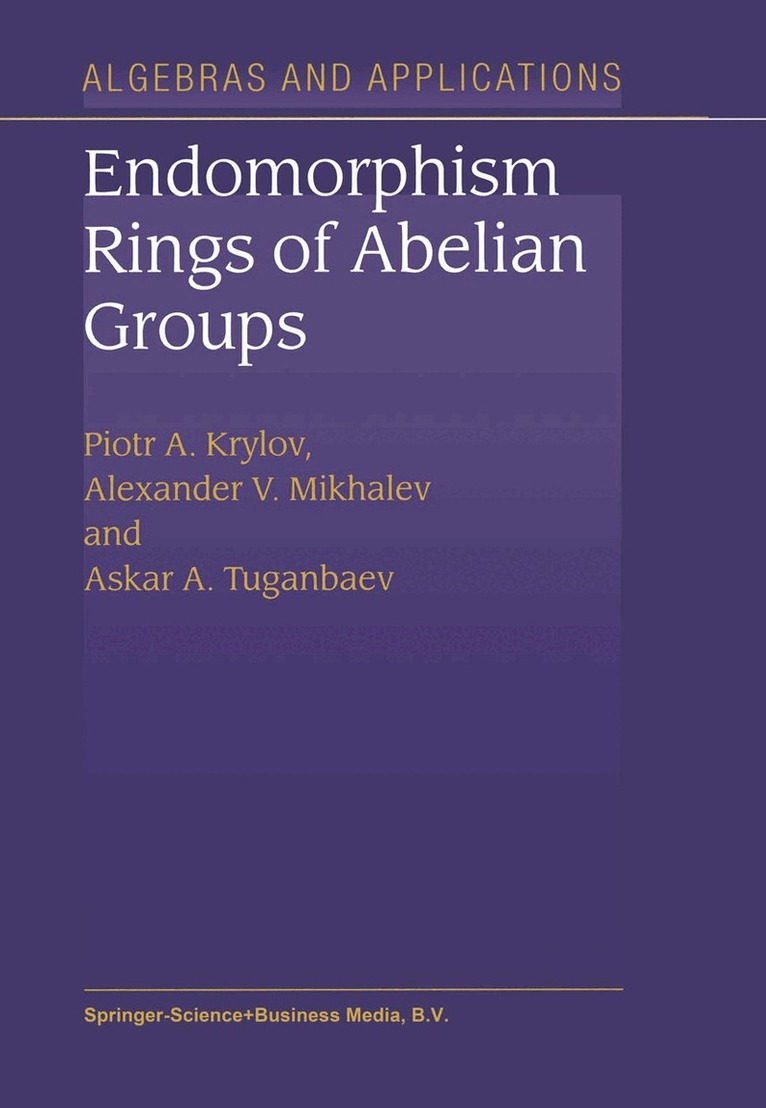
Every Abelian group can be related to an associative ring with an identity element, the ring of all its endomorphisms. Recently the theory of endomor phism rings of Abelian groups has become a rapidly developing area of algebra. On the one hand, it can be considered as a part of the theory of Abelian groups; on the other hand, the theory can be considered as a branch of the theory of endomorphism rings of modules and the representation theory of rings. There are several reasons for studying endomorphism rings of Abelian groups: first, it makes it possible to acquire additional information about Abelian groups themselves, to introduce new concepts and methods, and to find new interesting classes of groups; second, it stimulates further develop ment of the theory of modules and their endomorphism rings. The theory of endomorphism rings can also be useful for studies of the structure of additive groups of rings, E-modules, and homological properties of Abelian groups. The books of Baer [52] and Kaplansky [245] have played an important role in the early development of the theory of endomorphism rings of Abelian groups and modules. Endomorphism rings of Abelian groups are much stu died in monographs of Fuchs [170], [172], and [173]. Endomorphism rings are also studied in the works of Kurosh [287], Arnold [31], and Benabdallah [63].
Del 449 - Mathematics and Its Applications
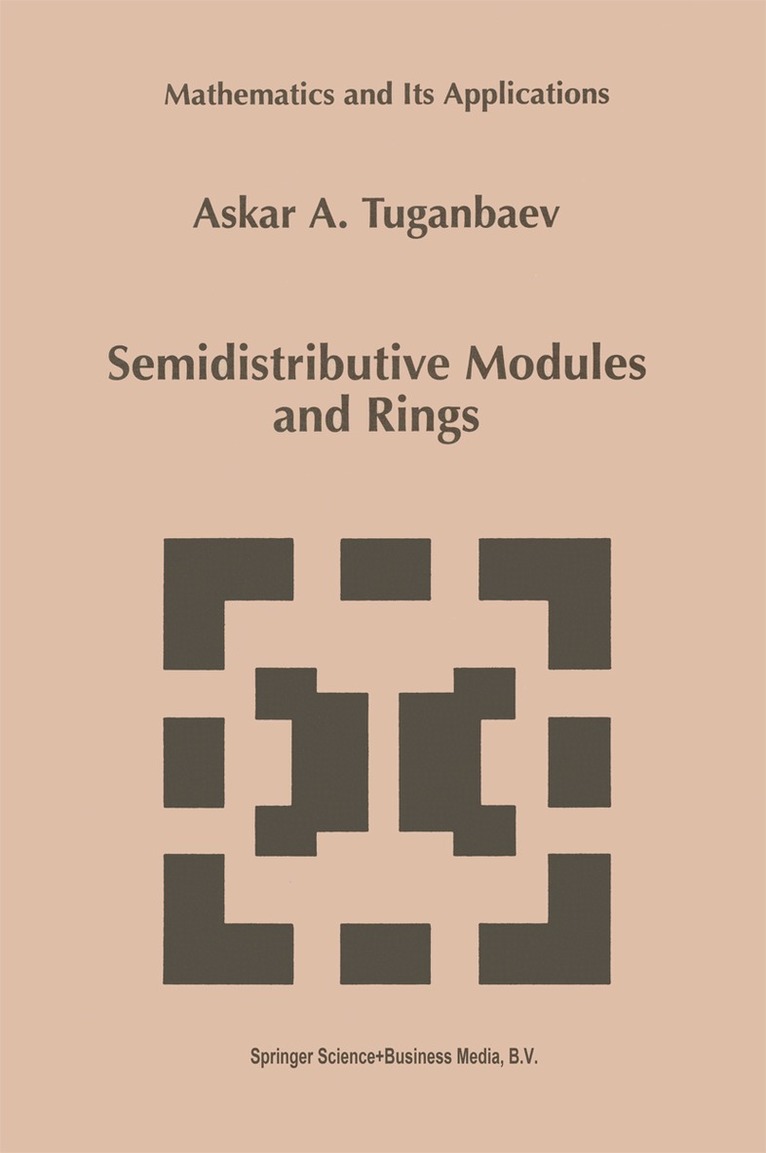
Semidistributive Modules and Rings
Häftad, Engelska, 2012
549 kr
Skickas inom 10-15 vardagar
A module M is called distributive if the lattice Lat(M) of all its submodules is distributive, i.e., Fn(G + H) = FnG + FnH for all submodules F,G, and H of the module M. A module M is called uniserial if all its submodules are comparable with respect to inclusion, i.e., the lattice Lat(M) is a chain. Any direct sum of distributive (resp. uniserial) modules is called a semidistributive (resp. serial) module. The class of distributive (resp. semidistributive) modules properly cont.ains the class ofall uniserial (resp. serial) modules. In particular, all simple (resp. semisimple) modules are distributive (resp. semidistributive). All strongly regular rings (for example, all factor rings of direct products of division rings and all commutative regular rings) are distributive; all valuation rings in division rings and all commutative Dedekind rings (e.g., rings of integral algebraic numbers or commutative principal ideal rings) are distributive. A module is called a Bezout module or a locally cyclic module ifevery finitely generated submodule is cyclic. If all maximal right ideals of a ring A are ideals (e.g., if A is commutative), then all Bezout A-modules are distributive.
E-bok
PDF, Engelska, 2012673 kr
Läs direkt efter köp
A module M is called distributive if the lattice Lat(M) of all its submodules is distributive, i.e., Fn(G + H) = FnG + FnH for all submodules F,G, and H of the module M. A module M is called uniserial if all its submodules are comparable with respect to inclusion, i.e., the lattice Lat(M) is a chain. Any direct sum of distributive (resp. uniserial) modules is called a semidistributive (resp. serial) module. The class of distributive (resp. semidistributive) modules properly cont.ains the class ofall uniserial (resp. serial) modules. In particular, all simple (resp. semisimple) modules are distributive (resp. semidistributive). All strongly regular rings (for example, all factor rings of direct products of division rings and all commutative regular rings) are distributive; all valuation rings in division rings and all commutative Dedekind rings (e.g., rings of integral algebraic numbers or commutative principal ideal rings) are distributive. A module is called a Bezout module or a locally cyclic module ifevery finitely generated submodule is cyclic. If all maximal right ideals of a ring A are ideals (e.g., if A is commutative), then all Bezout A-modules are distributive.
E-bok
PDF, Engelska, 2013687 kr
Läs direkt efter köp
Preface All rings are assumed to be associative and (except for nilrings and some stipulated cases) to have nonzero identity elements. A ring A is said to be regular if for every element a E A, there exists an element b E A with a = aba. Regular rings are well studied. For example, [163] and [350] are devoted to regular rings. A ring A is said to be tr-regular if for every element a E A, there is an element n b E A such that an = anba for some positive integer n. A ring A is said to be strongly tr-regular if for every a E A, there is a positive integer n with n 1 n an E a + An Aa +1. It is proved in [128] that A is a strongly tr-regular ring if and only if for every element a E A, there is a positive integer m with m 1 am E a + A. Every strongly tr-regular ring is tr-regular [38]. If F is a division ring and M is a right vector F-space with infinite basis {ei}~l'' then End(MF) is a regular (and tr-regular) ring that is not strongly tr-regular. The factor ring of the ring of integers with respect to the ideal generated by the integer 4 is a strongly tr-regular ring that is not regular.
E-bok
PDF, Engelska, 2013687 kr
Läs direkt efter köp
Every Abelian group can be related to an associative ring with an identity element, the ring of all its endomorphisms. Recently the theory of endomor phism rings of Abelian groups has become a rapidly developing area of algebra. On the one hand, it can be considered as a part of the theory of Abelian groups; on the other hand, the theory can be considered as a branch of the theory of endomorphism rings of modules and the representation theory of rings. There are several reasons for studying endomorphism rings of Abelian groups: first, it makes it possible to acquire additional information about Abelian groups themselves, to introduce new concepts and methods, and to find new interesting classes of groups; second, it stimulates further develop ment of the theory of modules and their endomorphism rings. The theory of endomorphism rings can also be useful for studies of the structure of additive groups of rings, E-modules, and homological properties of Abelian groups. The books of Baer [52] and Kaplansky [245] have played an important role in the early development of the theory of endomorphism rings of Abelian groups and modules. Endomorphism rings of Abelian groups are much stu died in monographs of Fuchs [170], [172], and [173]. Endomorphism rings are also studied in the works of Kurosh [287], Arnold [31], and Benabdallah [63].