Environmental economics is growing rapidly. It is simply not sufficient to consider consumption, production, and welfare in isolation from the natural environment. Integrating ecological systems in economic analysis requires to take the possible occurrence of tipping points or regime shifts into account. This Element focuses on two recent developments in environmental economics theory. One is economic management of ecological systems with tipping points, with the lake as the classical example. The other one is investigating the consequences of uncertain possible shocks to parameters in economic models, with the carrying capacity in a fishery and total factor productivity (due to climate tipping) in Ramsey growth as examples. This Element provides a precise account of the concepts, techniques, and results in the analysis of these models, which shows the effects of tipping and allows for other applications. This Element starts with a broader list of examples and management options.
In this book, distinguished scholars from Europe and the US examine a range of topical issues in environmental and resource economics. Employing cutting-edge tools, they take a fresh look at some of the most significant international and domestic issues at the forefront of public policy debates.The volume has two main themes: environmental policy making within a federalist context and valuation issues, including experimental design. Beyond this, the sixteen chapters give an overview of recent developments in the field and present important new views on pressing policy issues. Many of the chapters offer innovative approaches and contain original empirical or experimental evidence which may have considerable implications for environmental policy. As a whole, the volume provides the reader with a keen understanding of some of the most important theoretical and empirical work in environmental federalism, valuation and a number of other pertinent areas.This book extends current thinking and provides a state-of-the-art analysis of recent developments in environmental and resource economics. It will be indispensable for students, scholars and researchers in environmental economics and anyone wishing to remain at the frontier of advances in this arena.
Del 27 - WORLD SCIENTIFIC LECTURE NOTES IN ECONOMICS AND POLICY
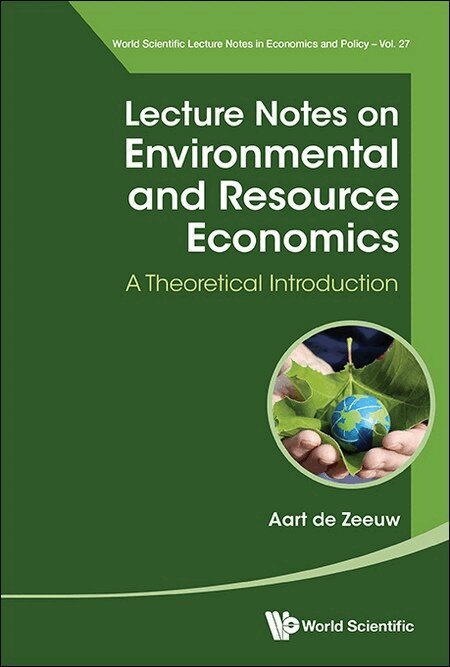
This set of lecture notes contains basic theory in environmental and resource economics. It covers not only the traditional topics pollution targets and instruments, renewable and non-renewable resources, growth, trade, and valuation, but also the newer topics international aspects, stock pollution and tipping points. The lectures focus on the main concepts, models, and results in the core areas of environmental and resource economics, and form the basis for extensions, applications, and policy issues in the courses.The book is compact and can serve as a basic text for a course in environmental and resource economics at the advanced undergraduate level. It can also be useful as a reference text at the graduate level or for research. The mathematics in the main text is elementary, with more advanced mathematical analyses in the appendices. The book provides a precise account of the essentials in environmental and resource economics.
Del 27 - WORLD SCIENTIFIC LECTURE NOTES IN ECONOMICS AND POLICY
This set of lecture notes contains basic theory in environmental and resource economics. It covers not only the traditional topics pollution targets and instruments, renewable and non-renewable resources, growth, trade, and valuation, but also the newer topics international aspects, stock pollution and tipping points. The lectures focus on the main concepts, models, and results in the core areas of environmental and resource economics, and form the basis for extensions, applications, and policy issues in the courses.The book is compact and can serve as a basic text for a course in environmental and resource economics at the advanced undergraduate level. It can also be useful as a reference text at the graduate level or for research. The mathematics in the main text is elementary, with more advanced mathematical analyses in the appendices. The book provides a precise account of the essentials in environmental and resource economics.