A.C. Peterson – författare
Visar alla böcker från författaren A.C. Peterson. Handla med fri frakt och snabb leverans.
7 produkter
7 produkter
Inbunden, Engelska, 1983
1 576 kr
Skickas inom 10-15 vardagar
The publication of this volume at this time appears particularly auspi cious. Biological, psychological, and social change is greater during the pubertal years than at any other period since infancy. While the past two decades have witnessed a virtual explosion of productive research on the first years of life, until recently research on adolescence, and particularly on puberty and early adolescence, has lagged substantially behind. This book provides encouraging evidence that things are changing for the better. Considered separately, the individual chapters in this book include important contributions to our growing knowledge of the biological mechanisms involved in pubertal onset and subsequent changes, as well as of the psychological and social aspects of these changes, both as con sequences and determinants. In this regard, the book clearly benefits from the breadth of disciplines represented by the contributors, includ ing developmental endocrinology, adolescent medicine, pediatrics, psy chology, and sociology, among others.
Inbunden, Engelska, 1996
3 237 kr
Skickas inom 10-15 vardagar
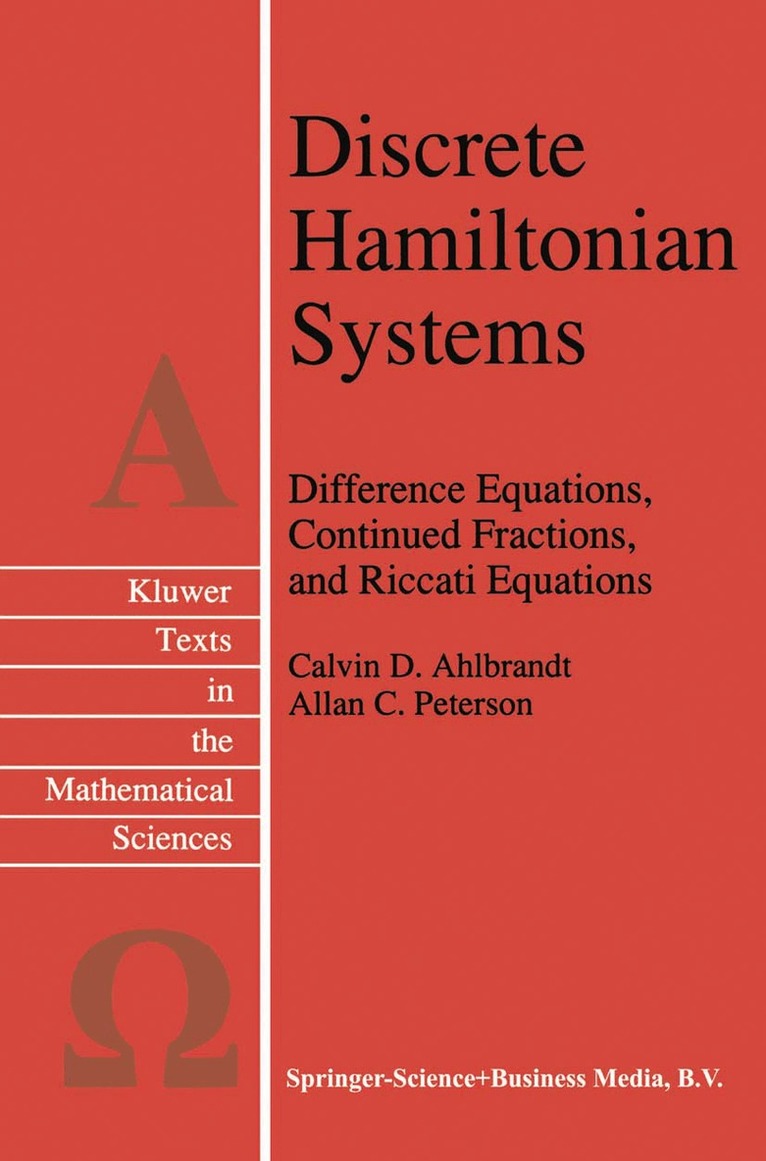
This book should be accessible to students who have had a first course in matrix theory. The existence and uniqueness theorem of Chapter 4 requires the implicit function theorem, but we give a self-contained constructive proof ofthat theorem. The reader willing to accept the implicit function theorem can read the book without an advanced calculus background. Chapter 8 uses the Moore-Penrose pseudo-inverse, but is accessible to students who have facility with matrices. Exercises are placed at those points in the text where they are relevant. For U. S. universities, we intend for the book to be used at the senior undergraduate level or beginning graduate level. Chapter 2, which is on continued fractions, is not essential to the material of the remaining chapters, but is intimately related to the remaining material. Continued fractions provide closed form representations of the extreme solutions of some discrete matrix Riccati equations. Continued fractions solution methods for Riccati difference equations provide an approach analogous to series solution methods for linear differential equations. The book develops several topics which have not been available at this level. In particular, the material of the chapters on continued fractions (Chapter 2), symplectic systems (Chapter 3), and discrete variational theory (Chapter 4) summarize recent literature. Similarly, the material on transforming Riccati equations presented in Chapter 3 gives a self-contained unification of various forms of Riccati equations. Motivation for our approach to difference equations came from the work of Harris, Vaughan, Hartman, Reid, Patula, Hooker, Erbe & Van, and Bohner.
Del 16 - Texts in the Mathematical Sciences
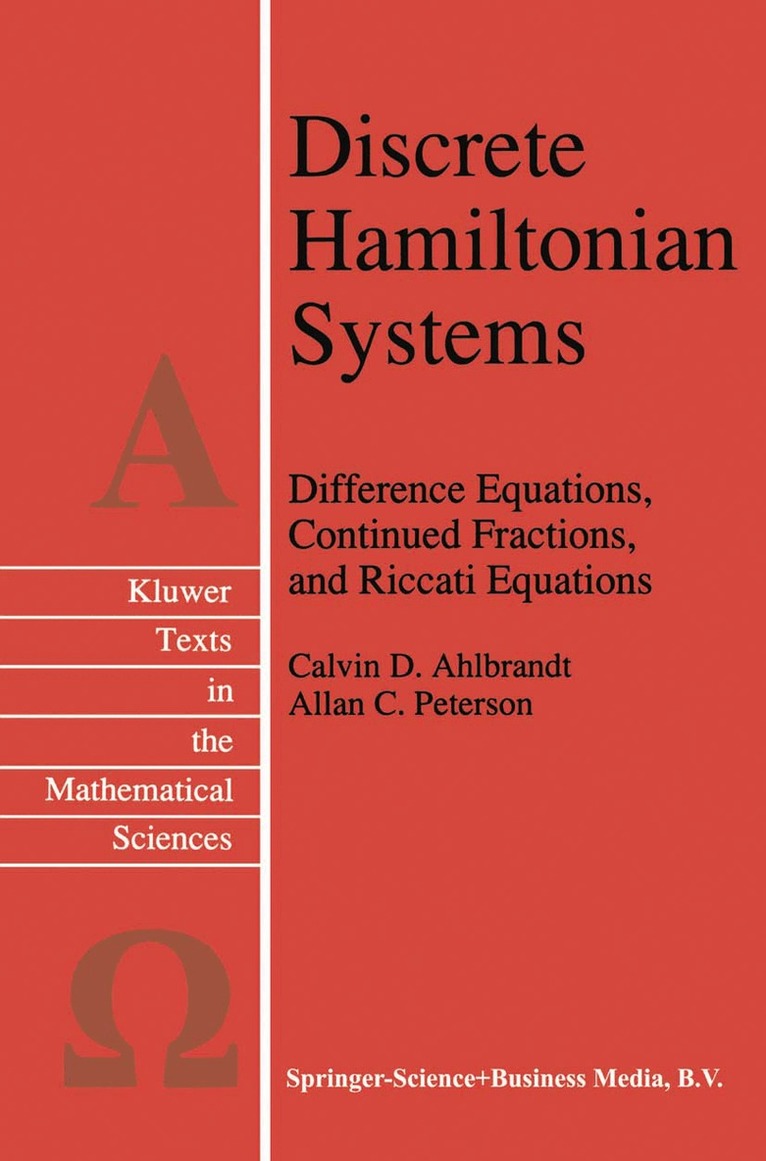
Discrete Hamiltonian Systems
Difference Equations, Continued Fractions, and Riccati Equations
Häftad, Engelska, 2010
3 237 kr
Skickas inom 10-15 vardagar
This book should be accessible to students who have had a first course in matrix theory. The existence and uniqueness theorem of Chapter 4 requires the implicit function theorem, but we give a self-contained constructive proof ofthat theorem. The reader willing to accept the implicit function theorem can read the book without an advanced calculus background. Chapter 8 uses the Moore-Penrose pseudo-inverse, but is accessible to students who have facility with matrices. Exercises are placed at those points in the text where they are relevant. For U. S. universities, we intend for the book to be used at the senior undergraduate level or beginning graduate level. Chapter 2, which is on continued fractions, is not essential to the material of the remaining chapters, but is intimately related to the remaining material. Continued fractions provide closed form representations of the extreme solutions of some discrete matrix Riccati equations. Continued fractions solution methods for Riccati difference equations provide an approach analogous to series solution methods for linear differential equations. The book develops several topics which have not been available at this level. In particular, the material of the chapters on continued fractions (Chapter 2), symplectic systems (Chapter 3), and discrete variational theory (Chapter 4) summarize recent literature. Similarly, the material on transforming Riccati equations presented in Chapter 3 gives a self-contained unification of various forms of Riccati equations. Motivation for our approach to difference equations came from the work of Harris, Vaughan, Hartman, Reid, Patula, Hooker, Erbe & Van, and Bohner.
E-bok
PDF, Engelska, 20133 948 kr
Läs direkt efter köp
This book should be accessible to students who have had a first course in matrix theory. The existence and uniqueness theorem of Chapter 4 requires the implicit function theorem, but we give a self-contained constructive proof ofthat theorem. The reader willing to accept the implicit function theorem can read the book without an advanced calculus background. Chapter 8 uses the Moore-Penrose pseudo-inverse, but is accessible to students who have facility with matrices. Exercises are placed at those points in the text where they are relevant. For U. S. universities, we intend for the book to be used at the senior undergraduate level or beginning graduate level. Chapter 2, which is on continued fractions, is not essential to the material of the remaining chapters, but is intimately related to the remaining material. Continued fractions provide closed form representations of the extreme solutions of some discrete matrix Riccati equations. Continued fractions solution methods for Riccati difference equations provide an approach analogous to series solution methods for linear differential equations. The book develops several topics which have not been available at this level. In particular, the material of the chapters on continued fractions (Chapter 2), symplectic systems (Chapter 3), and discrete variational theory (Chapter 4) summarize recent literature. Similarly, the material on transforming Riccati equations presented in Chapter 3 gives a self-contained unification of various forms of Riccati equations. Motivation for our approach to difference equations came from the work of Harris, Vaughan, Hartman, Reid, Patula, Hooker, Erbe & Van, and Bohner.
Engelska, 2013
625 kr
Skickas inom 5-8 vardagar
E-bok
PDF, Engelska, 20131 992 kr
Läs direkt efter köp
The publication of this volume at this time appears particularly auspi cious. Biological, psychological, and social change is greater during the pubertal years than at any other period since infancy. While the past two decades have witnessed a virtual explosion of productive research on the first years of life, until recently research on adolescence, and particularly on puberty and early adolescence, has lagged substantially behind. This book provides encouraging evidence that things are changing for the better. Considered separately, the individual chapters in this book include important contributions to our growing knowledge of the biological mechanisms involved in pubertal onset and subsequent changes, as well as of the psychological and social aspects of these changes, both as con sequences and determinants. In this regard, the book clearly benefits from the breadth of disciplines represented by the contributors, includ ing developmental endocrinology, adolescent medicine, pediatrics, psy chology, and sociology, among others.
Häftad, Engelska, 2013
1 576 kr
Skickas inom 10-15 vardagar
The publication of this volume at this time appears particularly auspi cious. Biological, psychological, and social change is greater during the pubertal years than at any other period since infancy. While the past two decades have witnessed a virtual explosion of productive research on the first years of life, until recently research on adolescence, and particularly on puberty and early adolescence, has lagged substantially behind. This book provides encouraging evidence that things are changing for the better. Considered separately, the individual chapters in this book include important contributions to our growing knowledge of the biological mechanisms involved in pubertal onset and subsequent changes, as well as of the psychological and social aspects of these changes, both as con sequences and determinants. In this regard, the book clearly benefits from the breadth of disciplines represented by the contributors, includ ing developmental endocrinology, adolescent medicine, pediatrics, psy chology, and sociology, among others.