Achim Menges - Böcker
Visar alla böcker från författaren Achim Menges. Handla med fri frakt och snabb leverans.
10 produkter
10 produkter
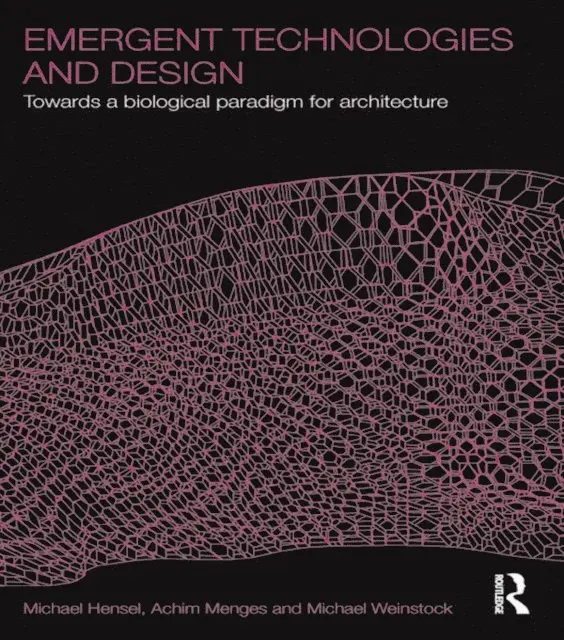
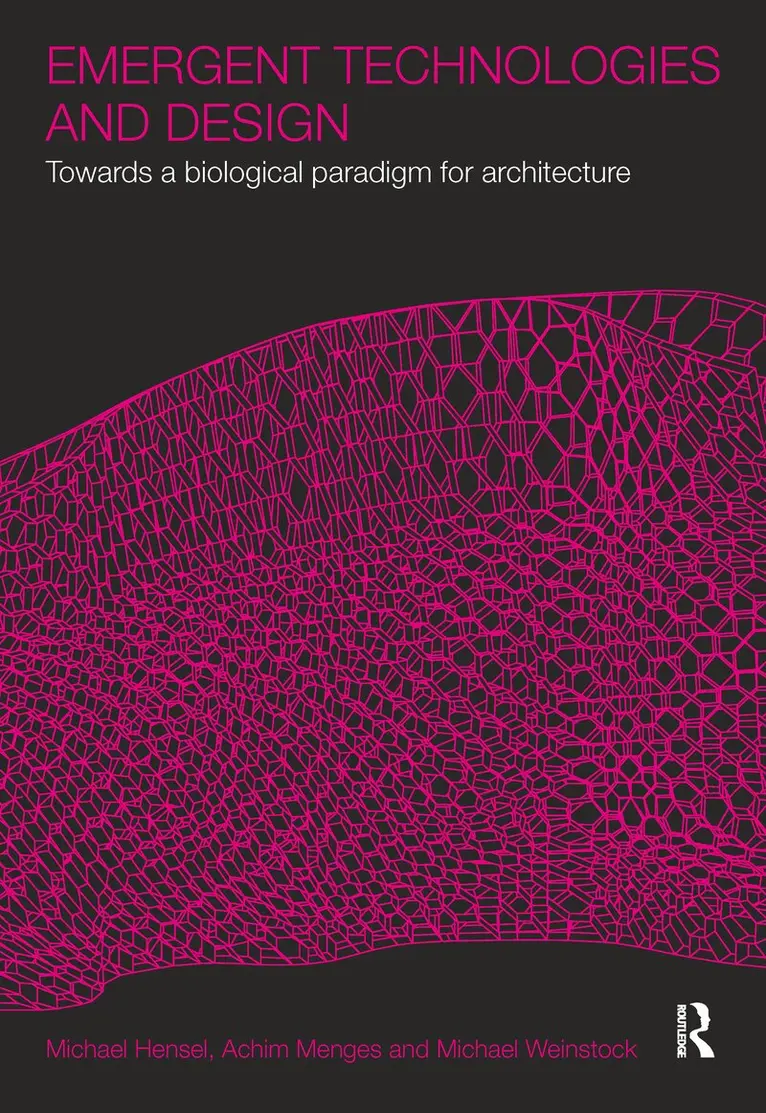
Emergent Technologies and Design
Towards a Biological Paradigm for Architecture
Häftad, Engelska, 2010
833 kr
Skickas inom 7-10 vardagar
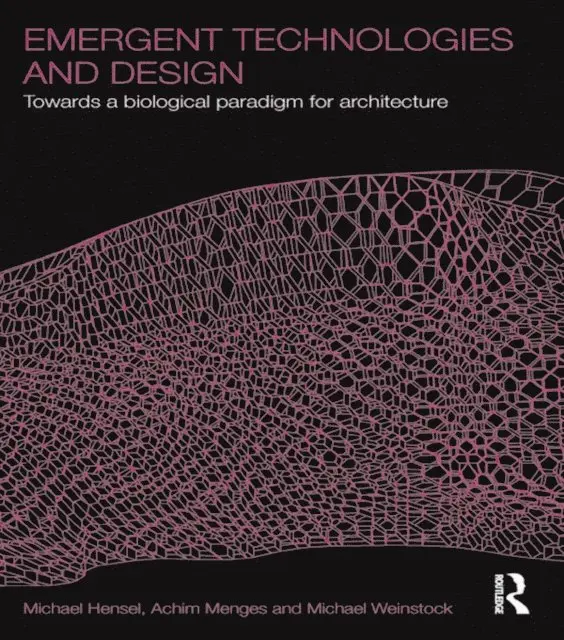
Emergence - the process by which new and coherent structures, patterns and properties ‘emerge’ from within complex systemsTraditional architecture starts from the premise that architectural structures are singular and fixed, and however well integrated are separate from their environment and context. Emergence requires that the opposite is true – that those structures are complex energy and material systems that have a lifespan, exist as part of an environment of other active systems, and develop in an evolutionary way.This book, based on the authors’ internationally renowned Emergent Technologies and Design course at the Architectural Association in London, introduces a new approach to the practice of architecture. The authors use essays and projects to demonstrate the interrelationship of concepts such as emergence and self-organisation with the latest technologies in design, manufacturing and construction.With projects from their course, and critiques and commentary from some of the world’s leading design theorists and practitioners, the authors of Emergent Technologies and Design have introduced a radical new way of understanding the way in which architecture is conceived, designed and produced.
900 kr
Tillfälligt slut
509 kr
Skickas inom 11-20 vardagar
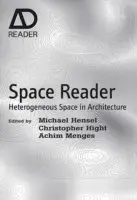
The Space Reader provides a highly pertinent and contemporary understanding of space for a new generation of students and architects. It espouses a definition of space that is heterogeneous (an object or system consisting of a diverse range of different items). An example of heterogeneous space, for instance, is Manhattan where complex and multiple social and technological conditions are overlaid. (This is to be contrasted with highly centralised and ordered Modernist cities.) With the onset of globalisation and the Web, heterogeneneous space, with its emphasis on differentiation, is more relevant to the contemporary condition, which encourages the mixing of space, than a much more static conception of Modernist space. This book foregrounds spatial issues and the potential of heterogeneous space through a threefold strategy:1) Its compilation of seminal essays on the discourse of heterogeneous space. These are to include previously published key texts by Reyner Banham, Andrew Benjamin, Robin Evans, Jeff Kipnis and Henri Lefebvre, as well as new texts by important contemporary commentators, such as Mark Cousins, Werner Durth and Anthony Vidler.2) By commenting on these seminal texts and drawing links between them.3) By distilling from the first two efforts a contemporary outlook on a discourse of heterogeneous space that is of future significance.
443 kr
Skickas inom 7-10 vardagar
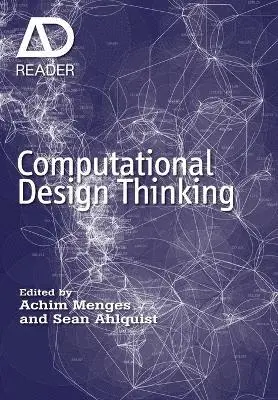
The current transition from Computer Aided Design (CAD) to Computational Design in architecture represents a profound shift in design thinking and methods. Representation is being replaced by simulation, and the crafting of objects is moving towards the generation of integrated systems through designer-authored computational processes. While there is a particular history of such an approach in architecture, its relative newness requires the continued progression of novel modes of design thinking for the architect of the 21st century. This AD Reader establishes a foundation for such thinking. It includes multifaceted reflections and speculations on the profound influence of computational paradigms on architecture. It presents relevant principles from the domains of mathematics and computer science, developmental and evolutionary biology, system science and philosophy, establishing a discourse for computational design thinking in architecture. Rather than a merely technical approach, the book will discuss essential intellectual concepts that are fundamental not only for a discourse on computational design but also for its practice. This anthology provides a unique collection of seminal texts by authors, who have either provided a significant starting point through which a computational approach to design has been pursued or have played a considerable role in shaping the field. An important aspect of this book is the manner in which adjacent fields and historical texts are connected. Both the source of original inspiration and scientific thought are presented alongside contemporary writings on the continually evolving computational design discourse. Emerging from the field of science, principally the subjects of morphogenesis, evolution and mathematics, selected texts provide a historical basis for a reconfigured mindset of processes that generate, arrange and describe form. Juxtaposed against more contemporary statements regarding the influence of computation on design thinking, the book offers advancements of fundamental texts to the particular purpose of establishing novel thought processes for architecture, theoretically and practically. The first reader to provide an effective framework for computational thinking in design. Includes classic texts by Johan W. von Goethe, D’Arcy Thompson, Ernst Mayr, Ludwig von Bertalanffy, Gordan Pask, Christopher Alexander, John H. Holland, Nicholas Negroponte, William Mitchell, Peter J. Bentley & David W. Corne, Sanford Kwinter, John Frazer, Kostis Terzidis, Michael Weinstock and Achim Menges Features new writing by: Mark Burry, Jane Burry, Manuel DeLanda and Peter Trummer.
1 111 kr
Skickas inom 7-10 vardagar
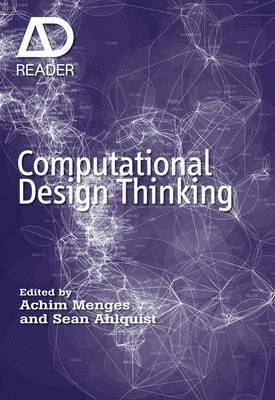
The current transition from Computer Aided Design (CAD) to Computational Design in architecture represents a profound shift in design thinking and methods. Representation is being replaced by simulation, and the crafting of objects is moving towards the generation of integrated systems through designer-authored computational processes. While there is a particular history of such an approach in architecture, its relative newness requires the continued progression of novel modes of design thinking for the architect of the 21st century. This AD Reader establishes a foundation for such thinking. It includes multifaceted reflections and speculations on the profound influence of computational paradigms on architecture. It presents relevant principles from the domains of mathematics and computer science, developmental and evolutionary biology, system science and philosophy, establishing a discourse for computational design thinking in architecture. Rather than a merely technical approach, the book will discuss essential intellectual concepts that are fundamental not only for a discourse on computational design but also for its practice. This anthology provides a unique collection of seminal texts by authors, who have either provided a significant starting point through which a computational approach to design has been pursued or have played a considerable role in shaping the field. An important aspect of this book is the manner in which adjacent fields and historical texts are connected. Both the source of original inspiration and scientific thought are presented alongside contemporary writings on the continually evolving computational design discourse. Emerging from the field of science, principally the subjects of morphogenesis, evolution and mathematics, selected texts provide a historical basis for a reconfigured mindset of processes that generate, arrange and describe form. Juxtaposed against more contemporary statements regarding the influence of computation on design thinking, the book offers advancements of fundamental texts to the particular purpose of establishing novel thought processes for architecture, theoretically and practically. The first reader to provide an effective framework for computational thinking in design. Includes classic texts by Johan W. von Goethe, D’Arcy Thompson, Ernst Mayr, Ludwig von Bertalanffy, Gordan Pask, Christopher Alexander, John H. Holland, Nicholas Negroponte, William Mitchell, Peter J. Bentley & David W. Corne, Sanford Kwinter, John Frazer, Kostis Terzidis, Michael Weinstock and Achim Menges Features new writing by: Mark Burry, Jane Burry, Manuel DeLanda and Peter Trummer.
2 653 kr
Skickas inom 10-15 vardagar
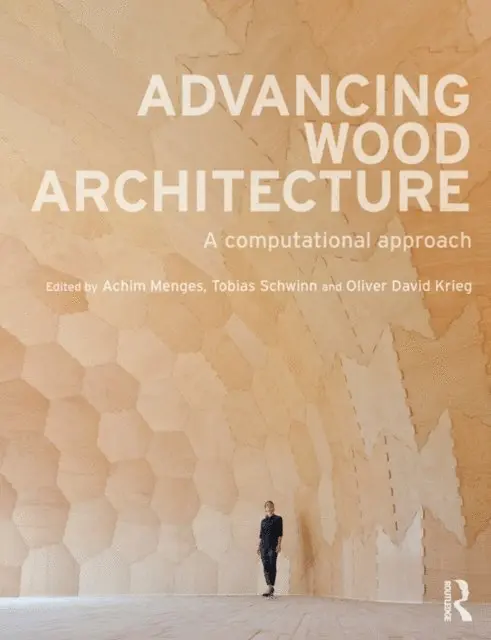
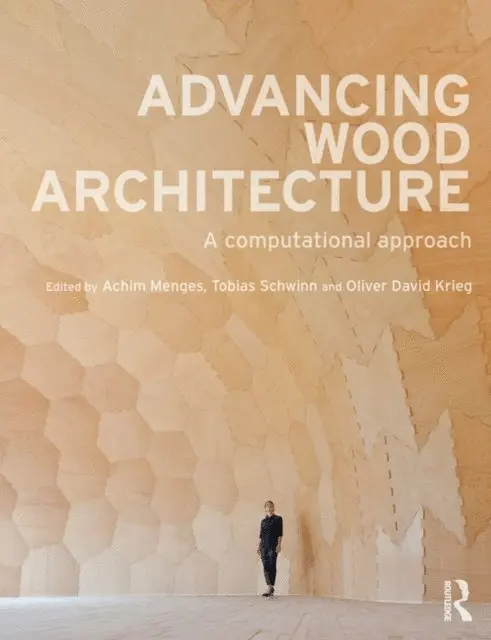
In light of environmental challenges architecture is facing, wood is no longer regarded as outmoded, nostalgic, and rooted in the past, but increasingly recognized as one of the most promising building materials for the future. Recent years have seen unprecedented innovation of new technologies for advancing wood architecture.Advancing Wood Architecture offers a comprehensive overview of the new architectural possibilities that are enabled by cutting-edge computational technologies in wood construction. It provides both an overarching architectural understanding and in-depth technological information through built projects and the works of four leading design research groups in Europe. The projects presented include large scale, permanent buildings such as the ETH Arch-Tec Lab Building in Zurich, the Landesgartenschau Exhibition Hall near Stuttgart and the Boiler House in Hooke Park, UK, as well as, built research prototypes investigating additive robotic fabrication, folded plate structures and meteorosensitive building skins. Illustrated in full colour, the book showcases the latest technological developments in design computation, simulation and digital fabrication together with an architectural, engineering and manufacturing perspective, offering an outlook towards novel spatial and constructional opportunities of a material with unrivalled ecological virtues.
780 kr
Skickas inom 10-15 vardagar
In light of environmental challenges architecture is facing, wood is no longer regarded as outmoded, nostalgic, and rooted in the past, but increasingly recognized as one of the most promising building materials for the future. Recent years have seen unprecedented innovation of new technologies for advancing wood architecture.Advancing Wood Architecture offers a comprehensive overview of the new architectural possibilities that are enabled by cutting-edge computational technologies in wood construction. It provides both an overarching architectural understanding and in-depth technological information through built projects and the works of four leading design research groups in Europe. The projects presented include large scale, permanent buildings such as the ETH Arch-Tec Lab Building in Zurich, the Landesgartenschau Exhibition Hall near Stuttgart and the Boiler House in Hooke Park, UK, as well as, built research prototypes investigating additive robotic fabrication, folded plate structures and meteorosensitive building skins. Illustrated in full colour, the book showcases the latest technological developments in design computation, simulation and digital fabrication together with an architectural, engineering and manufacturing perspective, offering an outlook towards novel spatial and constructional opportunities of a material with unrivalled ecological virtues.
607 kr
Skickas inom 7-10 vardagar
614 kr
Skickas inom 5-8 vardagar
How can the fundamental digital change taking place in design and construction be actively used to bring about cultural change in architecture? By exploring robotic production methods and innovative material developments, Achim Menges and Jan Knippers have succeeded in developing genuine digital building systems that combine architectural elegance with effective construction. The book provides an insight into ten years of joint research at the ICD and ITKE Institutes of Stuttgart University. Taking completed pavilions and buildings as examples, the authors demonstrate the viability of the underlying hypotheses that impressively push the limits of construction. Articles from international experts contribute to the current debate on architecture.
786 kr
Skickas inom 7-10 vardagar
This book contains 34 technical papers presented at the Advances in Architectural Geometry Conference held in Stuttgart 2023. Modern geometric computing increasingly plays a role in modeling environments and processing sensing information, providing a variety of tools for the efficient design, analysis, and manufacturing of complex shapes. The research area of architectural geometry (AG) has emerged at the common border of architecture, applied geometry, computational design, mathematics, and manufacturing. This book presents the state of the art of research in AG.