Adam Arvidsson - Böcker
Visar alla böcker från författaren Adam Arvidsson. Handla med fri frakt och snabb leverans.
10 produkter
10 produkter
794 kr
Skickas inom 7-10 vardagar
A more ethical economic system is now possible, one that rectifies the crisis spots of our current downturn while balancing the injustices of extreme poverty and wealth. Adam Arvidsson and Nicolai Peitersen, a scholar and an entrepreneur, outline the shape such an economy might take, identifying its origins in innovations already existent in our production, valuation, and distribution systems. Much like nineteenth-century entrepreneurs, philosophers, bankers, artisans, and social organizers who planned a course for modern capitalism that was more economically efficient and ethically desirable, we now have a chance to construct new instruments, institutions, and infrastructure to reverse the trajectory of a quickly deteriorating economic environment. Considering a multitude of emerging phenomena, Arvidsson and Peitersen show wealth creation can be the result of a new kind of social production, and the motivation of continuous capital accumulation can exist in tandem with a new desire to maximize our social impact. Arvidsson and Peitersen argue that financial markets could become a central arena in which diverse ethical concerns are integrated into tangible economic valuations.They suggest that such a common standard has already emerged and that this process is linked to the spread of social media, making it possible to capture the sentiment of value to most people. They ultimately recommend how to build upon these developments to initiate a radical democratization of economic systems and the value decisions they generate.
212 kr
Skickas inom 7-10 vardagar
A more ethical economic system is now possible, one that rectifies the crisis spots of our current downturn while balancing the injustices of extreme poverty and wealth. Adam Arvidsson and Nicolai Peitersen, a scholar and an entrepreneur, outline the shape such an economy might take, identifying its origins in innovations already existent in our production, valuation, and distribution systems. Much like nineteenth-century entrepreneurs, philosophers, bankers, artisans, and social organizers who planned a course for modern capitalism that was more economically efficient and ethically desirable, we now have a chance to construct new instruments, institutions, and infrastructure to reverse the trajectory of a quickly deteriorating economic environment. Considering a multitude of emerging phenomena, Arvidsson and Peitersen show wealth creation can be the result of a new kind of social production, and the motivation of continuous capital accumulation can exist in tandem with a new desire to maximize our social impact. Arvidsson and Peitersen argue that financial markets could become a central arena in which diverse ethical concerns are integrated into tangible economic valuations.They suggest that such a common standard has already emerged and that this process is linked to the spread of social media, making it possible to capture the sentiment of value to most people. They ultimately recommend how to build upon these developments to initiate a radical democratization of economic systems and the value decisions they generate.
2 219 kr
Skickas inom 10-15 vardagar
In Marketing Modernity, Adam Arvidsson traces the development of Italy's postmodern consumer culture from the 1920s to the present day. In so doing, Arvidsson argues that the culture of consumption we see in Italy today has its direct roots in the social vision articulated by the advertising industry in the years following the First World War. He then goes on to discuss how that vision was further elaborated by advertising's interaction with subsequent big discourses in Twentieth Century Italy: fascism, post-war mass political parties and the counter-culture of the 1960s and 1970s. Based on a wide range of primary sources, this fascinating book takes an innovative historical approach to the study of consumption.
2 150 kr
Skickas inom 10-15 vardagar
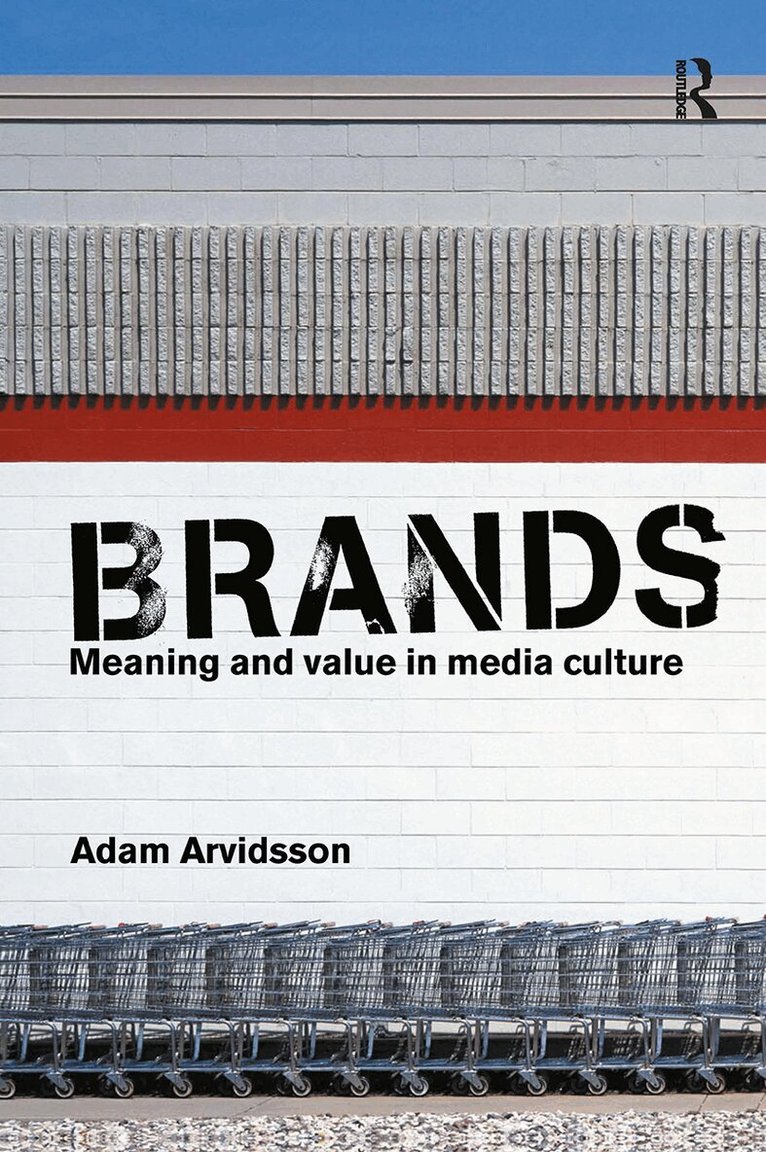
Drawing on rich empirical material, this revealing book builds up a critical theory, arguing that brands have become an important tool for transforming everyday life into economic value. When branding lifestyles or value complexes onto their products, companies assume that consumers desire products for their ability to give meaning to their lives. Yet, brands also have a key function within managerial strategy. Examining the history of audience and market research, marketing thought and advertising strategy; the first part of this book traces the historical development of branding, whilst the second part evaluates new media, contemporary management and overall media economics to present the first systematic theory of brands: the brand as a key institution in information capitalism. It includes chapters on:consumptionmarketingbrand managementonline branding the brand as informational capital.Richly illustrated with case studies from market research, advertising, shop displays, mobile phones, the internet and virtual companies, this outstanding book is essential reading for students and researchers of the sociology of media, cultural studies, advertising and consumer studies and marketing.
747 kr
Skickas inom 10-15 vardagar
Drawing on rich empirical material, this revealing book builds up a critical theory, arguing that brands have become an important tool for transforming everyday life into economic value. When branding lifestyles or value complexes onto their products, companies assume that consumers desire products for their ability to give meaning to their lives. Yet, brands also have a key function within managerial strategy. Examining the history of audience and market research, marketing thought and advertising strategy; the first part of this book traces the historical development of branding, whilst the second part evaluates new media, contemporary management and overall media economics to present the first systematic theory of brands: the brand as a key institution in information capitalism. It includes chapters on:consumptionmarketingbrand managementonline branding the brand as informational capital.Richly illustrated with case studies from market research, advertising, shop displays, mobile phones, the internet and virtual companies, this outstanding book is essential reading for students and researchers of the sociology of media, cultural studies, advertising and consumer studies and marketing.
1 117 kr
Skickas inom 7-10 vardagar
New and updated English translation of the highly successful book on digital mediaThis book introduces readers to the vast and rich world of digital media. It provides a strong starting point for understanding digital media’s social and political significance to our culture and the culture of others—drawing on an emergent and increasingly rich set of empirical and theoretical studies on the role and development of digital media in contemporary societies. Touching on the core points behind the discipline, the book addresses a wide range of topics, including media economics, online cooperation, open source, social media, software production, globalization, brands, marketing, the cultural industry, labor, and consumption.Presented in six sections—Media and Digital Technologies; The Information Society; Cultures and Identities; Digital Collaboration; Public Sphere and Power; Digital Economies—the book offers in-depth chapter coverage of new and old media; network infrastructure; networked economy and globalization; the history of information technologies; the evolution of networks; sociality and digital media; media and identity; collaborative media; open source and innovation; politics and democracy; social movements; surveillance and control; digital capitalism; global inequalities and development; and more. Delivers a reliable, compact and quick introduction to the core issues analyzed by digital culture studies and sociology of information societiesInterweaves main topics and theories with several examples and up-to-date case studies, often linked to our everyday lives on the internet, as well as suggestions for further readingsAnchors examples to discussions of the main sociological, political, and anthropological theoretical approaches at stake to help students make sense of the changes brought about by digital mediaUses critical sociological and political theory alongside every day examples to discuss concepts such as online sociality, digital labor, digital value creation, and the reputation economyClear and concise throughout, Introduction to Digital Media is an excellent primer for those teaching and studying digital culture and media.
367 kr
Skickas inom 7-10 vardagar
New and updated English translation of the highly successful book on digital mediaThis book introduces readers to the vast and rich world of digital media. It provides a strong starting point for understanding digital media’s social and political significance to our culture and the culture of others—drawing on an emergent and increasingly rich set of empirical and theoretical studies on the role and development of digital media in contemporary societies. Touching on the core points behind the discipline, the book addresses a wide range of topics, including media economics, online cooperation, open source, social media, software production, globalization, brands, marketing, the cultural industry, labor, and consumption.Presented in six sections—Media and Digital Technologies; The Information Society; Cultures and Identities; Digital Collaboration; Public Sphere and Power; Digital Economies—the book offers in-depth chapter coverage of new and old media; network infrastructure; networked economy and globalization; the history of information technologies; the evolution of networks; sociality and digital media; media and identity; collaborative media; open source and innovation; politics and democracy; social movements; surveillance and control; digital capitalism; global inequalities and development; and more. Delivers a reliable, compact and quick introduction to the core issues analyzed by digital culture studies and sociology of information societiesInterweaves main topics and theories with several examples and up-to-date case studies, often linked to our everyday lives on the internet, as well as suggestions for further readingsAnchors examples to discussions of the main sociological, political, and anthropological theoretical approaches at stake to help students make sense of the changes brought about by digital mediaUses critical sociological and political theory alongside every day examples to discuss concepts such as online sociality, digital labor, digital value creation, and the reputation economyClear and concise throughout, Introduction to Digital Media is an excellent primer for those teaching and studying digital culture and media.
747 kr
Skickas inom 10-15 vardagar
In Marketing Modernity, Adam Arvidsson traces the development of Italy's postmodern consumer culture from the 1920s to the present day. In so doing, Arvidsson argues that the culture of consumption we see in Italy today has its direct roots in the social vision articulated by the advertising industry in the years following the First World War. He then goes on to discuss how that vision was further elaborated by advertising's interaction with subsequent big discourses in Twentieth Century Italy: fascism, post-war mass political parties and the counter-culture of the 1960s and 1970s. Based on a wide range of primary sources, this fascinating book takes an innovative historical approach to the study of consumption.
640 kr
Skickas inom 7-10 vardagar
This book argues that, as industrial capitalism enters a period of prolonged crisis, a new paradigm of ‘industrious modernity’ is emerging. Based on small-scale, commons-based and market-oriented entrepreneurship, this industrious modernity is being pioneered by the many outcasts that no longer find a place within a crumbling industrial modernity. This new industriousness draws on the new planetary commons that have been generated by the globalization of industrial capitalism itself. The outsourcing of material production to global supply chains has made the skills necessary to engage in commodity production generic and common, and the globalization of media culture and the internet have generated new knowledge commons. Together these new commons have radically reduced the capital requirements to engage in economic activity, and are providing new, highly efficient tools of productive organization at little cost. This timely analysis of the new forces of change in our societies today will be of great interest to anyone concerned with the impact of digital technologies and the future of capitalism.
217 kr
Skickas inom 7-10 vardagar
This book argues that, as industrial capitalism enters a period of prolonged crisis, a new paradigm of ‘industrious modernity’ is emerging. Based on small-scale, commons-based and market-oriented entrepreneurship, this industrious modernity is being pioneered by the many outcasts that no longer find a place within a crumbling industrial modernity. This new industriousness draws on the new planetary commons that have been generated by the globalization of industrial capitalism itself. The outsourcing of material production to global supply chains has made the skills necessary to engage in commodity production generic and common, and the globalization of media culture and the internet have generated new knowledge commons. Together these new commons have radically reduced the capital requirements to engage in economic activity, and are providing new, highly efficient tools of productive organization at little cost. This timely analysis of the new forces of change in our societies today will be of great interest to anyone concerned with the impact of digital technologies and the future of capitalism.