A.G. Davis Philip - Böcker
Visar alla böcker från författaren A.G. Davis Philip. Handla med fri frakt och snabb leverans.
6 produkter
6 produkter
New Developments in Array Technology and Applications
Proceedings of the 167th Symposium of the International Astronomical Union, Held in the Hague, the Netherlands, August 23-27, 1994
Inbunden, Engelska, 1995
2 101 kr
Skickas inom 10-15 vardagar
This IAU Symposium brought together researchers who use CCDs and arrays, designers and manufacturers of CCDs and array mosaics, and those who write the software to control these devices and to reduce the large amounts of data contained in each frame. At the meeting such topics as plans for applying the new technology to the new large telescopes that have been built recently and those planned in the near future, new developments in infra-red arrays, advances and concerns with the use of CCDs in photometry and spectroscopy and the creation of large mosaics in photometry and spectroscopy, and the creation of large mosaics of chips which allow larger areas of the sky to be covered in a single frame were discussed. There were sessions devoted to the following topics: new developments in CCD technology; new developments in IR detector arrays; direct imaging with CCDs and other arrays; spectroscopy with CCDs and other arrays; and large field imaging with array mosaics. Scientific results of studies made with this technology were covered in the poster sessions. CCD and array detectors have become the detectors of choice at all the world's optical observatories.Such instruments on small university and college telescopes have turned these telescopes into instruments that can now do observations which in the past were done only on the largest telescopes. CCDs and arrays are known as "the people's detector" because of their ability to turn small telescopes into true research instruments. On large telescopes observations can be made of extremely faint and crowded objects that were impossible to observe before the advent of CCD and Array technology. The proceedings of this meeting should be useful to all those who are interested in the design, manufacture and use of CCDs and arrays for astronomical observations.
New Developments in Array Technology and Applications
Proceedings of the 167th Symposium of the International Astronomical Union, held in the Hague, the Netherlands, August 23–27, 1994
Häftad, Engelska, 1995
1 578 kr
Skickas inom 10-15 vardagar
This IAU Symposium brought together researchers who use CCDs and arrays, designers and manufacturers of CCDs and array mosaics, and those who write the software to control these devices and to reduce the large amounts of data contained in each frame. At the meeting such topics as plans for applying the new technology to the new large telescopes that have been built recently and those planned in the near future, new developments in infra-red arrays, advances and concerns with the use of CCDs in photometry and spectroscopy and the creation of large mosaics in photometry and spectroscopy, and the creation of large mosaics of chips which allow larger areas of the sky to be covered in a single frame were discussed. There were sessions devoted to the following topics: new developments in CCD technology; new developments in IR detector arrays; direct imaging with CCDs and other arrays; spectroscopy with CCDs and other arrays; and large field imaging with array mosaics. Scientific results of studies made with this technology were covered in the poster sessions. CCD and array detectors have become the detectors of choice at all the world's optical observatories.Such instruments on small university and college telescopes have turned these telescopes into instruments that can now do observations which in the past were done only on the largest telescopes. CCDs and arrays are known as "the people's detector" because of their ability to turn small telescopes into true research instruments. On large telescopes observations can be made of extremely faint and crowded objects that were impossible to observe before the advent of CCD and Array technology. The proceedings of this meeting should be useful to all those who are interested in the design, manufacture and use of CCDs and arrays for astronomical observations.
2 101 kr
Skickas inom 10-15 vardagar
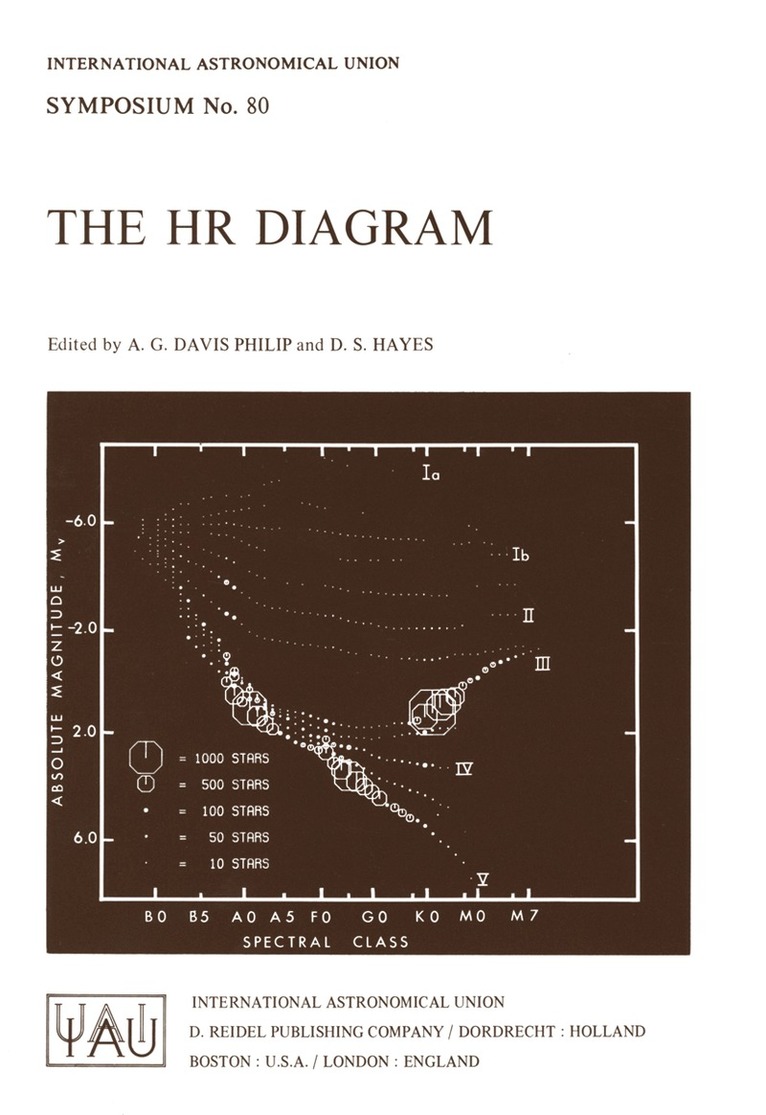
80, The HR Diagram - The 100th Anniversary of Henry Norris Russell was held on November 2-5, 1977 at the National Academy of Sciences in Washington D. The Position of Variable Stars in the Hertzsprung-Russell Diagram, a colloquium held at Bamberg in 1965 and The Hertzsprung Russell Diagram (IAU Symposium No.
2 101 kr
Skickas inom 10-15 vardagar
IAU Symposium No. 80, The HR Diagram - The 100th Anniversary of Henry Norris Russell was held on November 2-5, 1977 at the National Academy of Sciences in Washington D. C. , in order to commemmorate the birth of Henry Norris Russell on October 25, 1877 and to review current problems in the use of the Hertzsprung-Russell diagram. The IAU has sponsored two previous conferences concerned mainly with the HR diagram; The Position of Variable Stars in the Hertzsprung-Russell Diagram, a colloquium held at Bamberg in 1965 and The Hertzsprung Russell Diagram (IAU Symposium No. 10, J. L. Greenstein, ed. ) held in Moscow in 1959. In 1974 a conference, Multicolor Photometry and the Theoretical HR Diagram (Dudley Obs. Report No. 9, A. G. D. Philip and D. S. Hayes, eds. ) was held in Albany, N. Y. ; and in 1964 a conference, Basic Data Pertaining to the Hertzsprung-Russell Diagram, was held at the Flagstaff Station of the U. S. Naval Observatory in honor of Ejnar Hertzsprung and to dedicate the 61-inch astrometric reflector. (Vistas in Astronomy Vol. ~, A. Beer and K. Aa. Strand, eds. , Pergamon Press, Oxford). Volume 12 of Vistas in Astronomy, The Henry Norris Russell Memorial Volume (1970), contains a review paper on Changing Interpretations of the Hertzsprung-Russell Diagram 1910-1940, A Historical Note by B. W. Sitterly.
Calibration of Fundamental Stellar Quantities
Proceedings of the 111th Symposium of the International Astronomical Union held at Villa Olmo, Como, Italy, May 24–29, 1984
Häftad, Engelska, 1985
536 kr
Skickas inom 10-15 vardagar
IAU Symposium No. 111, "Calibration of Fundamental Stellar Quanti- ties", was held at Villa Olmo, Como, Italy, on May 24-29, 1984. Meet- ings held in the past ten years on related topics include: IAU Symposium No. 109, '*Astrometric Techniques", held at the University of Florida in Jan. , 1984, "The MK Process and Stellar Classification", held at the University of Toronto in June, 1983, "Stellar Absolute Energy Distri- butions", an unpublished Joint Meeting (Commissions 25 and 45), held at the General Assembly of the IAU in Patras, Greece in August, 1982, IAU Colloquium No. 62, "Current Techniques in Double and Multiple Star Re- search", held at Northern Arizona University in May, 1981, the ESO Work- fl shop: "Methods of Abundance Determination for Stars , held in Geneva in March, 1980, "Problems of Calibration of Multicolor Photometric Sys tems", held at Dudley Observatory in March, 1979, IAU Colloquium No. 48, "Modern Astrometry", held at the University of Vienna in Sept. , 1978, IAU Colloquium No. 50, "High Angular Resolution Stellar Interferometry" held at the University of Maryland in Aug. , 1978, "Spectral Classifice.- tion of the Future", held at the Vatican in July, 1978 and IAU Sympos- ium No. 72, "Abundance Effects in Classification", held at the Univer- sity of Lausanne in July, 1975. The present meeting was the first to cover the broad range of the calibration of fundamental stellar qU8T". ti- ties in one meeting. Nine commissions of the IAU co-sponsored the meeting.
536 kr
Skickas inom 10-15 vardagar
In the centennial year, 1985-86, of Harlow Shapley's birth, the study of globular clusters was no less important to the development of astronomy than in 1915, when Shapley first noted their concentration on the sky. By 1917 Shapley had used the properties of the system of globular clusters to complete the Copernican revolution and locate the solar system, and its Earth-bound observers, far from the center of the Galaxy and the globular cluster distribution. Seven decades later, in the year of these proceedings, globular cluster research and the study of the system of globular clusters in our own and distant galaxies is undergoing a renaissance of activity. The introduction of new observational tools, particularly CCD imagers and digital spectrographs, as well as powerful theoretical methods have transformed the study of globular clusters into one of the main line areas of modern astrophysics. Thus it seemed particularly appropriate to one of us, when considering how the Harvard College Observatory might mark the Shapley centennial, to propose and plan for an IAU Symposium on Globular Cluster Systems in Galaxies. Planning for the Shapley Symposium, as it came to be called, was even more drawn out than the preparation of this volume. The Symposium was originally proposed to the IAU Secretariat in time for it to be held in August, 1985, so that it might occur in the centennial (calendar) year.