

Agata Stopinska – författare
Visar alla böcker från författaren . Handla med fri frakt och snabb leverans.
2 produkter
2 produkter
Del 1 - Transpekte: Transdisziplinaere Perspektiven der Sozial- und Kulturwissenschaften / Transpects: Transdisciplinary Perspectives of the Social Sciences and Humanities
Discourses of Violence – Violence of Discourses
Critical Interventions, Transgressive Readings, and Post-National Negotiations
Häftad, Engelska, 2005
602 kr
Tillfälligt slut
The issues of violence and its control, containment or overcoming range prominently in the social sciences. Empirical sociology seeks to derive generalizable explanations from its research into concrete cases of the occurrence or absence of violent conflict, aspiring to transform such explanations into instructions for strategic action. Within cultural studies, discursive and epistemic formations are assumed to be fundamentally and endemically violent. In these perspectives, the quotidian violence that ineluctably inheres in modern discourses manifests itself as, e.g., normalisation, privilege and exclusion, thus sharing a wide range of common objects and objectives with the social sciences. The essays collected in this volume address contemporary conjunctures and discourses of violence in world society from different disciplines ranging from cultural studies, social science, political science and philosophy to history, literary criticism and psychology.
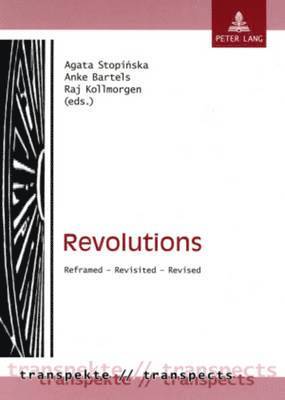
Del 5 - Transpekte: Transdisziplinaere Perspektiven der Sozial- und Kulturwissenschaften / Transpects: Transdisciplinary Perspectives of the Social Sciences and Humanities
Revolutions
Reframed – Revisited – Revised
Häftad, Engelska, 2007
719 kr
Tillfälligt slut
Revolution: Few terms have been as characteristic of the social, political, and intellectual history of the 19th and 20th century as this one. After the «French» and «Industrial Revolution» as well as the «academic and scientific» revolutions and the artistic vanguards from the end of the 19th century onwards, social conflicts have been deeply impregnated by the idea of revolution. «Revolution» was not only regarded in terms of a radical break with the old order swept away in an explosive act of emancipatory practice, but it has often been rejected as a senseless dissolution of all order and as a symptom of social decline. According to neo-conservative and neo-liberal circles, the era of political and social revolutions in world history has ended with the «revolutionary» collapse of state-socialist regimes in Central and Eastern Europe around 1989. Yet recently these diagnoses have been increasingly called into question, both in theory and in practice. «Revolution» has been set on the agenda again as a result of populist and revolutionary movements, the critique of neoliberalism, but also the new intellectual debates about strategies of the Left in a globalized capitalism.