agorad A. Milovanovic - Böcker
Visar alla böcker från författaren agorad A. Milovanovic. Handla med fri frakt och snabb leverans.
8 produkter
8 produkter
1 562 kr
Skickas inom 10-15 vardagar
In bringing to the readers the book 5G Multimedia Communication: Technology, Multiservices and Deployment, the aim is to present current work and direction on the challenging subject of multimedia communications, with theoretical and practical roots. The past two decades have witnessed an extremely fast evolution of mobile cellular network technology. The fifth generation of mobile wireless systems has achieved the first milestone toward finalization and deployment by 2020. This is vital to the development of future multimedia communications. Also, it is necessary to consider 5G technology from the performance point of view by analyzing network capabilities to the operator and to the end user in terms of data rate, capacity, coverage, energy efficiency, connectivity and latency.The book is divided into three major parts with each part containing four to seven chapters: • Critical enabling technology• Multiservices network• Deployment scenariosThe first part discusses enabling technologies, such as green communication, channel modeling, massive and distributed MIMO and ML-based networks. In the second part, different methodologies and standards for multiservices have been discussed. Exclusive chapters have been dedicated to each of the open research challenges such as multimedia operating in 5G environment, network slicing optimization, mobile edge computing, mobile video multicast/broadcast, integrated satellite and drone communication. The third part paved the way to deployment scenarios for different innovative services including integration of a multienergy system in smart cities, intelligent transportation systems, 5G connectivity in the transport sector, healthcare services, 5G edge-based video surveillance and challenges of connectivity for massive IoT in 5G and beyond systems.The book is written by experts in the field who introduced scientific and engineering concepts, covering the 5G multimedia communication areas. The book can be read cover-to-cover or selectively in the areas of interest for the readers. Generally, the book is intended for novel readers who could benefit from understanding general concepts, practitioners who seek guidance into the field and senior-level as well as graduate-level engineering students in understanding the process of today’s wireless multimedia communications.
629 kr
Skickas inom 10-15 vardagar
In bringing to the readers the book 5G Multimedia Communication: Technology, Multiservices and Deployment, the aim is to present current work and direction on the challenging subject of multimedia communications, with theoretical and practical roots. The past two decades have witnessed an extremely fast evolution of mobile cellular network technology. The fifth generation of mobile wireless systems has achieved the first milestone toward finalization and deployment by 2020. This is vital to the development of future multimedia communications. Also, it is necessary to consider 5G technology from the performance point of view by analyzing network capabilities to the operator and to the end user in terms of data rate, capacity, coverage, energy efficiency, connectivity and latency.The book is divided into three major parts with each part containing four to seven chapters: • Critical enabling technology• Multiservices network• Deployment scenariosThe first part discusses enabling technologies, such as green communication, channel modeling, massive and distributed MIMO and ML-based networks. In the second part, different methodologies and standards for multiservices have been discussed. Exclusive chapters have been dedicated to each of the open research challenges such as multimedia operating in 5G environment, network slicing optimization, mobile edge computing, mobile video multicast/broadcast, integrated satellite and drone communication. The third part paved the way to deployment scenarios for different innovative services including integration of a multienergy system in smart cities, intelligent transportation systems, 5G connectivity in the transport sector, healthcare services, 5G edge-based video surveillance and challenges of connectivity for massive IoT in 5G and beyond systems.The book is written by experts in the field who introduced scientific and engineering concepts, covering the 5G multimedia communication areas. The book can be read cover-to-cover or selectively in the areas of interest for the readers. Generally, the book is intended for novel readers who could benefit from understanding general concepts, practitioners who seek guidance into the field and senior-level as well as graduate-level engineering students in understanding the process of today’s wireless multimedia communications.
2 295 kr
Skickas inom 7-10 vardagar
With the rapid evolution of multimedia communications, engineers and other professionals are generally forced to hoard a plethora of different texts and journals to maintain a solid grasp on essential ideas and techniques in the field. Wireless Multimedia Communications provides researchers and students with a primary reference to help readers take maximum advantage of current systems and uncover opportunities to propose new and novel protocols, applications, and services. Extract the Essentials of System Design, Analysis, ImplementationA complete technical reference, the text condenses the essential topics of core wireless multimedia communication technologies, convergence, QoS, and security that apply to everything from networking to communications systems, signal processing, and security. From extensive existing literature, the authors distill the central tenets and primary methods of analysis, design, and implementation, to reflect the latest technologies and architectural concepts. The book addresses emerging challenges to inform the system standardization process and help engineers combat the high error rates and stringent delay constraints that remain a significant challenge to various applications and services. Keep Pace with Detailed Techniques to Optimize TechnologyThe authors identify causes of information loss in point-to-point signal transmission through wireless channels, and then they discuss techniques to minimize that loss. They use examples that illustrate the differences in implementing various systems, ranging from cellular voice telephony to wireless Internet access. Each chapter has been carefully organized with the latest information to serve dual purposes as an easy-to-reference guide for professionals and as a principal text for senior-level university students.
2 306 kr
Skickas inom 10-15 vardagar
Driving 5G Mobile Communications with Artificial Intelligence towards 6G presents current work and directions of continuous innovation and development in multimedia communications with a focus on services and users. The fifth generation of mobile wireless networks achieved the first deployment by 2020, completed the first phase of evolution in 2022, and started transition phase of 5G-Advanced toward the sixth generation. Perhaps one of the most important innovations brought by 5G is the platform-approach to connectivity, i.e., a single standard that can adapt to the heterogeneous connectivity requirements of vastly different use cases. 5G networks contain a list of different requirements, standardized technical specifications and a range of implementation options with spectral efficiency, latency, and reliability as primary performance metrics. Towards 6G, machine learning (ML) and artificial intelligence (AI) methods have recently proposed new approaches to modeling, designing, optimizing and implementing systems. They are now matured technologies that improve many research fields significantly.The area of wireless multimedia communications has developed immensely, generating a large number of concepts, ideas, technical specifications, mobile standards, patents, and articles. Identifying the basic ideas and their complex interconnections becomes increasingly important.The book is divided into three major parts, with each part containing four or five chapters:Advanced 5G communicationMachine learning-based communication and network automationArtificial Intelligence towards 6GThe first part discusses three main scenarios and standard specification of 5G use cases (eMBB, URLLC, mMTC), vehicular systems beyond 5G, and efficient edge architecture on NFV infrastructure. In the second part, different AI/ML-based methodologies and open research challenges are presented in introducing 5G-AIoT artificial intelligence of things, scheduling in 5G/6G communication systems, application of DL techniques to modulation, detection, and channel coding as well as 5G Open Source tools for experimentations and testing. The third part paved the way to deployment scenarios for different innovative services including technologies and applications of 5G/6G intelligent connectivity, AI-assisted eXtended Reality, integrated 5G-IoT architecture in next-generation Smart Grid, privacy requirements in a hyper-connected world, and evaluation of representative 6G use cases and technology trends. The book is written by field experts from Europe and Mauritius who introduce a blend of scientific and engineering concepts covering this emerging wireless communication era. It is a very good reference book for telecom professionals, engineers, and practitioner in various 5G vertical domains and, finally, a basis for student courses in 5G/6G wireless systems.
670 kr
Skickas inom 10-15 vardagar
Driving 5G Mobile Communications with Artificial Intelligence towards 6G presents current work and directions of continuous innovation and development in multimedia communications with a focus on services and users. The fifth generation of mobile wireless networks achieved the first deployment by 2020, completed the first phase of evolution in 2022, and started transition phase of 5G-Advanced toward the sixth generation. Perhaps one of the most important innovations brought by 5G is the platform-approach to connectivity, i.e., a single standard that can adapt to the heterogeneous connectivity requirements of vastly different use cases. 5G networks contain a list of different requirements, standardized technical specifications and a range of implementation options with spectral efficiency, latency, and reliability as primary performance metrics. Towards 6G, machine learning (ML) and artificial intelligence (AI) methods have recently proposed new approaches to modeling, designing, optimizing and implementing systems. They are now matured technologies that improve many research fields significantly.The area of wireless multimedia communications has developed immensely, generating a large number of concepts, ideas, technical specifications, mobile standards, patents, and articles. Identifying the basic ideas and their complex interconnections becomes increasingly important.The book is divided into three major parts, with each part containing four or five chapters:Advanced 5G communicationMachine learning-based communication and network automationArtificial Intelligence towards 6GThe first part discusses three main scenarios and standard specification of 5G use cases (eMBB, URLLC, mMTC), vehicular systems beyond 5G, and efficient edge architecture on NFV infrastructure. In the second part, different AI/ML-based methodologies and open research challenges are presented in introducing 5G-AIoT artificial intelligence of things, scheduling in 5G/6G communication systems, application of DL techniques to modulation, detection, and channel coding as well as 5G Open Source tools for experimentations and testing. The third part paved the way to deployment scenarios for different innovative services including technologies and applications of 5G/6G intelligent connectivity, AI-assisted eXtended Reality, integrated 5G-IoT architecture in next-generation Smart Grid, privacy requirements in a hyper-connected world, and evaluation of representative 6G use cases and technology trends. The book is written by field experts from Europe and Mauritius who introduce a blend of scientific and engineering concepts covering this emerging wireless communication era. It is a very good reference book for telecom professionals, engineers, and practitioner in various 5G vertical domains and, finally, a basis for student courses in 5G/6G wireless systems.
5G NR Modelling in MATLAB
Network Architecture, Protocols, and Physical Layer
Inbunden, Engelska, 2024
2 374 kr
Skickas inom 10-15 vardagar
5G is the fifth generation of wireless technology and NR stands for a new radio interface and radio access technology for cellular networks, i.e., a physical connection method for radio-based communication. It is a powerful platform that supports a wide range of services that includes enhanced mobile broadband, massive machine-type communication and ultra-reliability, and low latency covering several vertical industries such as e-health, transportation, energy, media, and factory automation.This book provides a detailed description of the fundamental aspects of 5G. It gives an in-depth coverage of the network architecture of 5G by considering both the network reference point architecture and the service-based architecture. It also describes all the user and control plane protocols including the standalone and nonstandalone architecture options. The radio access technologies such as the waveforms used in 5G, the multiaccess and duplexing techniques as well as the resource allocation schemes are treated in detail. Additionally, the physical layer signal processing blocks of 5G NR are covered in depth with elaborate numerical examples to illustrate the functioning of each block in the 5G downlink transmitter and receiver chain.The main originality of this book is the detailed illustration of the 5G NR preprocessing steps as well as MATLAB® simulation models with explanations of the codes to allow for a seamless understanding of the principles. In general, this book is meant for anyone with a basic engineering background who would be interested in acquiring a solid foundation in the fundamental concepts of 5G NR.
864 kr
Kommande
Provides an in-depth coverage of the network architecture of 5G by considering both the network reference point architecture and the service-based architecture. It also describes all the user and control plane protocols including the different standalone and non-standalone architecture options of 5G. The radio access technologies such as the waveforms used in 5G, the multi-access and duplexing techniques as well as the resource allocation schemes are treated in details. Additionally, the physical layer signal processing blocks of 5G-NR are covered in depth with elaborate numerical examples to illustrate the functioning of each block in the 5G downlink transmitter and receiver chain.
1 319 kr
Skickas inom 10-15 vardagar
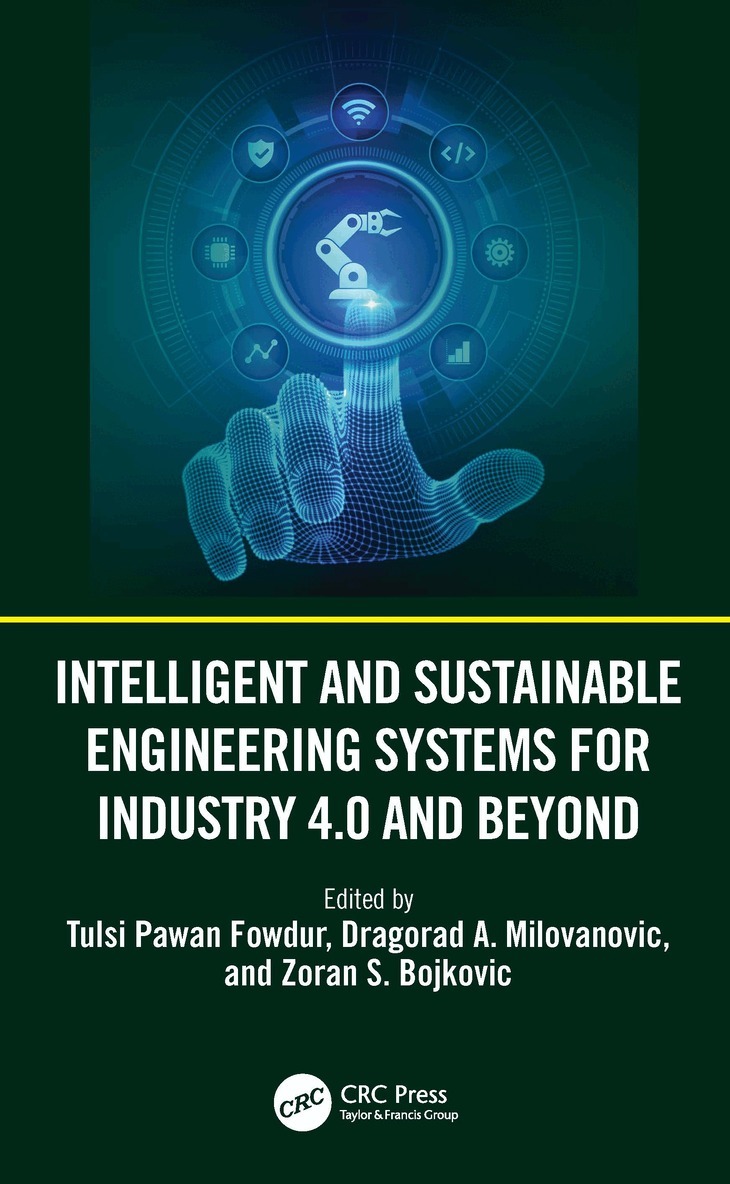
The Fourth Industrial Revolution, Industry 4.0, aims to significantly improve the flexibility, versatility, usability and efficiency of future smart factories. However, the concept of Industry 4.0 is not only limited to the factory but also encompasses the entire life cycle of the product, that is, from production and suppliers, to end users. Industry 4.0 delivers seamless vertical and horizontal integration down the entire value chain and across all layers of the automation pyramid.Industry 4.0 has its roots in a project for the high‑tech strategy of the German Government back in 2011, which led to the progression of cyber-physical systems into cyber-physical production systems (CPPS). CPPS can make intelligent decisions through real‑time communication and cooperation between manufacturing entities. Smart Factory, which is based on CPPS and artificial intelligence (AI), is one of the key associated initiatives of Industry 4.0. This enables flexible production of high‑quality personalized products with mass efficiency. Another important aspect of Industry 4.0 is sustainable engineering systems that can help make its processes align with the United Nations Sustainable Development Goals (UN SDGs). Sustainable and intelligent engineering systems such as 5G, Industrial IoT, robotics and automation, renewable energy, logistics and even intelligent waste management can be the main enablers of Industry 4.0.This is a multidisciplinary book and is meant for anyone with a basic engineering background interested in acquiring a solid foundation in the fundamental concepts and state‑of‑the‑art research trends in Industry 4.0. It explores the application of AI and machine learning as well as sustainable engineering systems, which can be the main drivers for Industry 4.0 and beyond and have a significant impact on the UN SDGs.