Agostino Cilardo – författare
Visar alla böcker från författaren . Handla med fri frakt och snabb leverans.
4 produkter
4 produkter
Inbunden, Engelska, 2005
1 098 kr
Skickas
Part of the JAIS Monographs seriesThe term kalala (meaning leaving no parents or children as heirs) occurs twice in the Qur’an. Wide divergences exist regarding its interpretation both in translations of the Qur’an and amongst scholars, while dictionaries generally pass over its technical meaning.This book discusses the origins of these diverging views regarding collateral inheritance, drawing on early poetry, the works of lexicographers and grammarians, Hadith, Qur’anic commentary, and numerous works of jurisprudence. It demonstrates how the particular interpretation of the term kalala by the law schools enabled jurists to create new rules in areas of inheritance law that were not covered by Qur’anic provisions and which may not correspond to the original intention of Muhammad.
Inbunden, Engelska, 2012
532 kr
Skickas inom 10-15 vardagar
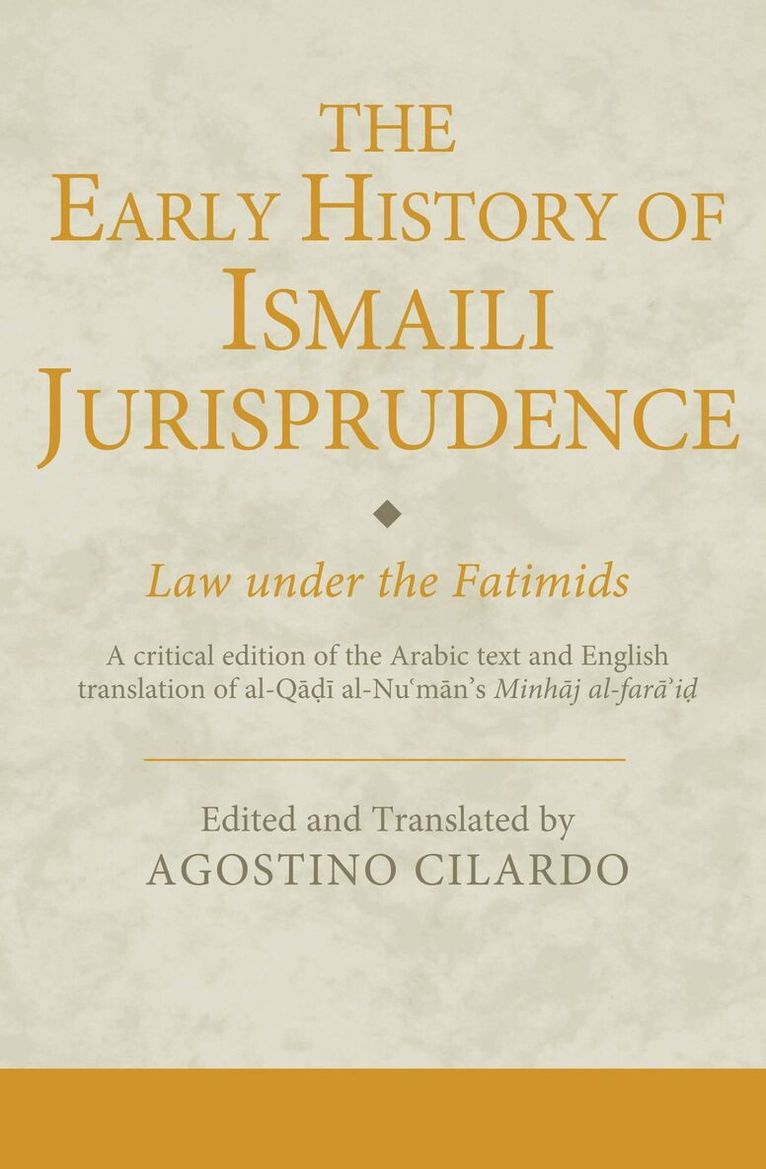
Researchers have shed light on the literary production of the Ismailis since the early 1930s. The cataloguing of these work has been carried out by Ivanow, Fyzee, Goriawala, Poonawala, Gacek, Cortese and de Bloise. Many works attributable to Ismaili scholars, however, are still unavailable either because they remain hidden in private collections or because they have not survived. Ismaili law, in particular, is still a largely unexplored field of study. Al-Qadi Abu Hanifa al-Nu'man is generally considered the founder and greatest exponent of Ismaili jurisprudence, Many of his works have been lost, and information on some others is scattered; yet other works remain in manuscript form, and only a few have been published. The present book is a critical edition and translation of al-Nu'man's Minhaj al-fara'id, based on its three known copies. It deals with the law of inheritance, one of the most complex in Islamic law.In comparing the Minhaj with two published works (the Da'a'im al-Islam and Kitab al-iqtisar) as well as a manuscript (Mukhtasar al-athar) of al-Nu'man, a significant doctrinal evolution clearly emerges, reflecting his early Maliki training and then his work under four Fatimid imams. Ismaili law is also compared with the doctrines of the Imami school as well as the legal system of the four Sunni schools. This book thus allows us to determine the time of the composition of the Minhaj al-fara id, the development and the originality of Ismaili jurisprudence, and its relation to other schools of law.
E-bok
Engelska, 2012571 kr
Läs direkt efter köp
Researchers have shed light on the literary production of the Ismailis since the early 1930s. The cataloguing of these work has been carried out by Ivanow, Fyzee, Goriawala, Poonawala, Gacek, Cortese and de Bloise. Many works attributable to Ismaili scholars, however, are still unavailable either because they remain hidden in private collections or because they have not survived. Ismaili law, in particular, is still a largely unexplored field of study. Al-Qadi Abu Hanifa al-Nu'man is generally considered the founder and greatest exponent of Ismaili jurisprudence, Many of his works have been lost, and information on some others is scattered; yet other works remain in manuscript form, and only a few have been published. The present book is a critical edition and translation of al-Nu'man's Minhaj al-fara'id, based on its three known copies. It deals with the law of inheritance, one of the most complex in Islamic law. In comparing the Minhaj with two published works (the Da'a'im al-Islam and Kitab al-iqtisar) as well as a manuscript (Mukhtasar al-athar) of al-Nu'man, a significant doctrinal evolution clearly emerges, reflecting his early Maliki training and then his work under four Fatimid imams. Ismaili law is also compared with the doctrines of the Imami school as well as the legal system of the four Sunni schools.This book thus allows us to determine the time of the composition of the Minhaj al-fara id, the development and the originality of Ismaili jurisprudence, and its relation to other schools of law.
E-bok
PDF, Engelska, 2012571 kr
Läs direkt efter köp
Researchers have shed light on the literary production of the Ismailis since the early 1930s. The cataloguing of these work has been carried out by Ivanow, Fyzee, Goriawala, Poonawala, Gacek, Cortese and de Bloise. Many works attributable to Ismaili scholars, however, are still unavailable either because they remain hidden in private collections or because they have not survived. Ismaili law, in particular, is still a largely unexplored field of study. Al-Qadi Abu Hanifa al-Nu'man is generally considered the founder and greatest exponent of Ismaili jurisprudence, Many of his works have been lost, and information on some others is scattered; yet other works remain in manuscript form, and only a few have been published. The present book is a critical edition and translation of al-Nu'man's Minhaj al-fara'id, based on its three known copies. It deals with the law of inheritance, one of the most complex in Islamic law.In comparing the Minhaj with two published works (the Da'a'im al-Islam and Kitab al-iqtisar) as well as a manuscript (Mukhtasar al-athar) of al-Nu'man, a significant doctrinal evolution clearly emerges, reflecting his early Maliki training and then his work under four Fatimid imams. Ismaili law is also compared with the doctrines of the Imami school as well as the legal system of the four Sunni schools. This book thus allows us to determine the time of the composition of the Minhaj al-fara id, the development and the originality of Ismaili jurisprudence, and its relation to other schools of law.