Ahmed Karmouch – författare
Visar alla böcker från författaren Ahmed Karmouch. Handla med fri frakt och snabb leverans.
11 produkter
11 produkter
Inbunden, Engelska, 2005
1 116 kr
Skickas inom 10-15 vardagar
Communication systems are now ubiquitous and making them more intelligent remains very challenging. The IFIP International Conference on Intelligence in Communication Systems is an effort to bring together researchers and practitioners who represent the latest developments in this area. This volume contains selected papers from the conference in the following focus areas: ad hoc networks / hybrid networks / WLAN; security, privacy and consumer protection; adaptive architectures and protocols; flexible QoS and QoS management; flexible service specification, validation, searching and querying; service composition and Web services; personal, terminal and node mobility; programmable and active networks.
E-bok
PDF, Engelska, 20061 416 kr
Läs direkt efter köp
Communication systems are now ubiquitous and making them more intelligent remains very challenging. The IFIP International Conference on Intelligence in Communication Systems is an effort to bring together researchers and practitioners who represent the latest developments in this area. This volume contains selected papers from the conference in the following focus areas: ad hoc networks / hybrid networks / WLAN; security, privacy and consumer protection; adaptive architectures and protocols; flexible QoS and QoS management; flexible service specification, validation, searching and querying; service composition and Web services; personal, terminal and node mobility; programmable and active networks.
Del 190 - IFIP Advances in Information and Communication Technology
Intelligence in Communication Systems
IFIP International Conference on Intelligence in Communication Systems, INTELLCOMM 2005, Montreal, Canada, October 17-19, 2005
Häftad, Engelska, 2010
1 084 kr
Skickas inom 10-15 vardagar
Communication systems are now ubiquitous and making them more intelligent remains very challenging. The IFIP International Conference on Intelligence in Communication Systems is an effort to bring together researchers and practitioners who represent the latest developments in this area. This volume contains selected papers from the conference in the following focus areas: ad hoc networks / hybrid networks / WLAN; security, privacy and consumer protection; adaptive architectures and protocols; flexible QoS and QoS management; flexible service specification, validation, searching and querying; service composition and Web services; personal, terminal and node mobility; programmable and active networks.
Häftad, Engelska, 2002
546 kr
Skickas inom 10-15 vardagar
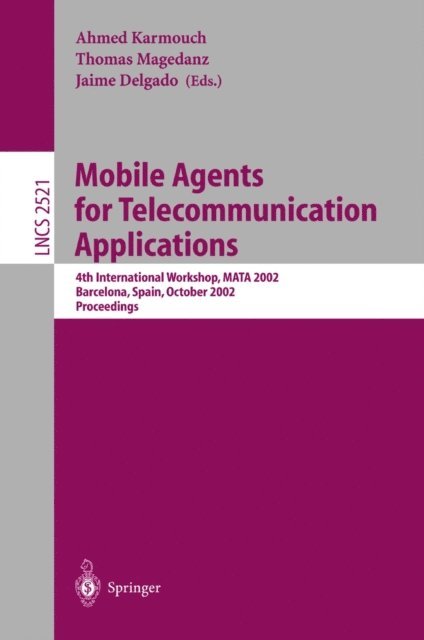
Research in the telecommunications ?eld suggests that future network infrastructures will be composed of sensors, wireless devices, personal digital assistants, networked appliances and numerous types of services. This brings up key issues such as unfamiliar users and service interfaces, discovering services that match user’s needs, ?nding and tracking people and resources, establishing useful contacts and appropriate associations between resources and users, and managing a large number of dynamic network entities all of which must be performed in an automated and proactive manner with a certain degree of autonomy and mobility. These are the main characteristics exhibited by mobile software agent behavior, making the technology more suitable for future telecommu- cation applications and services. It also reveals the tremendous potential for the mobile agent paradigm. The potential complexity of mobile agent operation requires that mechanisms exist on several levels to coordinate its activities. For this purpose research and development on various forms of mobile agents continues to grow in a staggering fashion. Age- based applications and services such as network management, e-commerce, information gathering on the Internet, mobile communications, active networking, and most recently ad hoc communications are becoming increasingly popular and continue to contribute to the development and to the success of mobile agent technology. In addition it is well established that mobile agents is an ideal sister technology for mobile ad hoc networks where users, applications, services, devices and networks are mobile and dynamically con?gurable.
Häftad, Engelska, 2004
562 kr
Skickas inom 10-15 vardagar
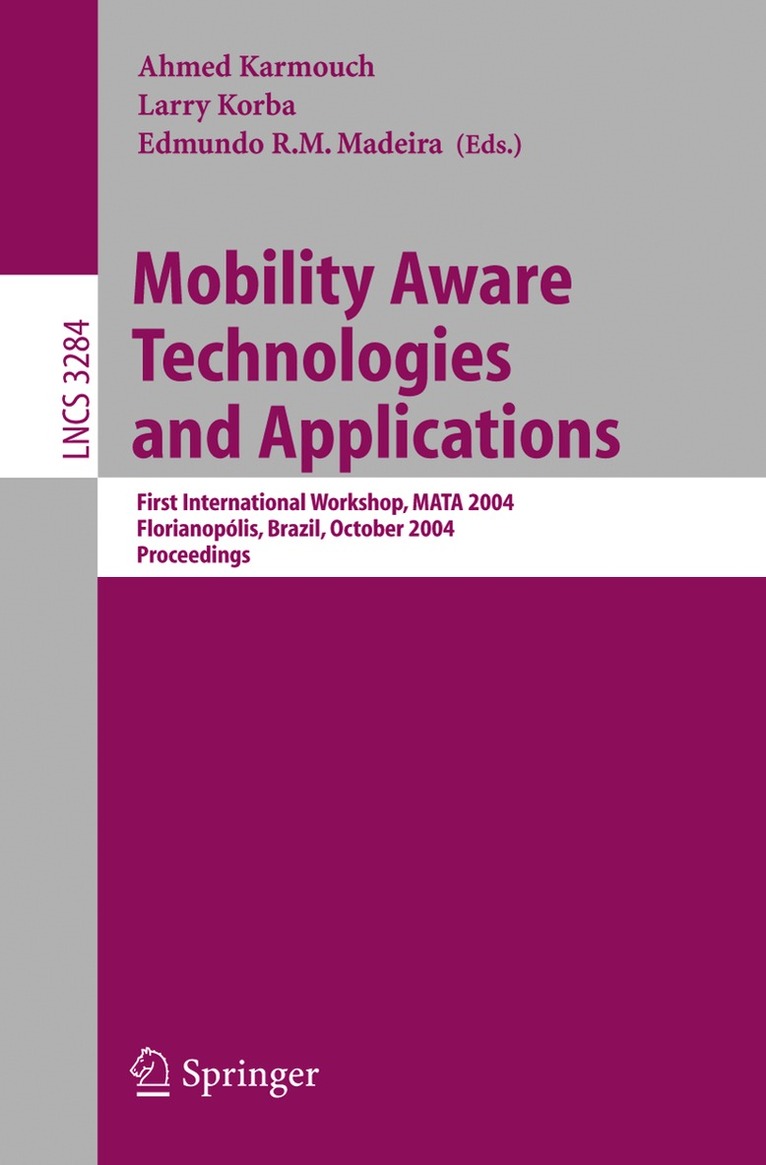
It is becoming quite clear that there will be important technological advances in - bile and wireless connectivity, known as third-/fourth-generation (3G and 4G) mobile telecommunications systems. As a result we will be surrounded by ever-growing m- tidomain (technical and administrative) heterogeneous communications in both wired and wireless networks. This resulting environment deals with communication in m- tizoned networks, where people, devices, appliances and servers are connected to each other via different kinds of networks. Networks will be pervasive, ubiquitous, multis- vice, multioperatorand multiaccess. The mobility trend will also be spurred forward by the growing availability of mobile-enabled handheld devices. Mobile systems are expected to provide mobile users with cost-effective, secure, yet ubiquitous service access anywhere and anytime. Users will then continue to enjoy the new-found freedom mobile access provides and will have increasingly high exp- tations of mobility-aware applications that should be capable of seamlessly supporting the mobile lifestyle. The papers in this volume discuss issues from models, platforms, and architectures for mobility-aware systems to security, mobile agent technologies, sensitive com- nications, context awareness, mobile applications and management. They cover both practical experience and novel research ideas and concepts.
Häftad, Engelska, 2005
562 kr
Skickas inom 10-15 vardagar
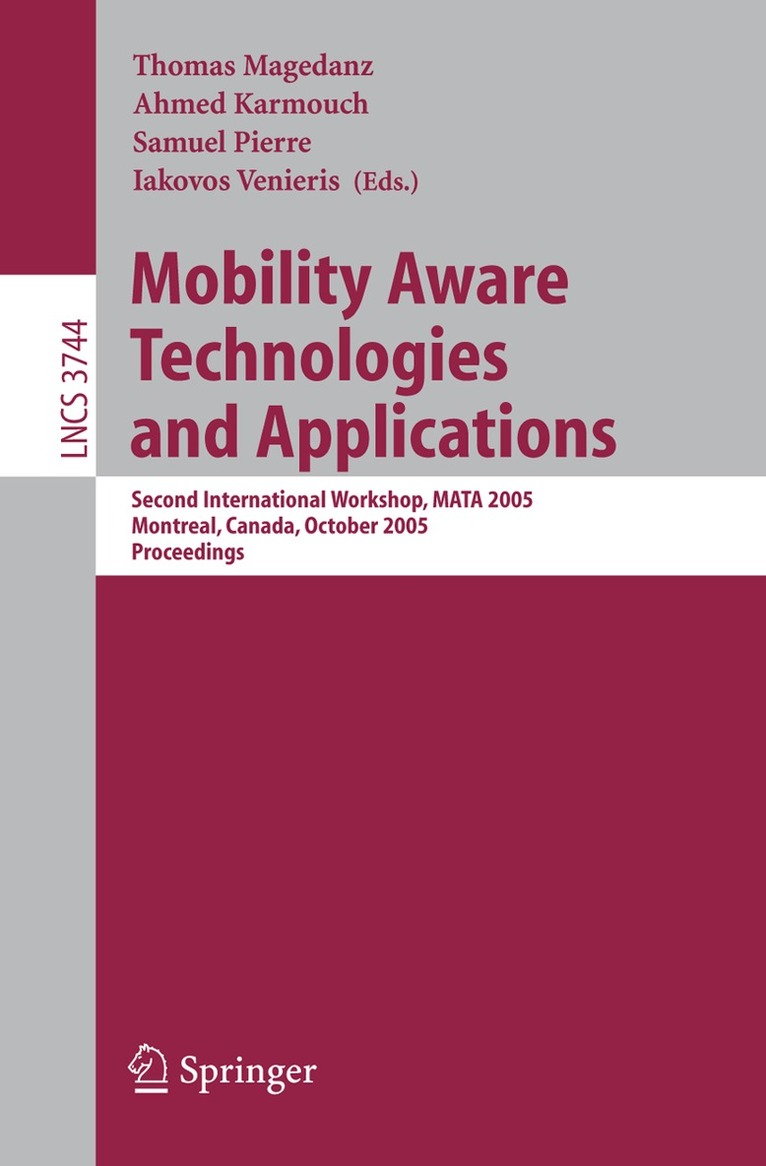
The beginning of the twenty-first century is characterized by global markets, and the mobility of people is becoming an important fact of life. Consequently, the mobile user is demanding appropriate technical solutions to make use of customized information and communication services. In this context the notion of next-generation networks (NGNs), which are driven by the convergence of the entertainment sector, the mobile Internet, and fixed/mobile telecommunications, is emerging. Such NGNs are aggregating a variety of different access networks and supporting the seamless connection of an open set of end-user devices, and due to the adoption of an all-IP network paradigm they enable a much better integration of voice and data services. Coincidently the buzzword ‘fixed mobile convergence’ (FMC) describes the current trend towards providing common services across fixed and mobile networks resulting in the medium term in the full integration of fixed and mobile telecommunication networks. The adoption of appropriate middleware technologies and the provision of - called service delivery platforms driven by the ongoing innovation in the field of information technologies provides today the technical foundation for supporting terminal, personal and service mobility and thus the implementation of real seamless information and communication services. Furthermore, users are nowadays looking, in light of an omnipresent service environment, for a much higher degree of customization and context awareness in the services they use. The papers in this volume look at these enabling mobility-aware technologies and their use for implementing mobility-aware and context-aware applications.
E-bok
PDF, Engelska, 2005734 kr
Läs direkt efter köp
It is becoming quite clear that there will be important technological advances in - bile and wireless connectivity, known as third-/fourth-generation (3G and 4G) mobile telecommunications systems. As a result we will be surrounded by ever-growing m- tidomain (technical and administrative) heterogeneous communications in both wired and wireless networks. This resulting environment deals with communication in m- tizoned networks, where people, devices, appliances and servers are connected to each other via different kinds of networks. Networks will be pervasive, ubiquitous, multis- vice, multioperatorand multiaccess. The mobility trend will also be spurred forward by the growing availability of mobile-enabled handheld devices. Mobile systems are expected to provide mobile users with cost-effective, secure, yet ubiquitous service access anywhere and anytime. Users will then continue to enjoy the new-found freedom mobile access provides and will have increasingly high exp- tations of mobility-aware applications that should be capable of seamlessly supporting the mobile lifestyle. The papers in this volume discuss issues from models, platforms, and architectures for mobility-aware systems to security, mobile agent technologies, sensitive com- nications, context awareness, mobile applications and management. They cover both practical experience and novel research ideas and concepts.
E-bok
PDF, Engelska, 2005734 kr
Läs direkt efter köp
The beginning of the twenty-first century is characterized by global markets, and the mobility of people is becoming an important fact of life. Consequently, the mobile user is demanding appropriate technical solutions to make use of customized information and communication services. In this context the notion of next-generation networks (NGNs), which are driven by the convergence of the entertainment sector, the mobile Internet, and fixed/mobile telecommunications, is emerging. Such NGNs are aggregating a variety of different access networks and supporting the seamless connection of an open set of end-user devices, and due to the adoption of an all-IP network paradigm they enable a much better integration of voice and data services. Coincidently the buzzword ‘fixed mobile convergence’ (FMC) describes the current trend towards providing common services across fixed and mobile networks resulting in the medium term in the full integration of fixed and mobile telecommunication networks. The adoption of appropriate middleware technologies and the provision of - called service delivery platforms driven by the ongoing innovation in the field of information technologies provides today the technical foundation for supporting terminal, personal and service mobility and thus the implementation of real seamless information and communication services. Furthermore, users are nowadays looking, in light of an omnipresent service environment, for a much higher degree of customization and context awareness in the services they use. The papers in this volume look at these enabling mobility-aware technologies and their use for implementing mobility-aware and context-aware applications.
E-bok
PDF, Engelska, 2003712 kr
Läs direkt efter köp
Research in the telecommunications ?eld suggests that future network infrastructures will be composed of sensors, wireless devices, personal digital assistants, networked appliances and numerous types of services. This brings up key issues such as unfamiliar users and service interfaces, discovering services that match user’s needs, ?nding and tracking people and resources, establishing useful contacts and appropriate associations between resources and users, and managing a large number of dynamic network entities all of which must be performed in an automated and proactive manner with a certain degree of autonomy and mobility. These are the main characteristics exhibited by mobile software agent behavior, making the technology more suitable for future telecommu- cation applications and services. It also reveals the tremendous potential for the mobile agent paradigm. The potential complexity of mobile agent operation requires that mechanisms exist on several levels to coordinate its activities. For this purpose research and development on various forms of mobile agents continues to grow in a staggering fashion. Age- based applications and services such as network management, e-commerce, information gathering on the Internet, mobile communications, active networking, and most recently ad hoc communications are becoming increasingly popular and continue to contribute to the development and to the success of mobile agent technology. In addition it is well established that mobile agents is an ideal sister technology for mobile ad hoc networks where users, applications, services, devices and networks are mobile and dynamically con?gurable.
Häftad, Engelska, 1999
2 725 kr
Tillfälligt slut
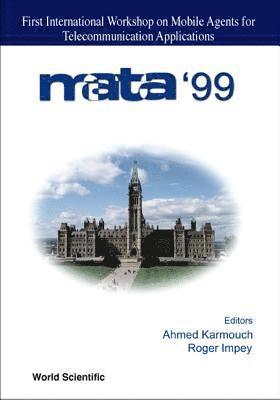
A software agent has a spectrum of definitions. At one end of the scale are relatively simple, client-based software applications that can assist users in performing mundane tasks such as sorting e-mail or downloading web pages. This class of agents is often referred to as “personal assistant” agents. At the other end of the scale is the concept of sophisticated software entities possessing artificial intelligence that autonomously travel through a network environment and make complex decisions on a user's behalf.In telecommunications, the definition lies somewhere between those two extremes. This classification of mobile agents, although not strictly adhering to the definition of “intelligent agents” originally proposed by the artificial intelligence community, is generally acknowledged to be a useful categorization and has started to gain widespread acceptance. We therefore define a mobile agent as a program that acts on behalf of a user or another program and is able to migrate from host to host on a network under its own control. The agent chooses when and where it will migrate and may interrupt its own execution and continue elsewhere on the network. The agent returns results and messages in an asynchronous fashion.This volume discusses the emerging field of mobile software agents and their applications to the area of telecommunications, such as active networks, e-commerce, the Internet, interactive QoS, network management, and feature interactions. It addresses the needs of a wide audience, including researchers, software agent systems and telecommunication applications designers, and users of software agents.
Häftad, Engelska, 1999
2 897 kr
Tillfälligt slut
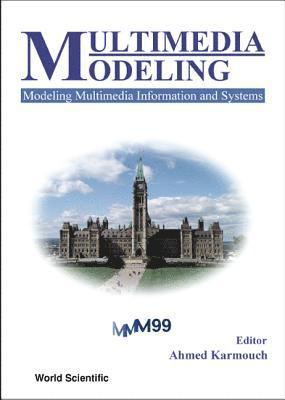
Multimedia systems result from the merging of the computing, communications and broadcasting industries. This merging has been made possible today by the technical advances in high speed broadband networks, computer desktop workstations, and information storage and compression techniques.Currently, text and image are the predominant forms of information exchanged over the Internet. However, there are clear signs that the situation is rapidly changing with the recent emergence of multimedia applications in the area of education, business, e-commerce and entertainment — resulting, therefore, in increased consumption of network bandwidth and in the creation of a very large volume of information that needs to be processed and stored. This trend has made strong demands on the multimedia modeling research community to develop new semantic models that will further facilitate the creation, representation, manipulation and animation of multimedia content with a better level of granularity than what is possible to achieve with today's multimedia information systems.This volume explores issues associated with multimedia modeling information and systems and presents the current status of work in this field. It covers a broad range of theoretical, conceptual and practical topics and addresses the needs of a wide audience, including researchers, multimedia systems designers and users of multimedia systems.