Ahmet Davutoglu – författare
Visar alla böcker från författaren . Handla med fri frakt och snabb leverans.
8 produkter
8 produkter
Häftad, Engelska, 2025
337 kr
Skickas inom 3-6 vardagar
Inbunden, Engelska, 2021
2 506 kr
Skickas inom 10-15 vardagar
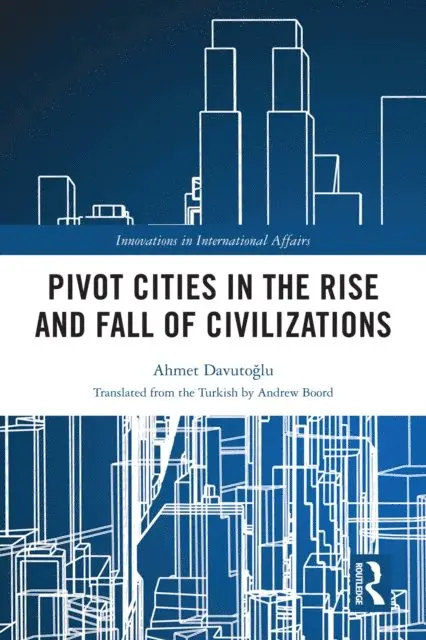
Based on the author’s long experience in academic life and the public realm, especially in foreign policy, this book argues that a single categoric classification of cities is inadequate, and that cities have had different and varied impacts and positions throughout the history of civilization.The author examines how the formation, transformation, destruction or reestablishment of many civilizational cities reveals a clearer picture of the cornerstones of the course of human history. These cities, which play a decisive and pivotal role in the direction of the flow of history as well as providing us with a compass to guide our efforts to understand and interpret this flow, are conceptualized by the author as civilizations’ "pivot cities". This innovative book explores the role of great cities in political historical change, presenting an alternative view of these pivot cities from a culturalist perspective. Within this framework, the role played by pivot cities in the history of civilization may be considered under seven distinct headings: pioneering cities which founded civilizations; cities which were founded by civilizations; cities which were transplanted during the formation of civilizations; "ghost cities" which lost their importance through shifts in political power and civilizational transformation; "lost cities" which were destroyed by civilizations; cities on lines of geocultural/geoeconomic interaction; and cities which combine, transform or are transformed by different civilizations. The author’s concept of pivot cities explores the interplay between vital cities and civilizations, which bears on the future of globalization at a time of instability, as projected continuing de-Westernization becomes a theme in studies of global history.This book provides highly productive discussions relevant to the literature on city-civilization relationships and the historicity of pivot cities. Its clear language, rich content, deep and original perspective, interdisciplinary approach and rich bibliography will ensure that it appeals to students and scholars in a variety of disciplines, including cultural studies, political science, comparative urban studies, anthropology, history and civilizational studies.
Häftad, Engelska, 2023
670 kr
Skickas inom 10-15 vardagar
Based on the author’s long experience in academic life and the public realm, especially in foreign policy, this book argues that a single categoric classification of cities is inadequate, and that cities have had different and varied impacts and positions throughout the history of civilization.The author examines how the formation, transformation, destruction or reestablishment of many civilizational cities reveals a clearer picture of the cornerstones of the course of human history. These cities, which play a decisive and pivotal role in the direction of the flow of history as well as providing us with a compass to guide our efforts to understand and interpret this flow, are conceptualized by the author as civilizations’ "pivot cities". This innovative book explores the role of great cities in political historical change, presenting an alternative view of these pivot cities from a culturalist perspective. Within this framework, the role played by pivot cities in the history of civilization may be considered under seven distinct headings: pioneering cities which founded civilizations; cities which were founded by civilizations; cities which were transplanted during the formation of civilizations; "ghost cities" which lost their importance through shifts in political power and civilizational transformation; "lost cities" which were destroyed by civilizations; cities on lines of geocultural/geoeconomic interaction; and cities which combine, transform or are transformed by different civilizations. The author’s concept of pivot cities explores the interplay between vital cities and civilizations, which bears on the future of globalization at a time of instability, as projected continuing de-Westernization becomes a theme in studies of global history.This book provides highly productive discussions relevant to the literature on city-civilization relationships and the historicity of pivot cities. Its clear language, rich content, deep and original perspective, interdisciplinary approach and rich bibliography will ensure that it appeals to students and scholars in a variety of disciplines, including cultural studies, political science, comparative urban studies, anthropology, history and civilizational studies.
Häftad, Engelska, 1993
1 053 kr
Skickas inom 10-15 vardagar
Many scholars were convinced that the existing Western style of life, thought, and political institutions could easily be adapted to Muslim societies by bringing them into line with Islamic belief systems and rules. But after some experiences they were surprised when even intellectuals who had Western academic training remained deeply attached to Islam. In this book, Davutoglu develops a comparative analysis between Western and Islamic political theories and images. His argument contends that the conflicts and contrasts between Islamic and Western political thought originate from their philosophical, methodological, and theoretical background rather than mere institutional and historical differences. The questions of how and through which processes these alternative conceptions of the world affect political ideas via a set of axiological presuppositions are the crux of the book.Contents: Transliteration; Introduction; I. Theoretical Inquiries. Western Paradigm: Ontological Proximity; Islamic Paradigm: Tawhid and Ontological Differentiation; II. Political Consequences. Justification of the Socio-Political System: Cosmologico-Ontological Foundations; Legitimation of Political Authority: Epistemologico-Axiological Foundations; Power Theories and Pluralism; The Political Unit and the Universal Political System; Concluding Comparative Remarks.
E-bok
Engelska, 2020570 kr
Läs direkt efter köp
Using the analogy of a devastating series of earthquakes, Davutoğlu provides a new theoretical approach, conceptualization, and methodology for understanding crisis in the post-Cold War era. In order to grasp the scale and scope of the ongoing crises we are experiencing today, Davutoğlu conceptualizes them as ''aftershocks'', following in the wake of the four great ''quakes'' that have shaken the world in recent times - namely, the geopolitical earthquake triggered by dissolution of the Soviet Union, 1991; the security earthquake, post- 9/11, 2001; the economic earthquake associated with the global economic crisis, 2008; and the structural earthquake of the Arab Spring, 2011. By contextualizing international order as being impacted by a number of intertwined processes, the book then looks to the possible futures ahead. Following his analysis of the ongoing systemic crisis, Davutoğlu forges a vision for a new order of global democracy, built from the rubble of the systemic earthquake.
E-bok
PDF, Engelska, 2020570 kr
Läs direkt efter köp
Using the analogy of a devastating series of earthquakes, Davutoğlu provides a new theoretical approach, conceptualization, and methodology for understanding crisis in the post-Cold War era. In order to grasp the scale and scope of the ongoing crises we are experiencing today, Davutoğlu conceptualizes them as ''aftershocks'', following in the wake of the four great ''quakes'' that have shaken the world in recent times - namely, the geopolitical earthquake triggered by dissolution of the Soviet Union, 1991; the security earthquake, post- 9/11, 2001; the economic earthquake associated with the global economic crisis, 2008; and the structural earthquake of the Arab Spring, 2011. By contextualizing international order as being impacted by a number of intertwined processes, the book then looks to the possible futures ahead. Following his analysis of the ongoing systemic crisis, Davutoğlu forges a vision for a new order of global democracy, built from the rubble of the systemic earthquake.
Häftad, Engelska, 2027
395 kr
Kommande
Inbunden, Engelska, 1994
863 kr
Tillfälligt slut
Many scholars were convinced that the existing Western style of life, thought, and political institutions could easily be adapted to Muslim societies by bringing them into line with Islamic belief systems and rules. But after some experiences they were surprised when even intellectuals who had Western academic training remained deeply attached to Islam. In this book, Davutoglu develops a comparative analysis between Western and Islamic political theories and images. His argument contends that the conflicts and contrasts between Islamic and Western political thought originate from their philosophical, methodological, and theoretical background rather than mere institutional and historical differences. The questions of how and through which processes these alternative conceptions of the world affect political ideas via a set of axiological presuppositions are the crux of the book. Contents: Transliteration; Introduction; I. Theoretical Inquiries. Western Paradigm: Ontological Proximity; Islamic Paradigm: Tawhid and Ontological Differentiation; II. Political Consequences. Justification of the Socio-Political System: Cosmologico-Ontological Foundations; Legitimation of Political Authority: Epistemologico-Axiological Foundations; Power Theories and Pluralism; The Political Unit and the Universal Political System; Concluding Comparative Remarks.