Ahmet Ibrahim – författare
Visar alla böcker från författaren Ahmet Ibrahim. Handla med fri frakt och snabb leverans.
9 produkter
9 produkter
E-bok
PDF, Engelska, 2023340 kr
Läs direkt efter köp
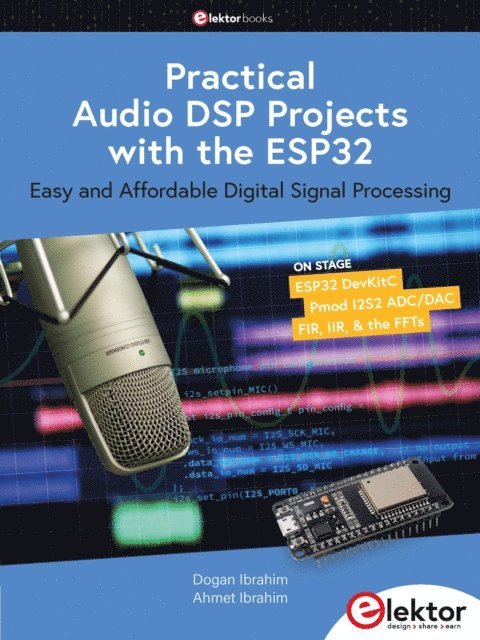
The aim of this book is to teach the basic principles of Digital Signal Processing (DSP) and to introduce it from a practical point of view using the bare minimum of mathematics. Only the basic level of discrete-time systems theory is given, sufficient to implement DSP applications in real time. The practical implementations are described in real time using the highly popular ESP32 DevKitC microcontroller development board. With the low cost and extremely popular ESP32 microcontroller, you should be able to design elementary DSP projects with sampling frequencies within the audio range. All programming is done using the popular Arduino IDE in conjunction with the C language compiler. After laying a solid foundation of DSP theory and pertinent discussions on the main DSP software tools on the market, the book present the following audio-based sound and DSP projects: > Using an I2S-based digital microphone to capture audio sound > Using an I2S-based class-D audio amplifier and speaker > Playing MP3 music stored on an SD card through an I2S-based amplifier and speaker > Playing MP3 music files stored in ESP32 flash memory through an I2S-based amplifier and speaker > Mono and stereo Internet radio with I2S-based amplifiers and speakers > Text-to-speech output with an I2S-based amplifier and speaker > Using the volume control in I2S-based amplifier and speaker systems > A speaking event counter with an I2S-based amplifier and speaker > An adjustable sinewave generator with I2S-based amplifier and speaker > Using the Pmod I2S2 24-bit fast ADC/DAC module > Digital low-pass and band-pass real-time FIR filter design with external and internal A/D and D/A conversion > Digital low-pass and band-pass real-time IIR filter design with external and internal A/D and D/A conversion > Fast Fourier Transforms (FFT)
E-bok
PDF, Tyska, 2023283 kr
Läs direkt efter köp
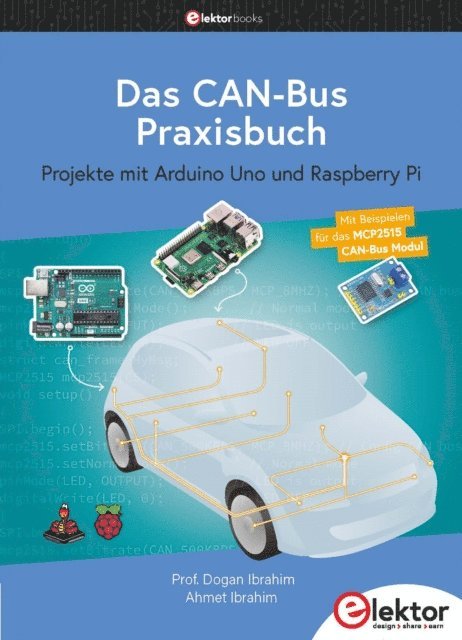
In diesem Buch werden Anwendungen von Arduino Uno und Raspberry Pi 4 in praxisnahen Projekten auf Basis von CAN-Bus detailliert beschrieben. Durch den Einsatz von entweder Arduino Uno oder Raspberry Pi in Verbindung mit handelsüblichen CAN-Bus Schnittstellenmodulen werden die Entwicklung, Fehlersuche und Fehlerbeseitigung sowie die Überprüfung von Projekten auf CAN-Bus-Basis erheblich erleichtert. Dieses Buch richtet sich an jeden, der mehr über den CAN-Bus lernen möchte und mit den Grundlagen der Elektronik vertraut ist. Hilfreich ist auch Erfahrung mit den Programmiersprachen C und Python sowie mit der Programmierung von Arduino Uno unter Verwendung seiner IDE und von Raspberry Pi zu haben.Das Buch ist eine nützliche Informationsquelle und ein Nachschlagewerk für jeden, der Antworten auf eine oder mehrere der folgenden Fragen sucht: > Welche Bus-Systeme stehen für die Automobilindustrie zur Verfügung? > Was sind die Grundprinzipien des CAN-Bus? > Welche Arten von Frames (oder Datenpaketen) stehen in einem CAN-Bussystem zur Verfügung? > Wie können Fehler in einem CAN-Bussystem erkannt werden, und wie zuverlässig ist ein CAN-Bussystem? > Welche Arten von CAN-Bus Controllern gibt es? > Welches sind die Funktionsprinzipien des MCP2515 CAN-Bus Controllers? > Wie kann ich ein CAN-Bus Projekt mit Arduino Uno realisieren?> Wie kann ich Arduino oder Raspberry Pi CAN-Bus Projekte mit 2 und 3 Knoten erstellen? > Wie kann ich die Daten auf dem CAN-Bus analysieren? > Wie kann ich ein CAN-Bus Projekt mit Raspberry Pi ausführen? Die vollständigen Programme aller im Buch besprochenen Projekte können kostenlos von der Elektor-Website www.elektor.de heruntergeladen werden.
Häftad, Engelska, 2024
413 kr
Skickas inom 3-6 vardagar
E-bok
PDF, Engelska, 2024334 kr
Läs direkt efter köp
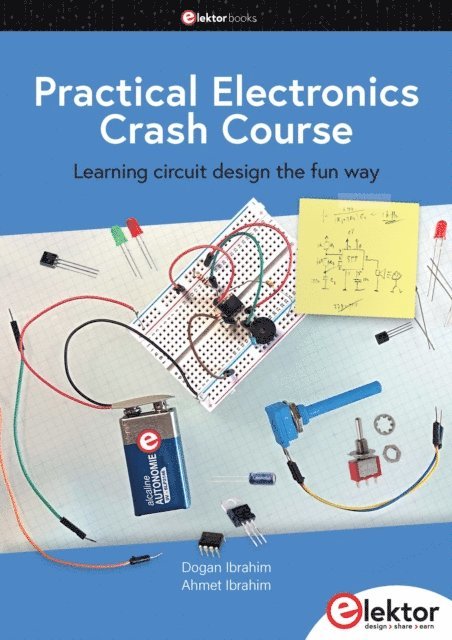
Welcome to the world of electronics! Getting started in electronics is not as difficult as you may think. Using this book, you will explore and learn the most important electrical and electronics engineering concepts in a fun way by doing various experiments and by simulating circuits. It will teach you electronics practically without getting into complex technical jargon and long calculations. As a result, you will be creating your own projects soon. No prior knowledge of electronics is required, only some basic algebra is used in a few simple calculations. Many tested and working projects and simulations are presented to familiarise yourself with the construction of electronic circuits. Circuit simulation is introduced at an early stage to enable you to experiment with circuits easily without breaking anything. You will learn: > The concepts of voltage, current, and power > AC and DC > Basic lamp circuits with switches > Passive components: resistors, capacitors & inductors > RC & RCL circuits > Electromagnetism > Loudspeakers, relays, buzzers, and transformers > Active components: diodes & LEDs, bipolar transistors & MOSFETs > Transistor-based switching circuits > Optocoupler circuits > Astable & monostable multivibrators > Using the 555 timer IC > The operational amplifier > Digital logic > Advanced examples: amplifiers, oscillators, filters, and sensors > Test and measurement tools> Microcontrollers: Arduino UNO, ESP32, Raspberry Pi Pico, and Raspberry Pi > Reading datasheets and best practices for selecting components > EMC & EMI and norms & regulations
Häftad, Engelska, 2024
425 kr
Skickas inom 3-6 vardagar
E-bok
PDF, Engelska, 2024340 kr
Läs direkt efter köp
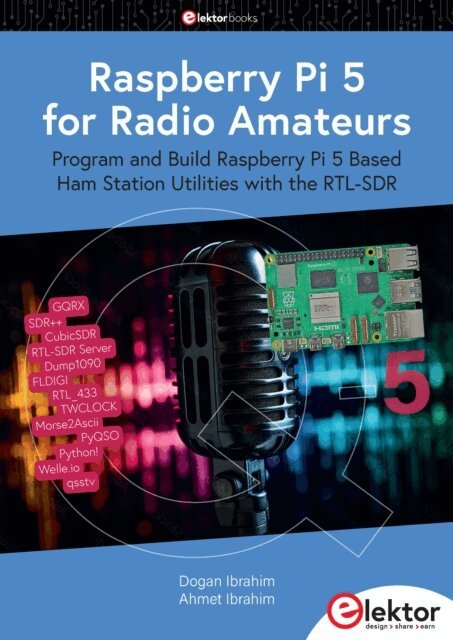
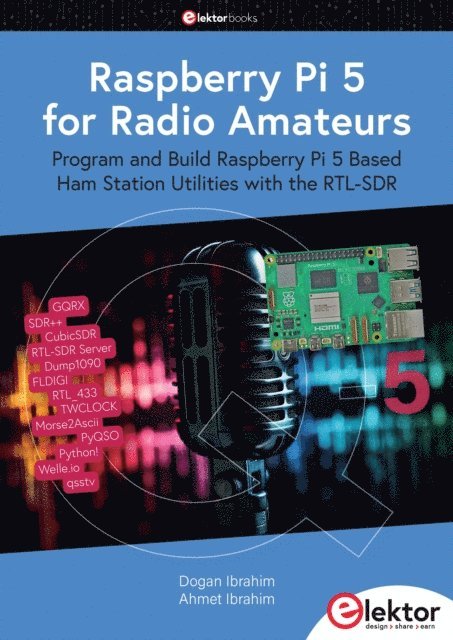
The RTL-SDR devices (V3 and V4) have gained popularity among radio amateurs because of their very low cost and rich features. A basic system may consist of a USB based RTL-SDR device (dongle) with a suitable antenna, a Raspberry Pi 5 computer, a USB based external audio inputoutput adapter, and software installed on the Raspberry Pi 5 computer. With such a modest setup, it is possible to receive signals from around 24 MHz to over 1.7 GHz.This book is aimed at amateur radio enthusiasts and electronic engineering students, as well as at anyone interested in learning to use the Raspberry Pi 5 to build electronic projects. The book is suitable for both beginners through experienced readers. Some knowledge of the Python programming language is required to understand and eventually modify the projects given in the book. A block diagram, a circuit diagram, and a complete Python program listing is given for each project, alongside a comprehensive description. The following popular RTL-SDR programs are discussed in detail, aided by step-by-step installation guides for practical use on a Raspberry Pi 5:> SimpleFM > GQRX > SDR++ > CubicSDR > RTL-SDR Server > Dump1090 > FLDIGI > Quick > RTL_433 > aldo > xcwcp > GPredict > TWCLOCK > CQRLOG > klog > Morse2Ascii > PyQSO > Welle.io > Ham Clock > CHIRP > xastir > qsstv > flrig > XyGrib > FreeDV > Qtel (EchoLink) > XDX (DX-Cluster) > WSJT-XThe application of the Python programming language on the latest Raspberry Pi 5 platform precludes the use of the programs in the book from working on older versions of Raspberry Pi computers.
E-bok
PDF, Engelska, 2024359 kr
Läs direkt efter köp
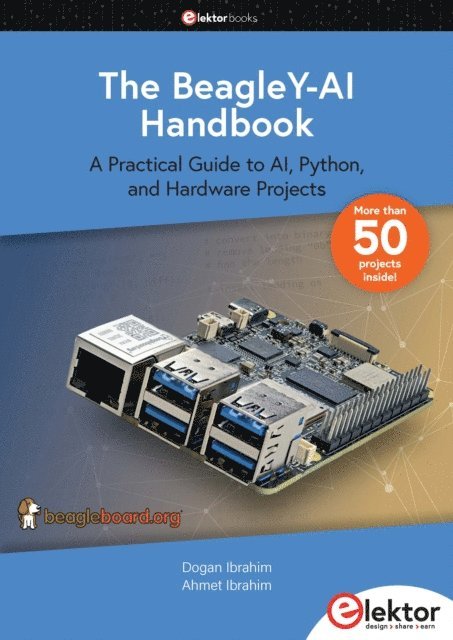
Welcome to your BeagleY-AI journey! This compact, powerful, and affordable single-board computer is perfect for developers and hobbyists. With its dedicated 4 TOPS AI co-processor and a 1.4GHz Quad-core Cortex-A53 CPU, the BeagleY-AI is equipped to handle both AI applications and real-time I/O tasks. Powered by the Texas Instruments AM67A processor, it offers DSPs, a 3D graphics unit, and video accelerators. Inside this handbook, you''ll find over 50 hands-on projects that cover a wide range of topics—from basic circuits with LEDs and sensors to an AI-driven project. Each project is written in Python 3 and includes detailed explanations and full program listings to guide you. Whether you''re a beginner or more advanced, you can follow these projects as they are or modify them to fit your own creative ideas. What you´ll be working on Here''s a glimpse of some exciting projects included in this handbook: > Morse Code Exerciser with LED or Buzzer Type a message and watch it come to life as an LED or buzzer translates your text into Morse code. > Ultrasonic Distance Measurement Use an ultrasonic sensor to measure distances and display the result in real time. > Environmental Data Display & Visualization Collect temperature, pressure, and humidity readings from the BME280 sensor, and display or plot them on a graphical interface. > SPI – Voltmeter with ADC Learn how to measure voltage using an external ADC and display the results on your BeagleY-AI. > GPS Coordinates Display Track your location with a GPS module and view geographic coordinates on your screen. > BeagleY-AI and Raspberry Pi 4 Communication Discover how to make your BeagleY-AI and Raspberry Pi communicate over a serial link and exchange data. > AI-Driven Object Detection with TensorFlow Lite Set up and run an object detection model using TensorFlow Lite on the BeagleY-AI platform, with complete hardware and software details provided.
E-bok
PDF, Tyska, 2025383 kr
Läs direkt efter köp
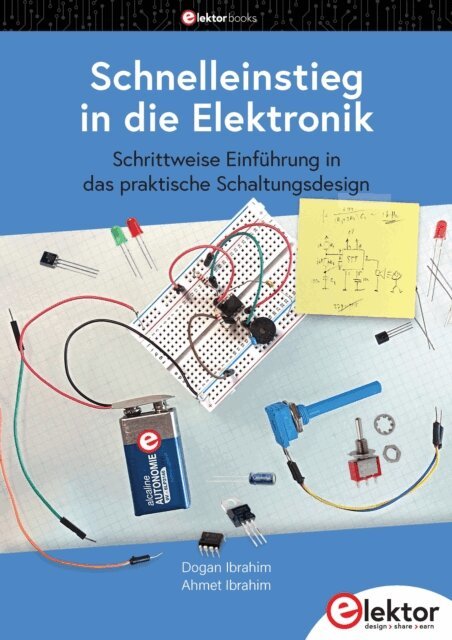
Der Einstieg in die Elektronik ist nicht so schwierig, wie man vielleicht denkt. Mit diesem Buch werden die wichtigsten Konzepte der Elektrotechnik und Elektronik auf spielerische Weise erkundet, indem verschiedene Experimente durchgeführt und Schaltungen simuliert werden. Es vermittelt Elektronik praxisnah, ohne in komplexen Fachjargon oder lange Berechnungen einzutauchen. Dadurch werden schon bald eigene Projekte ermöglicht. Es sind keine Vorkenntnisse in Elektronik erforderlich; lediglich einige grundlegende Algebra-Kenntnisse werden in wenigen einfachen Berechnungen verwendet. Viele getestete und funktionierende Projekte und Simulationen werden vorgestellt, um mit dem Aufbau elektronischer Schaltungen vertraut zu werden. Für problemloses Experimentieren – ohne die Gefahr, etwas zu beschädigen – werden zudem frühzeitig auch softwarebasierte Schaltungssimulationen vorgestellt. Lernziele: > Konzepte von Spannung, Strom und Leistung > Wechselstrom (AC) und Gleichstrom (DC) > Grundlegende Lampenschaltungen mit Schaltern > Passive Bauteile: Widerstände, Kondensatoren und Induktivitäten > RC- und RCL-Schaltungen und Elektromagnetismus > Lautsprecher, Relais, Summer und Transformatoren > Aktive Bauteile: Dioden und LEDs, Bipolartransistoren und MOSFETs > Transistorbasierte Schaltungen > Optokoppler-Schaltungen > Astabile und monostabile Multivibratoren > Verwendung des 555-Timer-ICs > Operationsverstärkertechnik > Digitale Logik > Beispiele: Verstärker, Oszillatoren, Filter und Sensoren > Test- und Messwerkzeuge > Mikrocontroller: Arduino Uno, ESP32, Raspberry Pi Pico und Raspberry Pi > Datenblätter lesen und Auswahl von Komponenten > EMV & EMI sowie Normen & Vorschriften
E-bok
Engelska, 2024334 kr
Läs direkt efter köp
The RTL-SDR devices (V3 and V4) have gained popularity among radio amateurs because of their very low cost and rich features. A basic system may consist of a USB based RTL-SDR device (dongle) with a suitable antenna, a Raspberry Pi 5 computer, a USB based external audio inputoutput adapter, and software installed on the Raspberry Pi 5 computer. With such a modest setup, it is possible to receive signals from around 24 MHz to over 1.7 GHz.This book is aimed at amateur radio enthusiasts and electronic engineering students, as well as at anyone interested in learning to use the Raspberry Pi 5 to build electronic projects. The book is suitable for both beginners through experienced readers. Some knowledge of the Python programming language is required to understand and eventually modify the projects given in the book. A block diagram, a circuit diagram, and a complete Python program listing is given for each project, alongside a comprehensive description. The following popular RTL-SDR programs are discussed in detail, aided by step-by-step installation guides for practical use on a Raspberry Pi 5:> SimpleFM > GQRX > SDR++ > CubicSDR > RTL-SDR Server > Dump1090 > FLDIGI > Quick > RTL_433 > aldo > xcwcp > GPredict > TWCLOCK > CQRLOG > klog > Morse2Ascii > PyQSO > Welle.io > Ham Clock > CHIRP > xastir > qsstv > flrig > XyGrib > FreeDV > Qtel (EchoLink) > XDX (DX-Cluster) > WSJT-XThe application of the Python programming language on the latest Raspberry Pi 5 platform precludes the use of the programs in the book from working on older versions of Raspberry Pi computers.