Akhil Sahai – författare
Visar alla böcker från författaren Akhil Sahai. Handla med fri frakt och snabb leverans.
5 produkter
5 produkter
Inbunden, Engelska, 2005
1 619 kr
Skickas inom 10-15 vardagar
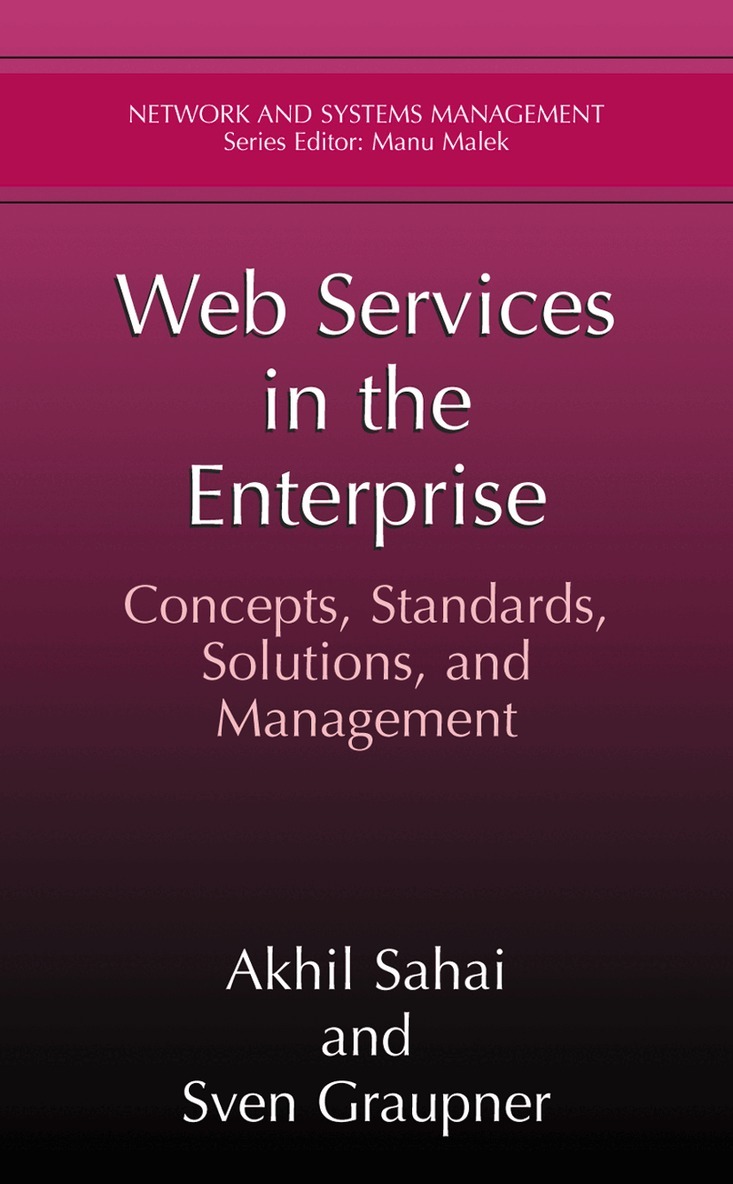
Enterprise IT infrastructure is getting increasingly complex. With the increase in complexity has arisen the need to manage it. Management in general can be seen as the process of assuring that a managed entity meets its expectations in a controlled and predictable manner. Examples of managed entities are not only components, entire systems, processes, but also people such as employees, developers, or operators, and entire organizations. Traditional management has addressed some of these issues in varied manner. The emergence of Web services has added a new complexity to the management problem and poses a new set of problems. But it also adds to the mix a set of technologies that will make the task of management simpler. Management of Web services will be critical as businesses come to rely on them as a substantial source of their revenue. The book tries to cover the broad area of web services, the concepts, implications for the enterprise, issues involved in their management and how they are being used for management themselves. The book is intended as a reference for current practice and future directions for web services and their management. The book is directed at: • Computing professionals, academicians and students to learn about the important concepts behind the web services paradigm and how it impacts the enterprise in general and how it affects traditional application, network and system management.
E-bok
PDF, Engelska, 20071 519 kr
Läs direkt efter köp
Enterprise IT infrastructure is getting increasingly complex. With the increase in complexity has arisen the need to manage it. Management in general can be seen as the process of assuring that a managed entity meets its expectations in a controlled and predictable manner. Examples of managed entities are not only components, entire systems, processes, but also people such as employees, developers, or operators, and entire organizations. Traditional management has addressed some of these issues in varied manner. The emergence of Web services has added a new complexity to the management problem and poses a new set of problems. But it also adds to the mix a set of technologies that will make the task of management simpler. Management of Web services will be critical as businesses come to rely on them as a substantial source of their revenue. The book tries to cover the broad area of web services, the concepts, implications for the enterprise, issues involved in their management and how they are being used for management themselves. The book is intended as a reference for current practice and future directions for web services and their management. The book is directed at: • Computing professionals, academicians and students to learn about the important concepts behind the web services paradigm and how it impacts the enterprise in general and how it affects traditional application, network and system management.
Häftad, Engelska, 2011
1 189 kr
Skickas inom 10-15 vardagar
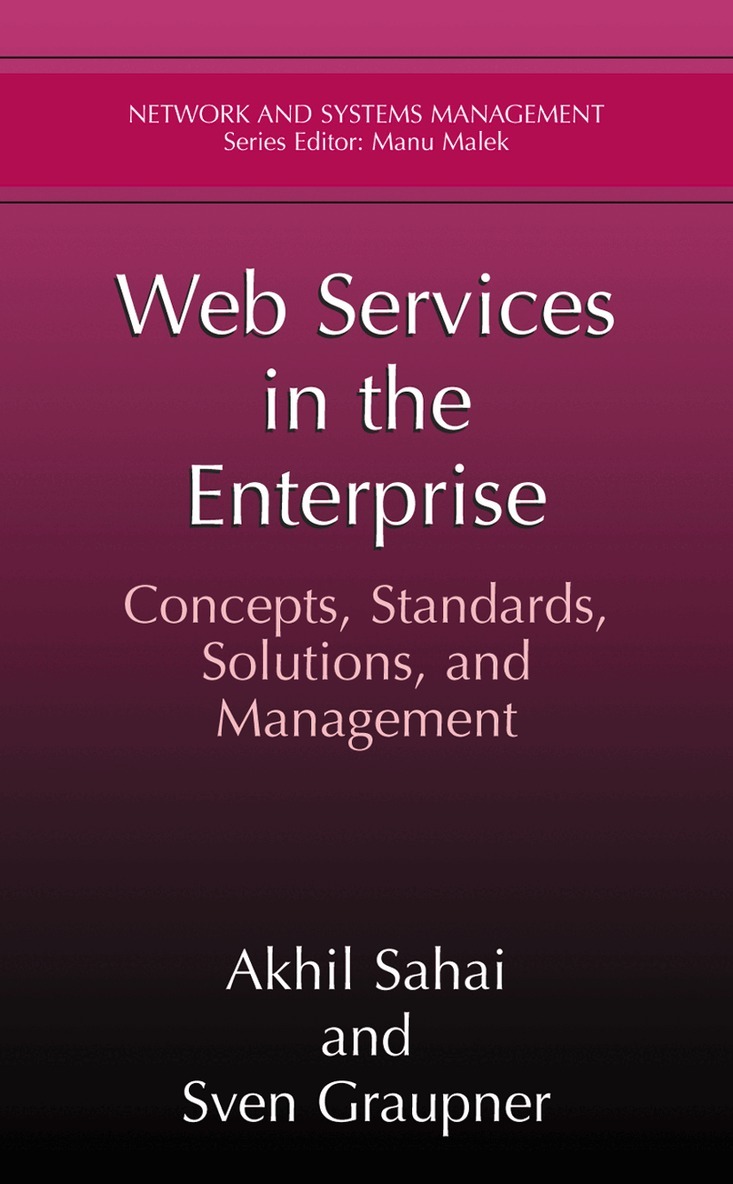
The emergence of Web services is transforming traditional enterprises. However, the industry hype surrounding these technologies obscures the understanding of their impact and implications to enterprises. Here the authors take the "big picture" perspective, offering a thorough understanding of the concepts behind Web service technologies: the challenges and opportunities they present, how they fit into the enterprise stack, how they relate to the business and IT layers of the enterprise, as well as the existing and emerging standards and their relevance. This professional reference is a guide for computing professionals, academics, students and researchers, helping them learn about the important concepts behind the Web services paradigm and its impact on the enterprise. In addition, the text instructs professionals, business managers and analysts on how to use Web services in the context of traditional application, system and network management.
Häftad, Engelska, 2004
561 kr
Skickas inom 10-15 vardagar
This book constitutes the refereed proceedings of the 15th IFIP/IEEE International Workshop on Distributed Systems, Operations and Management, DSOM 2004, held in Davis, CA, USA in November 2004. The 21 revised full papers and 4 short papers presented were carefully reviewed and selected from 110 submissions. The papers are organized in topical sections on management architecture; service level management; policy management; automated management; analysis and reasoning; trust and security; and implementation, instrumentation, and experience.
E-bok
PDF, Engelska, 2004708 kr
Läs direkt efter köp
This volume of the Lecture Notes in Computer Science series contains all the papersacceptedforpresentationatthe13thIFIP/IEEEInternationalWorkshop on Distributed Systems: Operations and Management (DSOM 2004), which was held at the University of California, Davis during November 15–17, 2004. DSOM2004wasthe?fteenthworkshopinaseriesofannualworkshopsandit followed in the footsteps of highly successful previous meetings, the most recent of which were held in Heidelberg, Germany (DSOM 2003), Montreal, Canada (DSOM 2002), Nancy, France (DSOM 2001), and Austin, USA (DSOM 2000). The goal of the DSOM workshops is to bring together researchers in the areas of networks, systems, and services management, from both industry and academia, to discuss recent advances and foster future growth in this ?eld. In contrast to the larger management symposia, such as IM (Integrated Management) and NOMS (Network Operations and Management Symposium), the DSOM wo- shops are organized as single-track programs in order to stimulate interaction among participants. The focus of DSOM 2004 was “Management Issues in Utility Computing. ” Increasingly there is a trend now towards managing large infrastructures and services within utility models where resources can be obtained on demand. Such a trend is being driven by the desire to consolidate infrastructures within - terprises and across enterprises using third-party infrastructure providers and networked infrastructures like Grid and PlanetLab. The intent in these init- tives is to create systems that provide automated provisioning, con?guration, and lifecycle management of a wide variety of infrastructure resources and s- vices, on demand.