Akihiro Hirakawa – författare
Visar alla böcker från författaren Akihiro Hirakawa. Handla med fri frakt och snabb leverans.
4 produkter
4 produkter
Häftad, Engelska, 2018
677 kr
Skickas inom 10-15 vardagar
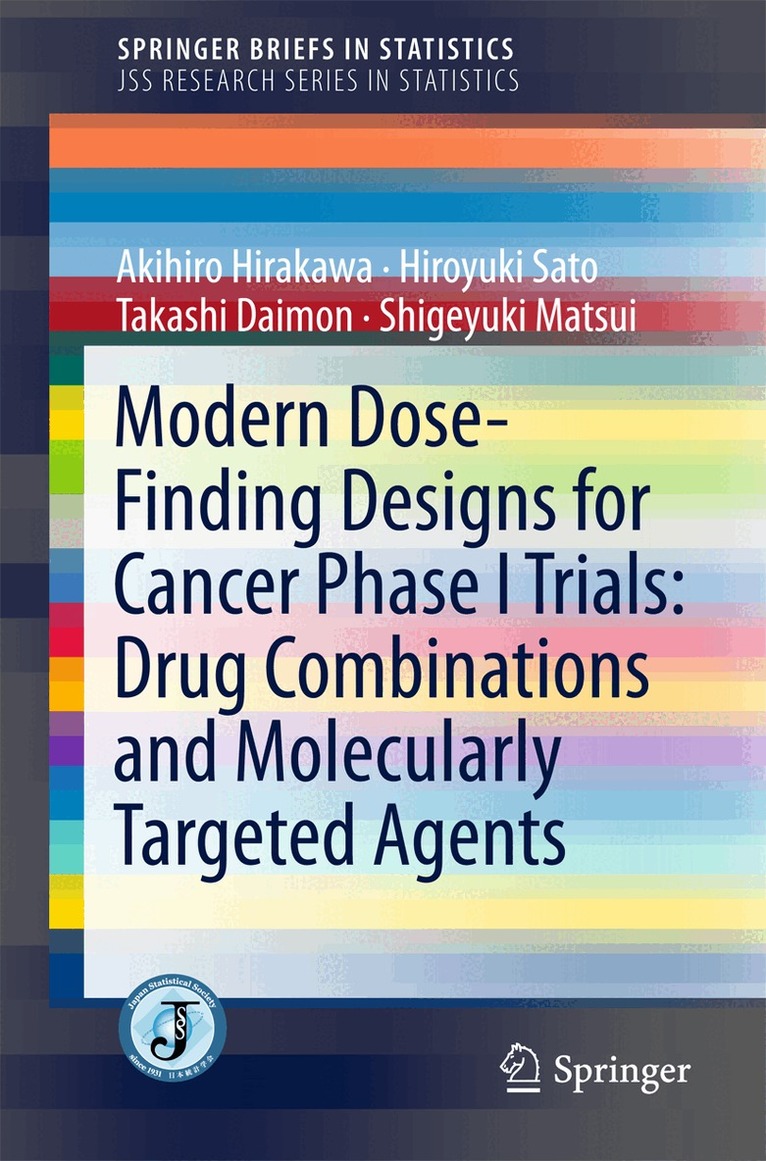
This book deals with advanced methods for adaptive phase I dose-finding clinical trials for combination of two agents and molecularly targeted agents (MTAs) in oncology. It provides not only methodological aspects of the dose-finding methods, but also software implementations and practical considerations in applying these complex methods to real cancer clinical trials. Thus, the book aims to furnish researchers in biostatistics and statistical science with a good summary of recent developments of adaptive dose-finding methods as well as providing practitioners in biostatistics and clinical investigators with advanced materials for designing, conducting, monitoring, and analyzing adaptive dose-finding trials. The topics in the book are mainly related to cancer clinical trials, but many of those topics are potentially applicable or can be extended to trials for other diseases. The focus is mainly on model-based dose-finding methods for two kinds of phase I trials. One is clinical trials with combinations of two agents. Development of dose-finding methods for two-agent combination trials requires reasonable models that can adequately capture joint toxicity probabilities for two agents, taking into consideration possible interactions of the two agents on toxicity probability such as synergistic or antagonistic effects. Another is clinical trials for evaluating both efficacy and toxicity outcomes in single- and two-agent combination trials. These methods are often applied to the phase I trials including MTAs because the toxicity and efficacy for a MTA does not monotonically increase with dose, but the efficacy often increases initially with the dose and then plateaus. Successful software implementations for several dose-finding methods are introduced in the book, and their operating characteristics in practice are discussed. Recent advance of the adaptive dose-finding methods in drug developments are also provided.
E-bok
Engelska, 2018870 kr
Läs direkt efter köp
This book deals with advanced methods for adaptive phase I dose-finding clinical trials for combination of two agents and molecularly targeted agents (MTAs) in oncology. It provides not only methodological aspects of the dose-finding methods, but also software implementations and practical considerations in applying these complex methods to real cancer clinical trials. Thus, the book aims to furnish researchers in biostatistics and statistical science with a good summary of recent developments of adaptive dose-finding methods as well as providing practitioners in biostatistics and clinical investigators with advanced materials for designing, conducting, monitoring, and analyzing adaptive dose-finding trials. The topics in the book are mainly related to cancer clinical trials, but many of those topics are potentially applicable or can be extended to trials for other diseases. The focus is mainly on model-based dose-finding methods for two kinds of phase I trials. One is clinical trials with combinations of two agents. Development of dose-finding methods for two-agent combination trials requires reasonable models that can adequately capture joint toxicity probabilities for two agents, taking into consideration possible interactions of the two agents on toxicity probability such as synergistic or antagonistic effects. Another is clinical trials for evaluating both efficacy and toxicity outcomes in single- and two-agent combination trials. These methods are often applied to the phase I trials including MTAs because the toxicity and efficacy for a MTA does not monotonically increase with dose, but the efficacy often increases initially with the dose and then plateaus. Successful software implementations for several dose-finding methods are introduced in the book, and their operating characteristics in practice are discussed. Recent advance of the adaptive dose-finding methods in drug developments are also provided.
Häftad, Engelska, 2019
677 kr
Skickas inom 10-15 vardagar
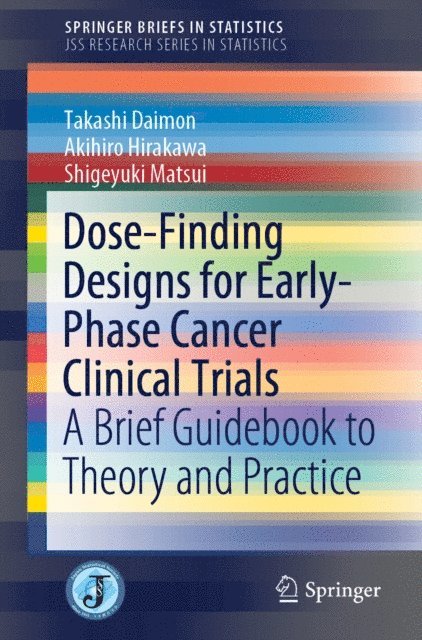
This book provides a comprehensive introduction to statistical methods for designing early phase dose-finding clinical trials. It will serve as a textbook or handbook for graduate students and practitioners in biostatistics and clinical investigators who are involved in designing, conducting, monitoring, and analyzing dose-finding trials. The book will also provide an overview of advanced topics and discussions in this field for the benefit of researchers in biostatistics and statistical science. Beginning with backgrounds and fundamental notions on dose finding in early phase clinical trials, the book then provides traditional and recent dose-finding designs of phase I trials for, e.g., cytotoxic agents in oncology, to evaluate toxicity outcome. Included are rule-based and model-based designs, such as 3 + 3 designs, accelerated titration designs, toxicity probability interval designs, continual reassessment method and related designs, and escalation overdose control designs. This bookalso covers more complex and updated dose-finding designs of phase I-II and I/II trials for cytotoxic agents, and cytostatic agents, focusing on both toxicity and efficacy outcomes, such as designs with covariates and drug combinations, maximum tolerated dose-schedule finding designs, and so on.
E-bok
Engelska, 2019870 kr
Läs direkt efter köp
This book provides a comprehensive introduction to statistical methods for designing early phase dose-finding clinical trials. It will serve as a textbook or handbook for graduate students and practitioners in biostatistics and clinical investigators who are involved in designing, conducting, monitoring, and analyzing dose-finding trials. The book will also provide an overview of advanced topics and discussions in this field for the benefit of researchers in biostatistics and statistical science. Beginning with backgrounds and fundamental notions on dose finding in early phase clinical trials, the book then provides traditional and recent dose-finding designs of phase I trials for, e.g., cytotoxic agents in oncology, to evaluate toxicity outcome. Included are rule-based and model-based designs, such as 3 + 3 designs, accelerated titration designs, toxicity probability interval designs, continual reassessment method and related designs, and escalation overdose control designs. This bookalso covers more complex and updated dose-finding designs of phase I-II and I/II trials for cytotoxic agents, and cytostatic agents, focusing on both toxicity and efficacy outcomes, such as designs with covariates and drug combinations, maximum tolerated dose-schedule finding designs, and so on.