Akira Maruoka – författare
Visar alla böcker från författaren Akira Maruoka. Handla med fri frakt och snabb leverans.
6 produkter
6 produkter
Inbunden, Engelska, 2011
544 kr
Skickas inom 10-15 vardagar
This textbook presents a thorough foundation to the theory of computation. Combining intuitive descriptions and illustrations with rigorous arguments and detailed proofs for key topics, the logically structured discussion guides the reader through the core concepts of automata and languages, computability, and complexity of computation. Topics and features: presents a detailed introduction to the theory of computation, complete with concise explanations of the mathematical prerequisites; provides end-of-chapter problems with solutions, in addition to chapter-opening summaries and numerous examples and definitions throughout the text; draws upon the author’s extensive teaching experience and broad research interests; discusses finite automata, context-free languages, and pushdown automata; examines the concept, universality and limitations of the Turing machine; investigates computational complexity based on Turing machines and Boolean circuits, as well as the notion of NP-completeness.
E-bok
PDF, Engelska, 2011687 kr
Läs direkt efter köp
This textbook presents a thorough foundation to the theory of computation. Combining intuitive descriptions and illustrations with rigorous arguments and detailed proofs for key topics, the logically structured discussion guides the reader through the core concepts of automata and languages, computability, and complexity of computation. Topics and features: presents a detailed introduction to the theory of computation, complete with concise explanations of the mathematical prerequisites; provides end-of-chapter problems with solutions, in addition to chapter-opening summaries and numerous examples and definitions throughout the text; draws upon the author’s extensive teaching experience and broad research interests; discusses finite automata, context-free languages, and pushdown automata; examines the concept, universality and limitations of the Turing machine; investigates computational complexity based on Turing machines and Boolean circuits, as well as the notion of NP-completeness.
Häftad, Engelska, 2014
544 kr
Skickas inom 10-15 vardagar
This textbook presents a thorough foundation to the theory of computation. Combining intuitive descriptions and illustrations with rigorous arguments and detailed proofs for key topics, the logically structured discussion guides the reader through the core concepts of automata and languages, computability, and complexity of computation. Topics and features: presents a detailed introduction to the theory of computation, complete with concise explanations of the mathematical prerequisites; provides end-of-chapter problems with solutions, in addition to chapter-opening summaries and numerous examples and definitions throughout the text; draws upon the author’s extensive teaching experience and broad research interests; discusses finite automata, context-free languages, and pushdown automata; examines the concept, universality and limitations of the Turing machine; investigates computational complexity based on Turing machines and Boolean circuits, as well as the notion of NP-completeness.
Häftad, Engelska, 2004
561 kr
Skickas inom 10-15 vardagar
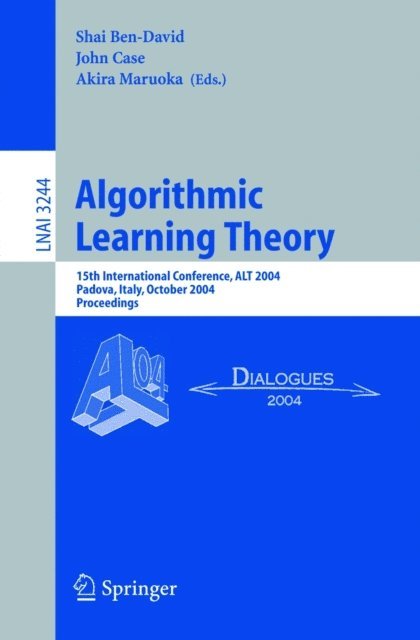
This book constitutes the refereed proceedings of the 15th International Conference on Algorithmic Learning Theory, ALT 2004, held in Padova, Italy in October 2004. The 29 revised full papers presented together with 5 invited papers and 3 tutorial summaries were carefully reviewed and selected from 91 submissions. The papers are organized in topical sections on inductive inference, PAC learning and boosting, statistical supervised learning, online sequence learning, approximate optimization algorithms, logic based learning, and query and reinforcement learning.
E-bok
PDF, Engelska, 2004708 kr
Läs direkt efter köp
Algorithmic learning theory is mathematics about computer programs which learn from experience. This involves considerable interaction between various mathematical disciplines including theory of computation, statistics, and c- binatorics. There is also considerable interaction with the practical, empirical ?elds of machine and statistical learning in which a principal aim is to predict, from past data about phenomena, useful features of future data from the same phenomena. The papers in this volume cover a broad range of topics of current research in the ?eld of algorithmic learning theory. We have divided the 29 technical, contributed papers in this volume into eight categories (corresponding to eight sessions) re?ecting this broad range. The categories featured are Inductive Inf- ence, Approximate Optimization Algorithms, Online Sequence Prediction, S- tistical Analysis of Unlabeled Data, PAC Learning & Boosting, Statistical - pervisedLearning,LogicBasedLearning,andQuery&ReinforcementLearning. Below we give a brief overview of the ?eld, placing each of these topics in the general context of the ?eld. Formal models of automated learning re?ect various facets of the wide range of activities that can be viewed as learning. A ?rst dichotomy is between viewing learning as an inde?nite process and viewing it as a ?nite activity with a de?ned termination. Inductive Inference models focus on inde?nite learning processes, requiring only eventual success of the learner to converge to a satisfactory conclusion.
Häftad, Engelska, 1997
561 kr
Skickas inom 10-15 vardagar
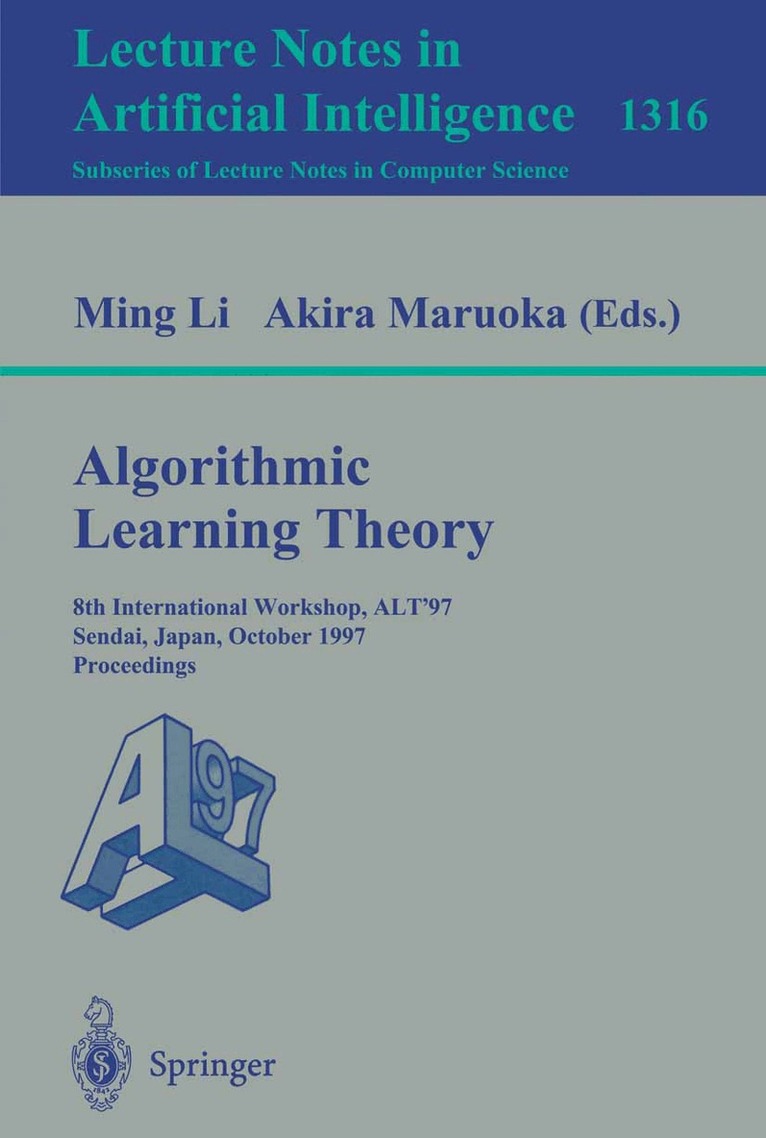
This book constitutes the refereed proceedings of the 8th International Workshop on Algorithmic Learning Theory, ALT'97, held in Sendai, Japan, in October 1997.The volume presents 26 revised full papers selected from 42 submissions. Also included are three invited papers by leading researchers. Among the topics addressed are PAC learning, learning algorithms, inductive learning, inductive inference, learning from examples, game-theoretical aspects, decision procedures, language learning, neural algorithms, and various other aspects of computational learning theory.