Alan Bollard - Böcker
Visar alla böcker från författaren Alan Bollard. Handla med fri frakt och snabb leverans.
9 produkter
9 produkter
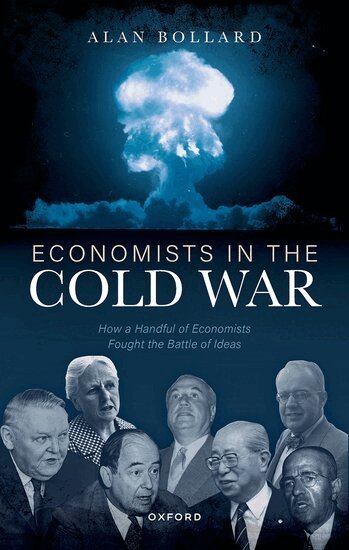
Economists in the Cold War
How a Handful of Economists Fought the Battle of Ideas
Inbunden, Engelska, 2023
396 kr
Skickas
Economists in the Cold War is an account of the economic drivers and outcomes of the Cold War, told through the stories of seven international economists, who were all closely involved in theory and policy in the period 1945-73. For them, the Cold War was a battle of economic ideas, a fight between central planning and market allocation, exploring economic thinking derived from the battle between Marxist and Capitalist ideologies, a fundamental difference but with many intricacies.The book recounts how economic theory advanced, how new economic tools were developed, and how policies were tested. Each chapter is based on the involvement of one of the selected economists. It was a challenging but dangerous time in economics: a time of economic recovery post-war, with industrial rebuilding, economic growth, and rising incomes. But it was also a time of ideological warfare, nuclear rivalry, military expansion, and personal conflict. The narrative is approximately chronological, ranging from the Potsdam Conference in Germany to the Pinochet Coup in Chile. The selected economists include an American, a Pole, a Hungarian, a German, a British, a Japanese, and an Argentinian, all very different economists, but with interconnections among them. Each chapter also features a dissenting economist who held a contrasting view, and recounts the subsequent economic arguments that played out.
259 kr
Skickas inom 7-10 vardagar
The Phillips Curve is world famous amongst economists. The man who invented it was an inventor, an engineer, a genius, who led an exciting life and contributed to economics in many different ways. Born and brought up on a remote farm in rural New Zealand, his early life was a search for adventure. He invented toys and rebuilt machinery as a child. He experienced the rigours of the Great Depression on construction sites, and while still a young man he roamed the outback of Australia picking up casual work, sometimes working in gold mines, sometimes crocodile hunting. In 1937 he set off to discover militarising Japan, a guerrilla war in Manchuria, Stalin's Soviet Union, and the tensions in Europe. On the outbreak of war, he joined the RAF and was sent to Singapore where he rearmed planes but was eventually incarcerated in a POW camp by the Japanese. In camp he learned languages, invented gadgets for the troops and built a clandestine radio. If his first 30 years had been a search for adventure, his later life was a search for economic stability. Back in Britain after the war, he scraped through a sociology degree at the LSE, before convincing a sceptical faculty to let him build a hydraulic model of the economy. This beautiful complex machine was a great success and put Bill Phillips on the track of serious economics. In the next few decades he developed new ideas for stabilising economies, was one of the first to use electronic computers, developed the Phillips Curve, showed ways to help an economy to grow, and developed new techniques to model economies. Always innovative, he took another heading in his later years, working out how to stabilise the Chinese economy which was being wracked by the Cultural Revolution. Bill Phillips pioneered a dozen new directions in economics, making him one of the most innovative and influential of our economic pioneers.
Economists at War
How a Handful of Economists Helped Win and Lose the World Wars
Inbunden, Engelska, 2019
454 kr
Skickas inom 5-8 vardagar
Wartime is not just about military success. Economists at War tells a different story - about a group of remarkable economists who used their skills to help their countries fight their battles during the Chinese-Japanese War, Second World War, and the Cold War.1935-55 was a time of conflict, confrontation, and destruction. It was also a time when the skills of economists were called upon to finance the military, to identify economic vulnerabilities, and to help reconstruction. Economists at War: How a Handful of Economists Helped Win and Lose the World Wars focuses on the achievements of seven finance ministers, advisors, and central bankers from Japan, China, Germany, the UK, the USSR, and the US. It is a story of good and bad economic thinking, good and bad policy, and good and bad moral positions. The economists suffered threats, imprisonment, trial, and assassination. They all believed in the power of economics to make a difference, and their contributions had a significant impact on political outcomes and military ends.Economists at War shows the history of this turbulent period through a unique lens. It details the tension between civilian resources and military requirements; the desperate attempts to control economies wracked with inflation, depression, political argument, and fighting; and the clever schemes used to evade sanctions, develop barter trade, and use economic espionage. Politicians and generals cannot win wars if they do not have the resources. This book tells the human stories behind the economics of wartime.
433 kr
Skickas inom 5-8 vardagar
224 kr
Skickas inom 5-8 vardagar
355 kr
Skickas inom 5-8 vardagar
206 kr
Tillfälligt slut
380 kr
Tillfälligt slut
271 kr
Skickas inom 5-8 vardagar