Alan Bundy – författare
Visar alla böcker från författaren Alan Bundy. Handla med fri frakt och snabb leverans.
7 produkter
7 produkter
Del 56 - Cambridge Tracts in Theoretical Computer Science
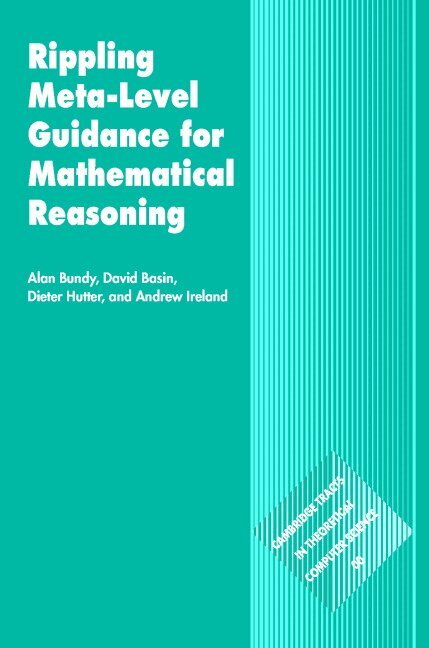
Rippling: Meta-Level Guidance for Mathematical Reasoning
Inbunden, Engelska, 2005
1 567 kr
Skickas inom 7-10 vardagar
Rippling is a radically new technique for the automation of mathematical reasoning. It is widely applicable whenever a goal is to be proved from one or more syntactically similar givens. It was originally developed for inductive proofs, where the goal was the induction conclusion and the givens were the induction hypotheses. It has proved to be applicable to a much wider class of tasks, from summing series via analysis to general equational reasoning. The application to induction has especially important practical implications in the building of dependable IT systems, and provides solutions to issues such as the problem of combinatorial explosion. Rippling is the first of many new search control techniques based on formula annotation; some additional annotated reasoning techniques are also described here. This systematic and comprehensive introduction to rippling, and to the wider subject of automated inductive theorem proving, will be welcomed by researchers and graduate students alike.
Häftad, Engelska, 1994
559 kr
Skickas inom 10-15 vardagar
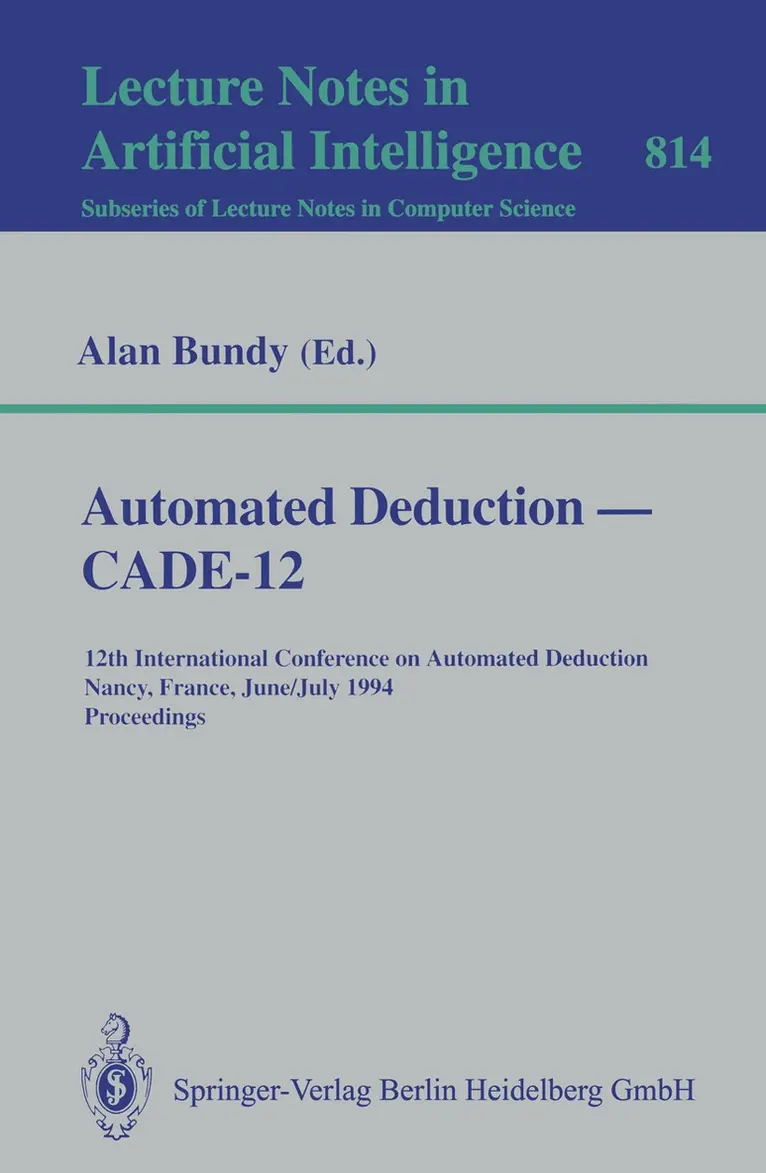
This volume contains the reviewed papers presented at the 12th International Conference on Automated Deduction (CADE-12) held at Nancy, France in June/July 1994.The 67 papers presented were selected from 177 submissions and document many of the most important research results in automated deduction since CADE-11 was held in June 1992. The volume is organized in chapters on heuristics, resolution systems, induction, controlling resolutions, ATP problems, unification, LP applications, special-purpose provers, rewrite rule termination, ATP efficiency, AC unification, higher-order theorem proving, natural systems, problem sets, and system descriptions.
Häftad, Engelska, 1996
559 kr
Skickas inom 10-15 vardagar
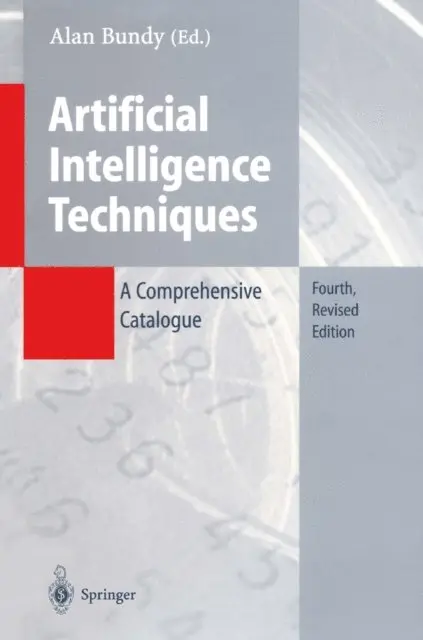
The purpose of "Artificial Intelligence Techniques: A Comprehensive Cata logue" is to promote interaction between members of the AI community. It does this by announcing the existence of AI techniques, and acting as a pointer into the literature. Thus the AI community has access to a common, extensional definition of the field, which promotes a common terminology, discourages the reinvention of wheels, and acts as a clearing house for ideas and algorithms. I am grateful to the impressive group of AI experts who have contributed the many descriptions of AI techniques which go to make up this Catalogue. They have managed to distill a very wide knowledge of AI into a very compact form. The Catalogue is a reference work providing a quick guide to the AI tech niques available for different tasks. Intentionally, it only provides a brief de scription of each technique, with no extended discussion of its historical origin or how it has been used in particular AI programs.
E-bok
PDF, Engelska, 2012687 kr
Läs direkt efter köp
The purpose of "Artificial Intelligence Techniques: A Comprehensive Cata logue" is to promote interaction between members of the AI community. It does this by announcing the existence of AI techniques, and acting as a pointer into the literature. Thus the AI community has access to a common, extensional definition of the field, which promotes a common terminology, discourages the reinvention of wheels, and acts as a clearing house for ideas and algorithms. I am grateful to the impressive group of AI experts who have contributed the many descriptions of AI techniques which go to make up this Catalogue. They have managed to distill a very wide knowledge of AI into a very compact form. The Catalogue is a reference work providing a quick guide to the AI tech niques available for different tasks. Intentionally, it only provides a brief de scription of each technique, with no extended discussion of its historical origin or how it has been used in particular AI programs.
E-bok
PDF, Engelska, 20121 174 kr
Läs direkt efter köp
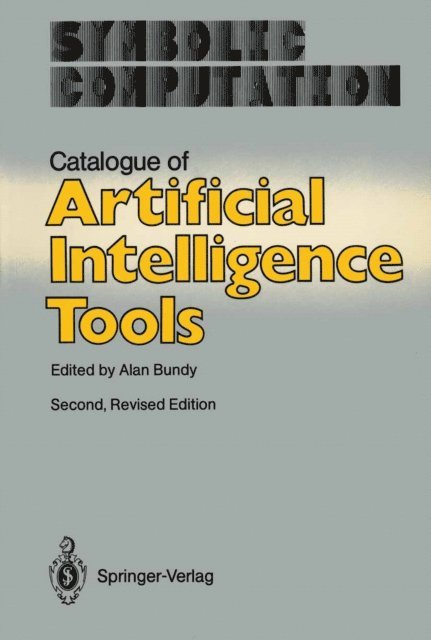
The purpose of this catalogue is to promote interaction between members of the AI community. It will do this by announcing the existence of AI techniques and portable software, and acting as 30 pointer into the literature. Thus the AI community will have access to 30 common, extensional definition of the field, which will: promote 30 common terminology, discourage the reinvention of w heels, and act as 30 clearing house for ideas and software. The catalogue is 30 reference work providing 30 quick guide to the AI tools ava.ilable for different jobs. It is not intended to be 30 textbook like the Artificial Intelligence Handbook. It, intentiona11y, only provides 30 brief description of each tool, with no extended discussion of the historical origin of the tool or how it has been used in particular AI programs. The focus is on techniques abstracted from their historical origins. The original version of the catalogue, was hastily built in 1983 as part of the UK SERC-DoI, IKBS, Architecture Study. It has now been adopted by the UK Alvey Programme and is both kept as an on-line document undergoing constant revision and refinement and published as 30 paperback by Springer-Verlag. Springer-Verlag have agreed to reprint the Catalogue at frequent intervals in order to keep it up to date.
E-bok
PDF, Engelska, 20121 416 kr
Läs direkt efter köp
The purpose of the Catalogue of Artificial Intelligence Techniques is to promote interaction between members of the AI community. It does this by announcing the existence of AI techniques, and acting as a pointer into the literature. Thus the AI community will have access to a common, extensional definition of the field, which will promote a common terminology, discourage the reinvention of wheels, and act as a clearing house for ideas and algorithms. The catalogue is a reference work providing a quick guide to the AI techniques available for different jobs. It is not intended to be a textbook like the Artificial Intelligence Handbook. Intentionally, it only provides a brief description of each technique, with no extended discussion of its historical origin or how it has been used in particular AI programs. The original version of the catalogue was hastily built in 1983 as part of the UK SERC-DoI, IKBS Architecture Study. It was adopted by the UK Alvey Programme and, during the life of the programme, was both circulated to Alvey grant holders in hard copy form and maintained as an on-line document. A version designed for the international community was published as a paperback by Springer-Verlag. All these versions have undergone constant revision and refinement. Springer-Verlag has agreed to reprint the catalogue at frequent intervals in order to keep it up to date and this is the third edition of their paperback version.
Häftad, Engelska, 2012
1 389 kr
Skickas inom 5-8 vardagar
The purpose of the Catalogue of Artificial Intelligence Techniques is to promote interaction between members of the AI community. It does this by announcing the existence of AI techniques, and acting as a pointer into the literature. Thus the AI community will have access to a common, extensional definition of the field, which will promote a common terminology, discourage the reinvention of wheels, and act as a clearing house for ideas and algorithms. The catalogue is a reference work providing a quick guide to the AI techniques available for different jobs. It is not intended to be a textbook like the Artificial Intelligence Handbook. Intentionally, it only provides a brief description of each technique, with no extended discussion of its historical origin or how it has been used in particular AI programs. The original version of the catalogue was hastily built in 1983 as part of the UK SERC-DoI, IKBS Architecture Study. It was adopted by the UK Alvey Programme and, during the life of the programme, was both circulated to Alvey grant holders in hard copy form and maintained as an on-line document. A version designed for the international community was published as a paperback by Springer-Verlag. All these versions have undergone constant revision and refinement. Springer-Verlag has agreed to reprint the catalogue at frequent intervals in order to keep it up to date and this is the third edition of their paperback version.