Alan Burton-Jones - Böcker
Visar alla böcker från författaren Alan Burton-Jones. Handla med fri frakt och snabb leverans.
4 produkter
4 produkter
1 944 kr
Skickas inom 5-8 vardagar
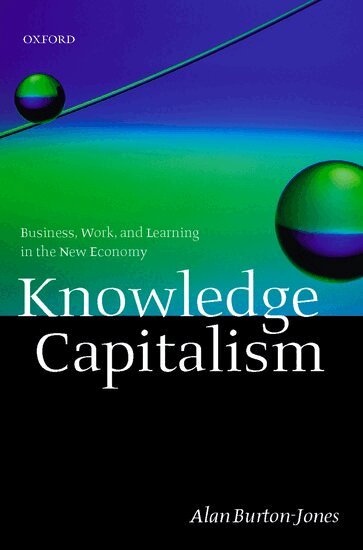
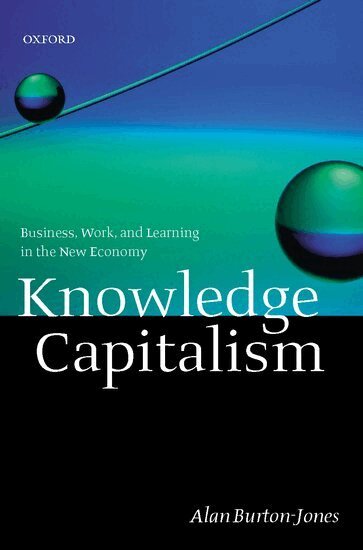
Knowledge Capitalism probes the surface of contemporary economic and social change, revealing how the shift to a knowledge-based economy is redefining firms, empowering individuals, and reshaping the links between learning and work. Using economic, management and knowledge-based theories, supported by empirical data and illustrations from leading companies, Knowledge Capitalism describes the emergence of a new breed of capitalist, one dependent on knowledge rather than physical resources. The author argues that industrial-era models of firm-market boundaries, work arrangements, and ownership and control are inhibiting firms and individuals success in the emerging knowledge economy. New models are proposed based on knowledge-centred organisation, knowledge-led growth, and knowledge supply as distinct from labour supply or flexible employment. Continuous learning is shown to be critical to firms as integrators of disparate knowledge resources, and the only practical route for individuals to become free agents. Knowledge Capitalism illuminates the new business landscape and provides a practical tool-set for business practitioners and theorists to interpret and manage change in a rapidly deconstructing economic environment.
658 kr
Skickas inom 7-10 vardagar
What will organizations and work be like in the future? Who will survive and prosper? Knowlege Capitalism reveals haw the shift to a knowledge-based economy is redefining firms, empowering individuals and reshaping the links between learning and work. Burton-Jones arguew that industrial-era models of firm-market boundaries, work arrangements, and ownership and control are inhibiting firms' and individuals' success in the emerging knowledge economy. New models are described to help management make better insourcing/outsourcing decisions, align organizational structure and incentives with knowledge goals, and plan learning and knowledge growth strategies. The author charts the change in the business/knowledge landscape with arresting clarity and an impressive range of evidence, including illustrations from leading companines. Every page contains something that will make you think about how you and your organization will need to adapt. Knowledge Capitalism provides a practical tool-set for anybody wantint to interpret and manage change in the new economy.
1 989 kr
Skickas inom 5-8 vardagar
Macroeconomic research on human capital - the stock of human capabilities and knowledge - has been extensively published but to date the literature has lacked a comprehensive analysis of human capital within the organization. The Oxford Handbook of Human Capital has been designed to fill that gap, providing an authoritative, inter-disciplinary, and up to date survey of relevant concepts, research areas, and applications. Specially commissioned contributions from over 40 authors reveal the importance of human capital for contemporary organizations, exploring its conceptual underpinnings, relevance to theories of the firm, implications for organizational effectiveness, interdependencies with other resources, and role in the future economy. Unlike neoclassical macroeconomic concepts of human capital, human capital in organizations is shown to be dynamic and heterogeneous, requiring new theories and management frameworks. The systemic role of human capital is explored, revealing it as the lynchpin of social, structural and other forms of intangible and tangible capital. Connections between human capital and organizational performance are investigated from HR management, procurement, alignment, value appropriation, and accounting perspectives. Links between micro and macro perspectives are provided through analyses of inter firm human capital mobility, national and regional human capital formation regimes and industry employment relations practices.This Handbook is designed for scholars and graduate students of organization and management theory, strategy, entrepreneurship, knowledge and intellectual capital, accounting, IT, HR, IR, economic sociology and cultural studies. For policy makers and practitioners it should provide an up to date guide to the nature and role of human capital in contemporary organizations and the roles that government, industry and other extra firm institutions can play in facilitating its development.
643 kr
Skickas inom 5-8 vardagar
Macroeconomic research on human capital - the stock of human capabilities and knowledge - has been extensively published but to date the literature has lacked a comprehensive analysis of human capital within the organization. The Oxford Handbook of Human Capital has been designed to fill that gap, providing an authoritative, inter-disciplinary, and up to date survey of relevant concepts, research areas, and applications. Specially commissioned contributions from over 40 authors reveal the importance of human capital for contemporary organizations, exploring its conceptual underpinnings, relevance to theories of the firm, implications for organizational effectiveness, interdependencies with other resources, and role in the future economy. Unlike neoclassical macroeconomic concepts of human capital, human capital in organizations is shown to be dynamic and heterogeneous, requiring new theories and management frameworks. The systemic role of human capital is explored, revealing it as the lynchpin of social, structural and other forms of intangible and tangible capital. Connections between human capital and organizational performance are investigated from HR management, procurement, alignment, value appropriation, and accounting perspectives. Links between micro and macro perspectives are provided through analyses of inter firm human capital mobility, national and regional human capital formation regimes and industry employment relations practices. This Handbook is designed for scholars and graduate students of organization and management theory, strategy, entrepreneurship, knowledge and intellectual capital, accounting, IT, HR, IR, economic sociology and cultural studies. For policy makers and practitioners it should provide an up to date guide to the nature and role of human capital in contemporary organizations and the roles that government, industry and other extra firm institutions can play in facilitating its development.