Alan G. Futerman - Böcker
Visar alla böcker från författaren Alan G. Futerman. Handla med fri frakt och snabb leverans.
5 produkter
5 produkter
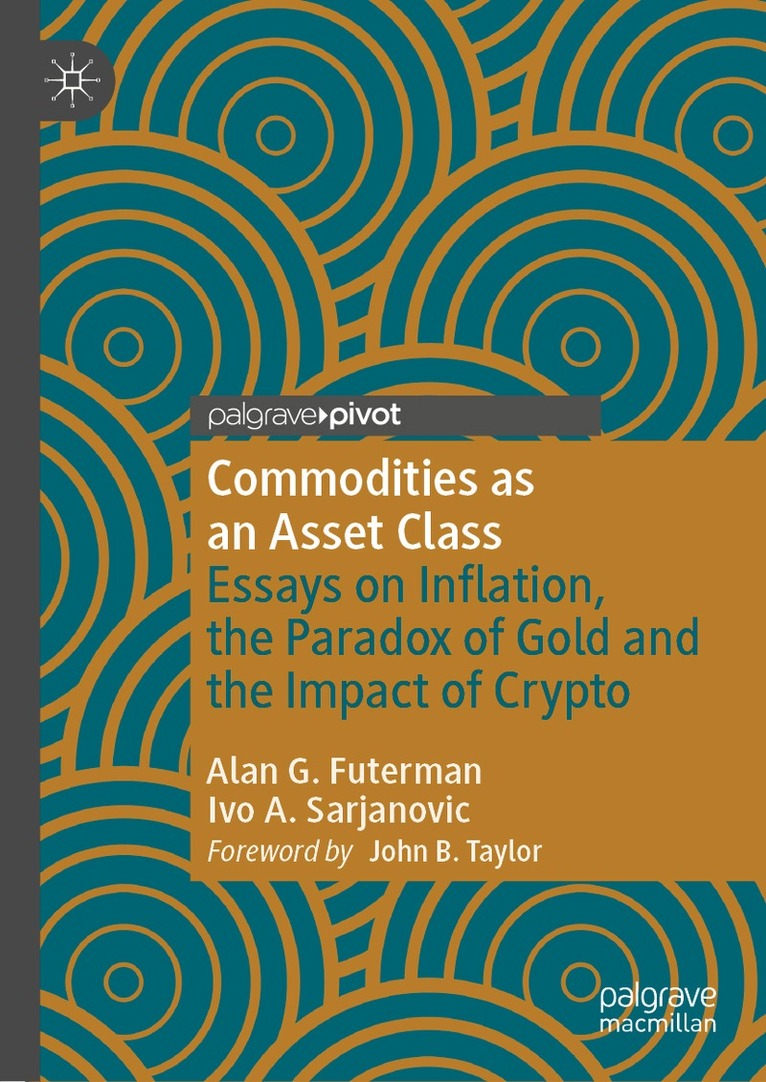
Commodities as an Asset Class
Essays on Inflation, the Paradox of Gold and the Impact of Crypto
Inbunden, Engelska, 2022
573 kr
Skickas inom 5-8 vardagar
This book challenges the notion that commodities are always good hedges against inflation, which is the conventional belief today in financial markets.
1 381 kr
Skickas inom 10-15 vardagar
This book offers a unique perspective on the State of Israel based on classical liberalism, both on a historical and theoretical level. Specifically, it makes a classical liberal and libertarian analysis based upon homesteading and private property rights to defend the State of Israel. As such, this work explores the history of the Jewish State, both to provide a positive case for its right to exist, and to clarify the myths surrounding its origin and development. At the same time, it deals with other relevant related subjects, such as the complex situation between Israel and the Palestinian Arabs, the military campaigns against the Jewish State, the connection between anti-Zionism and anti-Semitism, and Israel’s economic miracle. The thorough analysis presented in this work intends to show not only why the voices and movements against Israel are wrong (including the Boycott, Divestment and Sanctions movement, BDS), but more importantly, why Israel is an example of human flourishing and freedom that every advocate for liberty should celebrate. The Classical Liberal Case for Israel makes the practical and moral case for Israel. It is based on truths and facts that need to be repeated over and over.Block & Futerman understand that the only way to defeat a big lie is with a big truth.Benjamin Netanyahu, Prime Minister of the State of Israel, Jerusalem, Israel Classical Liberalism, often associated with the spread West from Northern Europe in creating free nations, is argued here as applying to Israel, with ancient roots in the principles of human freedom.Vernon L. Smith, Ph.D. Nobel Prize in Economic Sciences (2002), and Professor, George L. Argyros Endowed Chair in Finance and Economics, Professor of Economics and Law, SmithInstitute for Political Economy and Philosophy, at Chapman University.
1 381 kr
Skickas inom 10-15 vardagar
This book offers a unique perspective on the State of Israel based on classical liberalism, both on a historical and theoretical level. Specifically, it makes a classical liberal and libertarian analysis based upon homesteading and private property rights to defend the State of Israel. As such, this work explores the history of the Jewish State, both to provide a positive case for its right to exist, and to clarify the myths surrounding its origin and development. At the same time, it deals with other relevant related subjects, such as the complex situation between Israel and the Palestinian Arabs, the military campaigns against the Jewish State, the connection between anti-Zionism and anti-Semitism, and Israel’s economic miracle. The thorough analysis presented in this work intends to show not only why the voices and movements against Israel are wrong (including the Boycott, Divestment and Sanctions movement, BDS), but more importantly, why Israel is an example of human flourishing and freedom that every advocate for liberty should celebrate. The Classical Liberal Case for Israel makes the practical and moral case for Israel. It is based on truths and facts that need to be repeated over and over.Block & Futerman understand that the only way to defeat a big lie is with a big truth.Benjamin Netanyahu, Prime Minister of the State of Israel, Jerusalem, Israel Classical Liberalism, often associated with the spread West from Northern Europe in creating free nations, is argued here as applying to Israel, with ancient roots in the principles of human freedom.Vernon L. Smith, Ph.D. Nobel Prize in Economic Sciences (2002), and Professor, George L. Argyros Endowed Chair in Finance and Economics, Professor of Economics and Law, SmithInstitute for Political Economy and Philosophy, at Chapman University.
Austro-Libertarian Point of View
Essays on Austrian Economics and Libertarianism
Inbunden, Engelska, 2021
1 096 kr
Skickas inom 10-15 vardagar
This book covers several areas of economic theory and political philosophy from the perspective of Austrian Economics and libertarianism. As such, it deals with Epistemology and Methodology, Microeconomics, Macroeconomics, Labor Economics, International Economics, Political Philosophy, Law and Public Policy, all from the Austro-libertarian perspective.Hence, this book offers an integrated view of libertarianism and Austrian economics in the light of recent debates in the areas of economic science and political philosophy. Moreover, it builds from the foundations of the Austrian approach (epistemology and methodology), while the latter material deals with its application to the individual from the microeconomic perspective, which in turn allows an exploration of subjects in macroeconomics. Additionally, this work applies Austro-libertarianism to law, politics, and public policy. Thus, it offers a unified view of the entire approach, in a logical progression, allowing thereaders to judge this perspective in full.Futerman and Block say that their book is not a manual, which I suppose it is not. But it is a collection of highly pertinent essays, from which you can understand what is mistaken in the orthodoxy of economics, law, and politics. The central term of art in Austrian economics is that phrase “human action.” It is the exercise of human will, not the blind bumping of one molecule against another or one organism against another, as in the physical sciences…Futerman and Block distinguish Austrian economics as a scientific enterprise based on liberty of the will from “libertarianism” as an advocacy based on policies implied by such liberty. “Although Austrian economics is positive and libertarianism is normative,” they write, “this book shows how both are related; how each can support the other.” Indeed they do.Deirdre N. McCloskey, PhDUIC Distinguished Professor of Economics and ofHistory Emerita,Professor of English Emerita,Professor of Communication Emerita,University of Illinois at Chicago
Austro-Libertarian Point of View
Essays on Austrian Economics and Libertarianism
Häftad, Engelska, 2022
769 kr
Skickas inom 10-15 vardagar
This book covers several areas of economic theory and political philosophy from the perspective of Austrian Economics and libertarianism. As such, it deals with Epistemology and Methodology, Microeconomics, Macroeconomics, Labor Economics, International Economics, Political Philosophy, Law and Public Policy, all from the Austro-libertarian perspective.Hence, this book offers an integrated view of libertarianism and Austrian economics in the light of recent debates in the areas of economic science and political philosophy. Moreover, it builds from the foundations of the Austrian approach (epistemology and methodology), while the latter material deals with its application to the individual from the microeconomic perspective, which in turn allows an exploration of subjects in macroeconomics. Additionally, this work applies Austro-libertarianism to law, politics, and public policy. Thus, it offers a unified view of the entire approach, in a logical progression, allowing thereaders to judge this perspective in full.Futerman and Block say that their book is not a manual, which I suppose it is not. But it is a collection of highly pertinent essays, from which you can understand what is mistaken in the orthodoxy of economics, law, and politics. The central term of art in Austrian economics is that phrase “human action.” It is the exercise of human will, not the blind bumping of one molecule against another or one organism against another, as in the physical sciences…Futerman and Block distinguish Austrian economics as a scientific enterprise based on liberty of the will from “libertarianism” as an advocacy based on policies implied by such liberty. “Although Austrian economics is positive and libertarianism is normative,” they write, “this book shows how both are related; how each can support the other.” Indeed they do.Deirdre N. McCloskey, PhDUIC Distinguished Professor of Economics and ofHistory Emerita,Professor of English Emerita,Professor of Communication Emerita,University of Illinois at Chicago