Alan R. Townsend - Böcker
Visar alla böcker från författaren Alan R. Townsend. Handla med fri frakt och snabb leverans.
4 produkter
4 produkter
New Perspectives on Nitrogen Cycling in the Temperate and Tropical Americas
Report of the International SCOPE Nitrogen Project
Inbunden, Engelska, 1999
1 062 kr
Skickas inom 10-15 vardagar
The global cycle of nitrogen has been altered by human activity to a greater extent than that of any other element. The production of nitrogen fertilizer, cultivation of legumes, and incidental nitrogen fixation in internal combustion engines together transfer more nitrogen from the atmosphere into biologically available forms than is fixed by all natural processes combined. Additionally, biomass burning and land-use change mobilize large quantities of recalcitrant nitrogen into dynamic forms. Although the global change in nitrogen cycling is immense, reactive and biologically available forms of nitrogen do not truly cycle globally. Rather, their transport is over distances of tens to many hundreds of kilometers. Consequently, the alteration of the global nitrogen cycle is manifested as changes at the scale of large regions. Since 1994 the International SCOPE Nitrogen Project has held a series of workshops focused upon nitrogen dynamics in several different regions of the globe.
1 303 kr
Skickas inom 10-15 vardagar
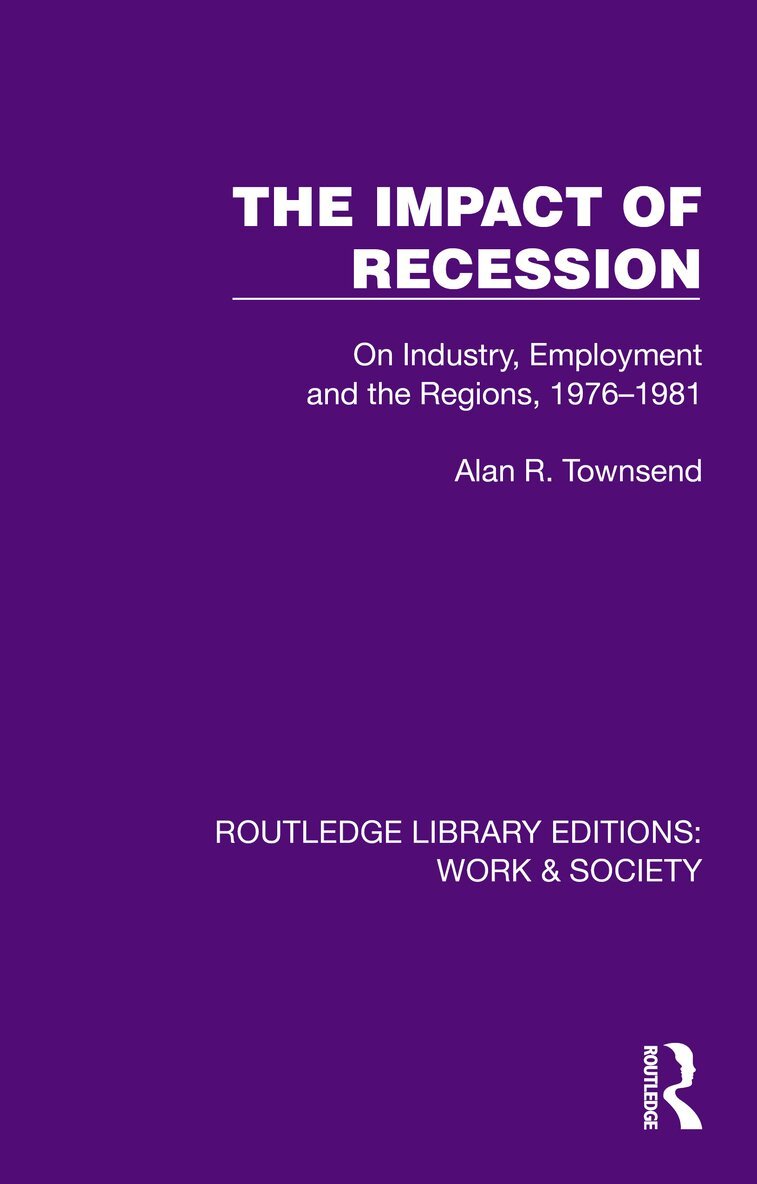
Rich industrialised countries entered the 1980s with unemployment higher than before the Second World War. Britain experienced the impact of recession more immediately and sharply; over one million factory jobs were lost. Originally published in 1983 and now reissued with a new Preface by the author, this book points to the industries, corporations and places in which job losses occurred between 1976 and 1981. The Impact of Recession opens with an examination of national trends which includes the post-war rise and fall of manufacturing employment and the fashionable concept of ‘de-industrialisation’. It considers the possible and actual roles of leading industrial corporations in distributing decline to different areas. The effects of the crisis on individual regions is examined in detail and the author emphasizes that it is not only the traditional areas of recession such as the North East that were affected, but also the manufacturing centres of the Midlands and the normally prosperous South East. Alternative explanations of the distribution of employment are examined and the adequacy of previous explanations of unequal growth and decline are questioned. The book also looks at the extent to which New Towns have suffered in the crisis and whether the well-established consensus about the merits of regional planning has been broken down by the recession.
453 kr
Skickas inom 10-15 vardagar
Rich industrialised countries entered the 1980s with unemployment higher than before the Second World War. Britain experienced the impact of recession more immediately and sharply; over one million factory jobs were lost. Originally published in 1983 and now reissued with a new Preface by the author, this book points to the industries, corporations and places in which job losses occurred between 1976 and 1981. The Impact of Recession opens with an examination of national trends which includes the post-war rise and fall of manufacturing employment and the fashionable concept of ‘de-industrialisation’. It considers the possible and actual roles of leading industrial corporations in distributing decline to different areas. The effects of the crisis on individual regions is examined in detail and the author emphasizes that it is not only the traditional areas of recession such as the North East that were affected, but also the manufacturing centres of the Midlands and the normally prosperous South East. Alternative explanations of the distribution of employment are examined and the adequacy of previous explanations of unequal growth and decline are questioned. The book also looks at the extent to which New Towns have suffered in the crisis and whether the well-established consensus about the merits of regional planning has been broken down by the recession.
New Perspectives on Nitrogen Cycling in the Temperate and Tropical Americas
Report of the International SCOPE Nitrogen Project
Häftad, Engelska, 2012
1 062 kr
Skickas inom 10-15 vardagar
Inputs of nitrogen to terrestrial and aquatic ecosystems have increased several-fold over the last one hundred and fifty years, with the steepest increases during the last four decades. The expansion of fertilizer manu facture and use, the increase in fossil fuel combustion, the intensification of animal husbandry, and widespread cultivation of N2 fixing crops have all contributed to the dramatic increase in N inputs. The increase has been most rapid in Northern Hemisphere (NH) temperate ecosystems, but presently subtropical and tropical regions of Asia are also experiencing an explosive increase in N inputs to terrestrial ecosystems (W. Chameides, pers. comm. ; Galloway et al. 1996). Projected increases in N deposition for these trop ical and subtropical regions, with a high natural background of N inputs, exceed increases projected for temperate and arctic regions (Cleveland et al. submitted; Galloway et al. 1994; Holland & Lamarque 1997a). Compared to biological N fixation, N deposition is becoming a proportionately greater source of N to terrestrial and aquatic ecosystems worldwide (Vitousek et al. 1997). 6 The nitrogen contained in the atmosphere as N , 3. 9 * 10 Tg (Tg = 2 12 10 g), is the largest reservoir of N in the Earth system (Warneck 1988). However, this paper focuses on the nitrogen emissions and deposition that have been transformed from N2 into reactive forms that are biologically avail able (e. g. Vitousek et al. 1997).