Alan Schrift - Böcker
Visar alla böcker från författaren Alan Schrift. Handla med fri frakt och snabb leverans.
14 produkter
14 produkter
659 kr
Skickas inom 10-15 vardagar
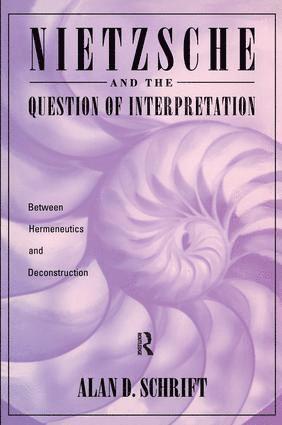
The first attempt at assessing the references to interpretation theory in the Nietzschean text.
578 kr
Skickas inom 10-15 vardagar
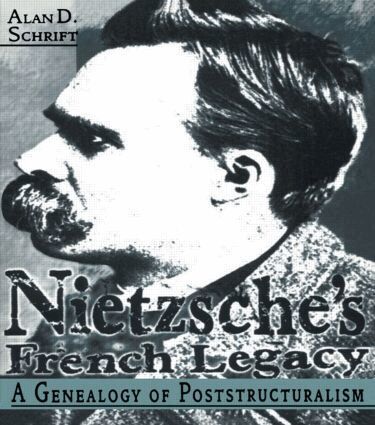
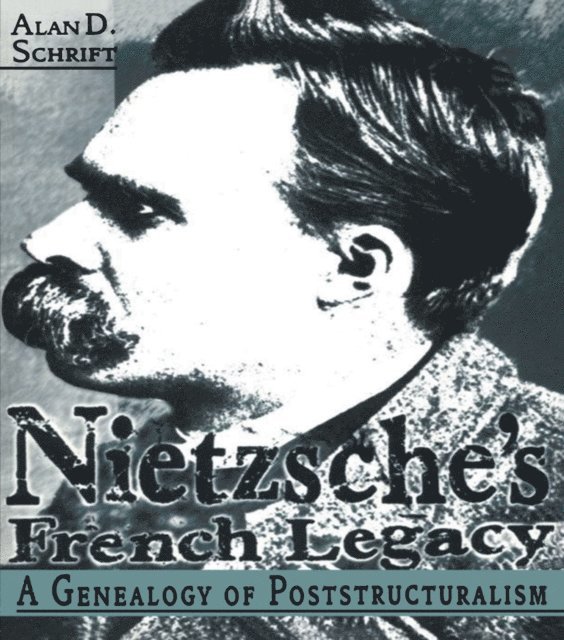
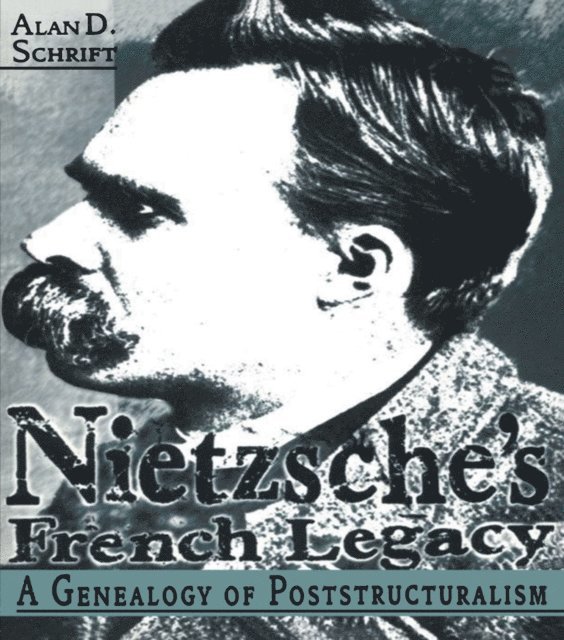
More than any other figure, Friedrich Nietzsche is cited as the philosopher who anticipates and previews the philosophical themes that have dominated French theory since structuralism. Informed by the latest developments in both contemporary French philosophy and Nietzsche scholarship, Alan Schrift's Nietzsche's French Legacy provides a detailed examination and analysis of the way the French have appropriated Nietzsche in developing their own critical projects. Using Nietzsche's thought as a springboard, this study makes accessible the ideas of some of the most important and difficult of contemporary French poststructuralist theorists including Jacques Derrida, Gilles Deleuze, Michel Foucault and Helene Cixous. Through a careful analysis and close reading of the texts of Nietzsche and French poststructuralism, Schrift illuminates the ways in which Nietzsche's thought prefigures certain poststructuralist motifs. He demonstrates how several dominant themes in contemporary French philosophy emerge out of Nietzsche's own thinking. As one of the first books to critically examine the work of the new French anti-Nietzschean's, Schrift defends the value of poststructuralism and Nietzsche as critical resources for confronting the present.
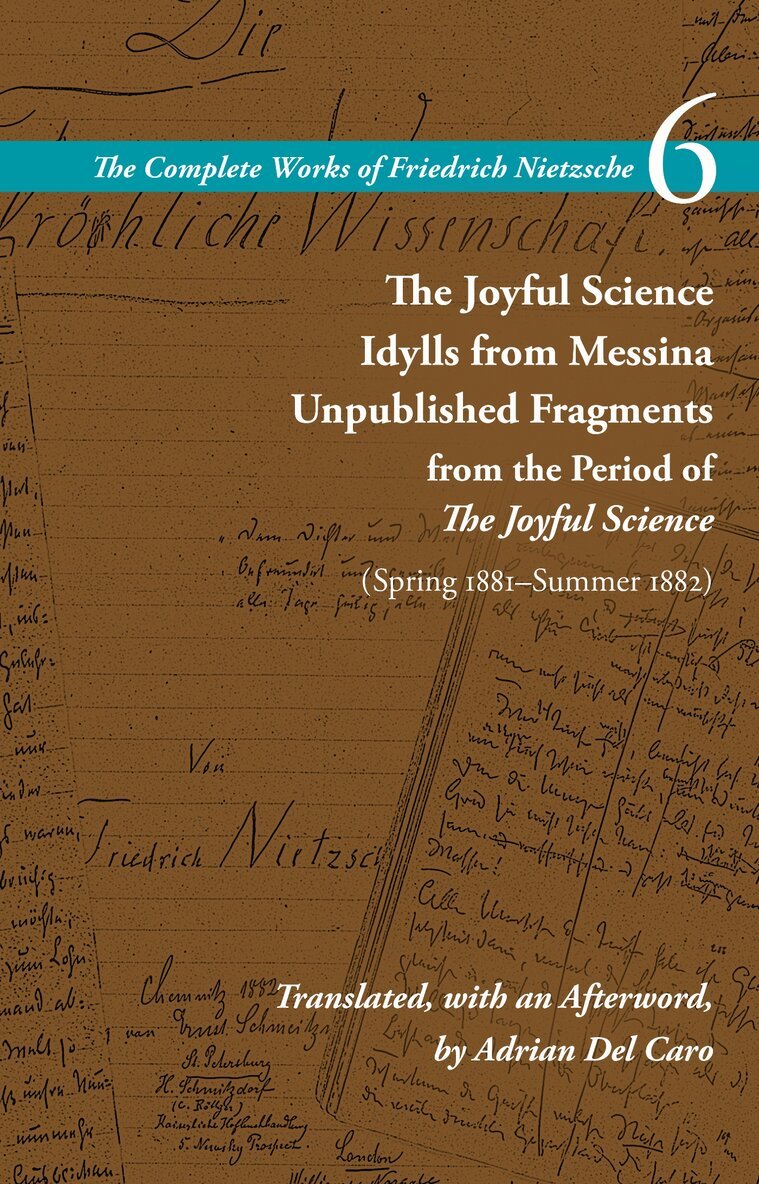
Joyful Science / Idylls from Messina / Unpublished Fragments from the Period of the Joyful Science (Spring 1881–Summer 1882)
Volume 6
Inbunden, Engelska, 2023
956 kr
Skickas inom 7-10 vardagar
Written on the threshold of Thus Spoke Zarathustra during a high point of social, intellectual and psychic vibrancy, The Joyful Science (frequently translated as The Gay Science) is one of Nietzsche's thematically tighter books. Here he debuts and practices the art of amor fati, love of fate, to explore what is "species preserving" in relation to happiness (Book One); inspiration and the role of art as they keep us mentally fit for inhabiting a world dominated by science (Book Two); the challenges of living authentically and overcoming after the death of God (Book Three); and the crescendo of life affirmation in which Nietzsche revealed the doctrine of eternal recurrence and previewed the figure of Zarathustra (Book Four). Invigorated and motivated by Thus Spoke Zarathustra and Beyond Good and Evil, Nietzsche in 1887 added a new preface, an appendix of poems, and Book Five, where he deepened the critique of science and displayed a more genealogical approach. This volume provides the first English translation of the Idylls from Messina and, more importantly, it includes the first English translation of the notebooks of 1881–1882, in which Nietzsche first formulated the eternal recurrence. Structurally and stylistically, The Joyful Science remains Nietzsche's most effective book of aphorisms, immediately after which he took on the voice and alter ego of Zarathustra in order to push beyond the boundaries of even the most liberating prose.
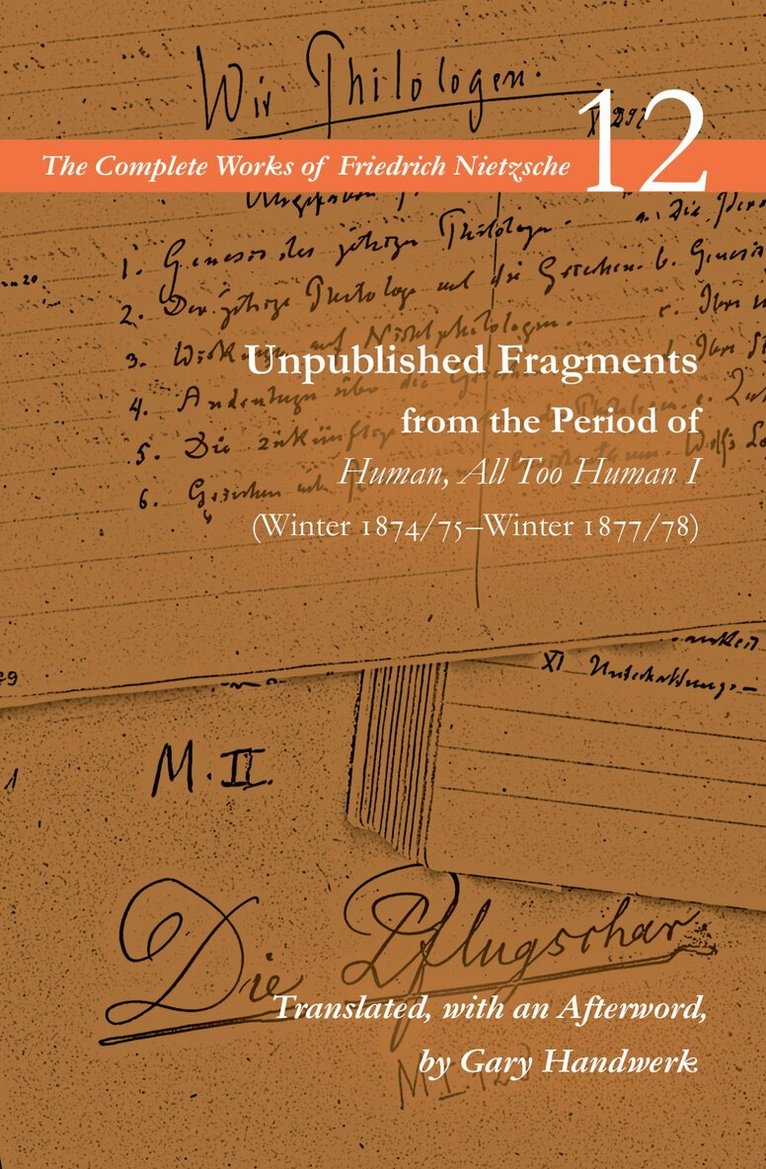
Unpublished Fragments from the Period of Human, All Too Human I (Winter 1874/75–Winter 1877/78)
Volume 12
Inbunden, Engelska, 2021
1 272 kr
Skickas inom 7-10 vardagar
This volume in The Complete Works presents the first English translations of Nietzsche's unpublished notebooks from Winter 1874/1875 through 1878, the period in which he developed the mixed aphoristic-essayistic mode that continued across the rest of his career. These notebooks comprise a range of different materials, including early drafts and near-final versions of aphorisms that would appear in both volumes of Human, All Too Human. Additionally, there are extensive notes for a never-completed Unfashionable Observation that was to be titled "We Philologists," early drafts for the final sections of "Richard Wagner in Bayreuth," plans for other possible publications, and detailed reading notes on philologists, philosophers, and historians of his era, including Friedrich August Wolf, Eugen Dühring, and Jacob Burckhardt. Through this volume, readers gain insight into Nietzsche's emerging sense of himself as a composer of complexly orchestrated, stylistically innovative philosophical meditations—influenced by, but moving well beyond, the modes used by aphoristic precursors such as Goethe, La Rochefoucauld, Vauvenargues, and Schopenhauer. Further, these notebooks allow readers to trace more closely Nietzsche's development of ideas that remain central to his mature philosophy, such as the contrast between free and constrained spirits, the interplay of national, supra-national, and personal identities, and the cultural centrality of the process of Bildung as formation, education, and cultivation. With this latest book in the series, Stanford continues its English-language publication of the famed Colli-Montinari edition of Nietzsche's complete works, which include the philosopher's notebooks and early unpublished writings. Scrupulously edited so as to establish a new standard for the field, each volume includes an Afterword that presents and contextualizes the material it contains.
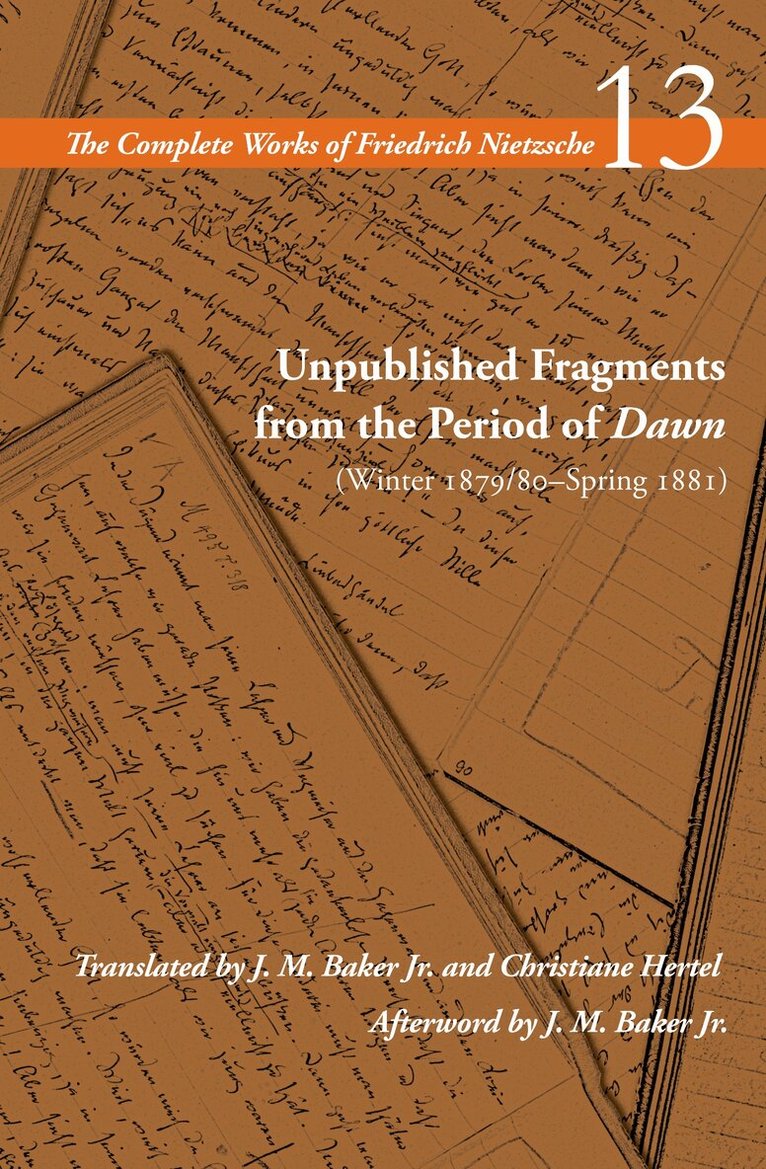
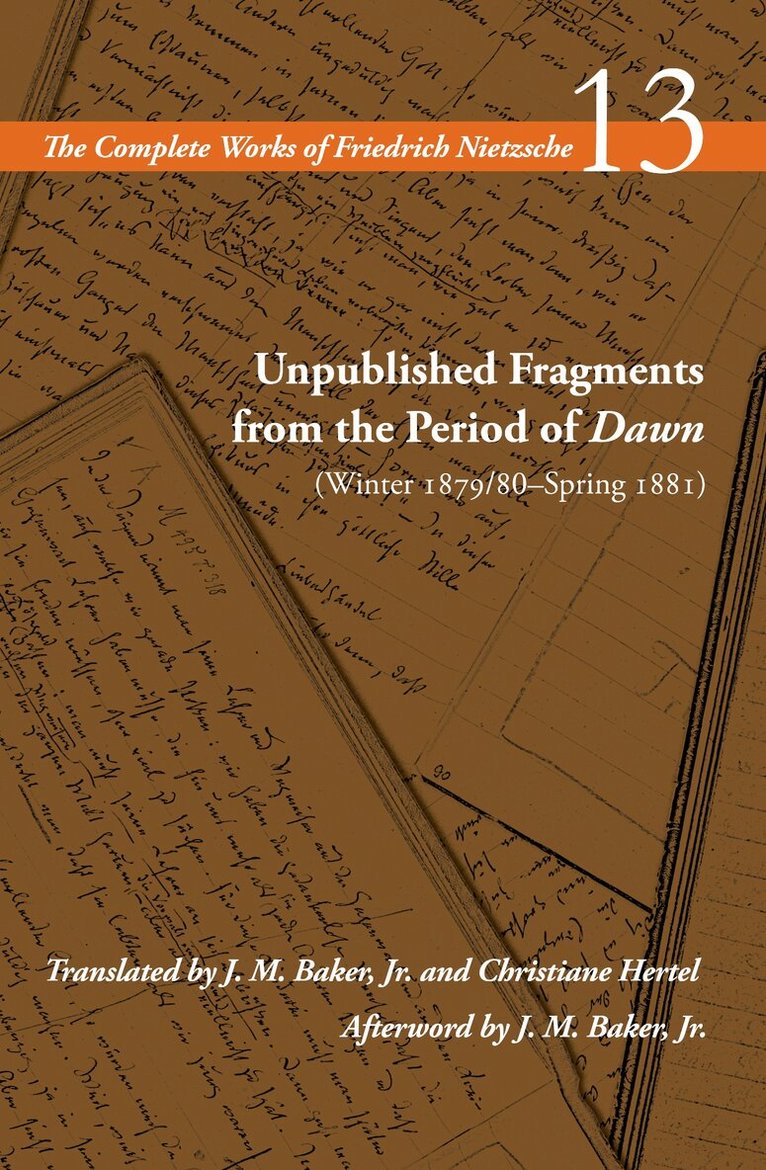
Unpublished Fragments from the Period of Dawn (Winter 1879/80–Spring 1881)
Volume 13
Inbunden, Engelska, 2023
1 378 kr
Skickas inom 7-10 vardagar
This volume provides the first English translation of Nietzsche's unpublished notes from late 1879 to early 1881, the period in which he authored Dawn, the second book in the trilogy that began with Human, All Too Human and concluded with The Joyful Science.In these fragments, we see Nietzsche developing the conceptual triad of morals, customs, and ethics, which undergirds his critique of morality as the reification into law or dogma of conceptions of good and evil. Here, Nietzsche assesses Christianity's role in the determination of moral values as the highest values and of redemption as the representation of humanity's highest aspirations. These notes show the resulting tension between Nietzsche's contrasting thoughts on modernity, which he critiques as an unrecognized aftereffect of the Christian worldview, but also views as the springboard to "the dawn" of a transformed humanity and culture. The fragments further allow readers insight into Nietzsche's continuous internal debate with exemplary figures in his own life and culture—Napoleon, Schopenhauer, and Wagner—who represented challenges to hitherto existing morals and culture—challenges that remained exemplary for Nietzsche precisely in their failure. Presented in Nietzsche's aphoristic style, Dawn is a book that must be read between the lines, and these fragments are an essential aid to students and scholars seeking to probe this work and its partners.
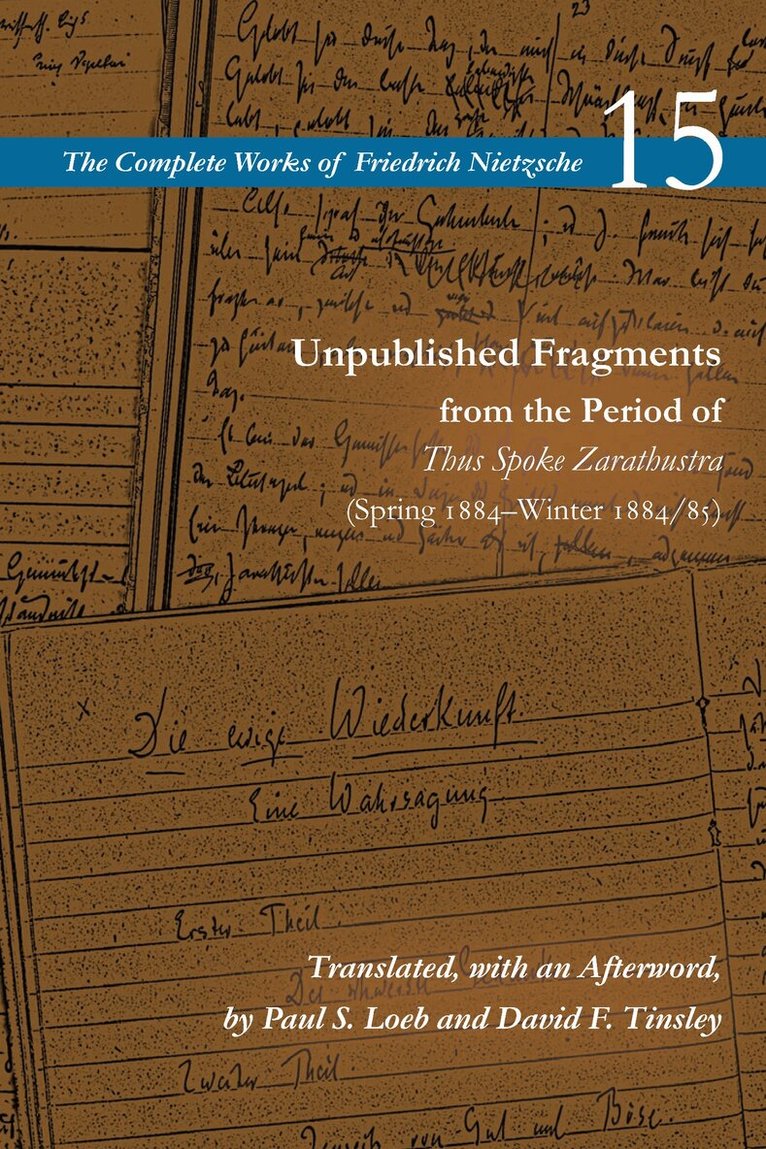
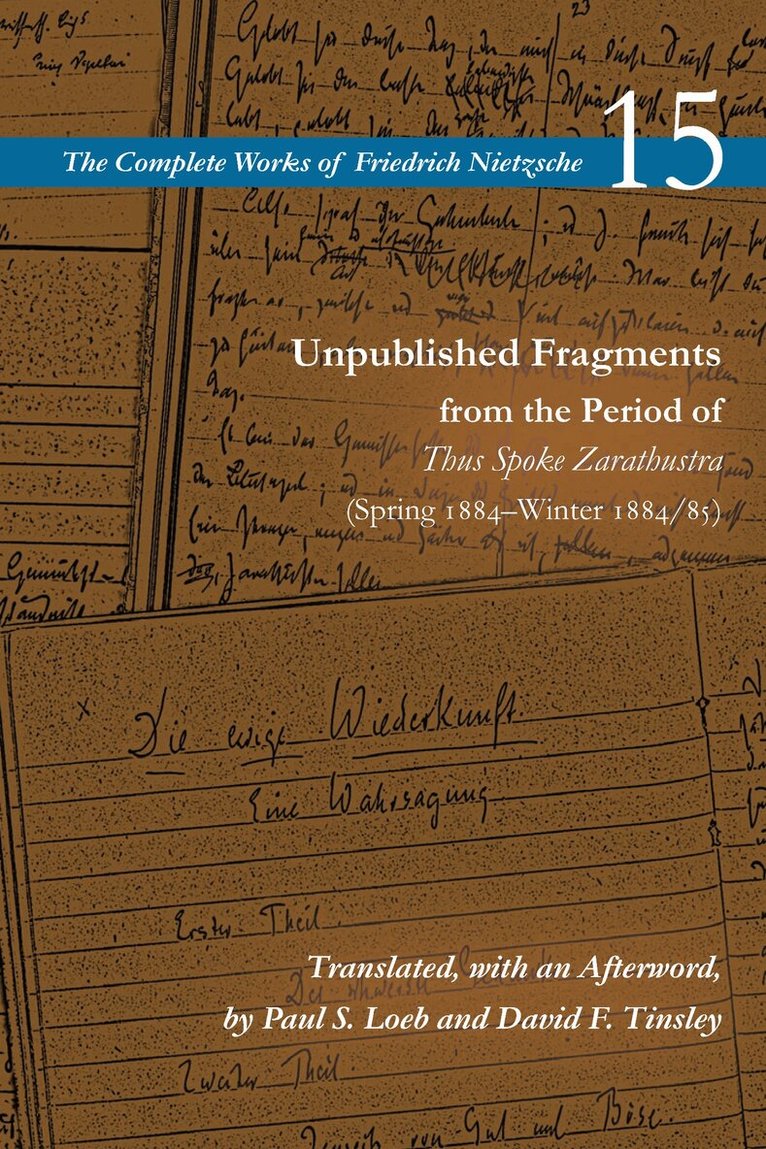
Unpublished Fragments from the Period of Thus Spoke Zarathustra (Spring 1884–Winter 1884/85)
Volume 15
Inbunden, Engelska, 2022
1 272 kr
Skickas inom 7-10 vardagar
This volume provides the first English translation of Nietzsche's unpublished notes from the spring of 1884 through the winter of 1884–85, the period in which he was composing the fourth and final part of his favorite work, Thus Spoke Zarathustra. These notebooks therefore provide special insight into Nietzsche's philosophical concept of superior humans,as well as important clues to the identities of the famous nineteenth-century European figures who inspired Nietzsche's invention of fictional characters such as "the prophet," "the sorcerer," and "the ugliest human."In these notebooks, Nietzsche also further explores ideas that were introduced in the first three parts of Thus Spoke Zarathustra: Zarathustra's teaching about the death of God; his proclamation that it is time for humankind to overcome itself and create the superhumans; his discovery that the secret of life is the will to power; and his most profound thought—that the entire cosmos will eternally return.Readers will encounter here a wealth of material that Nietzsche would include in his next book, Beyond Good and Evil, as he engages the ideas of Kant and Schopenhauer, challenges cultural icons like Richard Wagner, and mercilessly exposes the foibles of his contemporaries, especially of his fellow Germans. Readers will also discover an extensive collection of Nietzsche's poetry. Richly annotated and accompanied by a detailed translators' afterword, this volume showcases the cosmopolitanism at work in Nietzsche's multifaceted and critical exploration of aesthetic and cultural influences that transcend national (and nationalist) notions of literature, music, and culture.
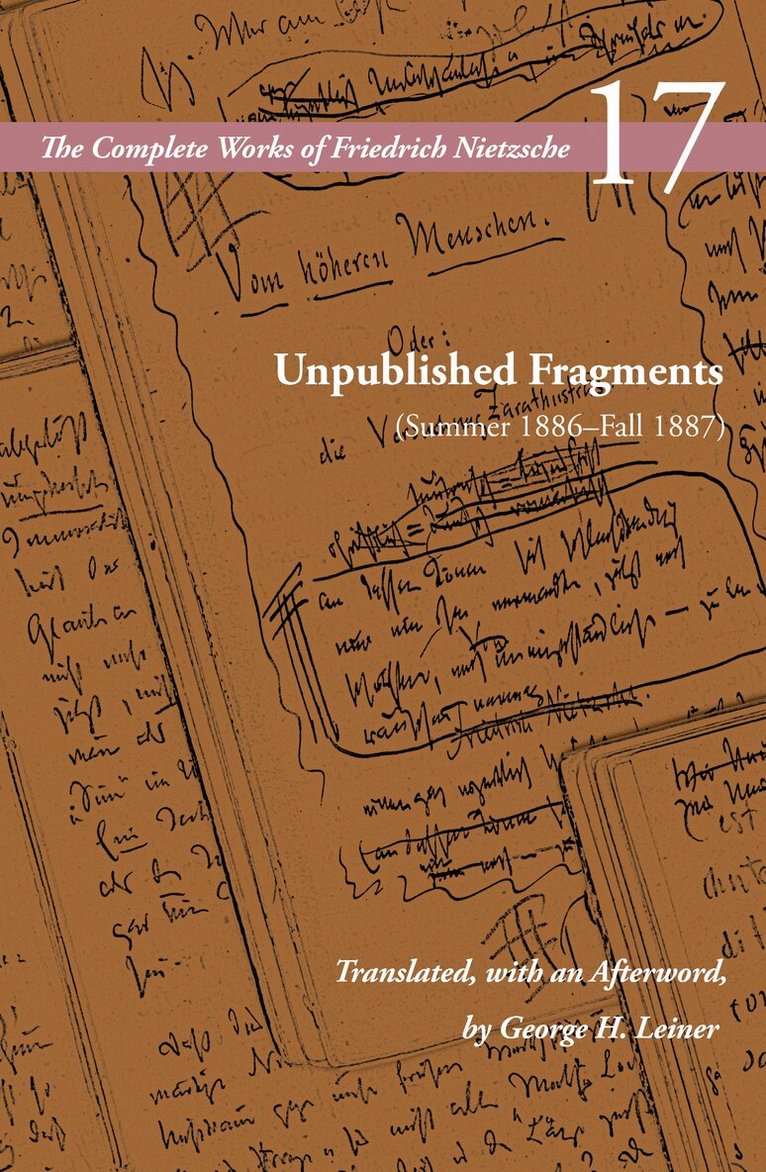
1 378 kr
Skickas inom 7-10 vardagar
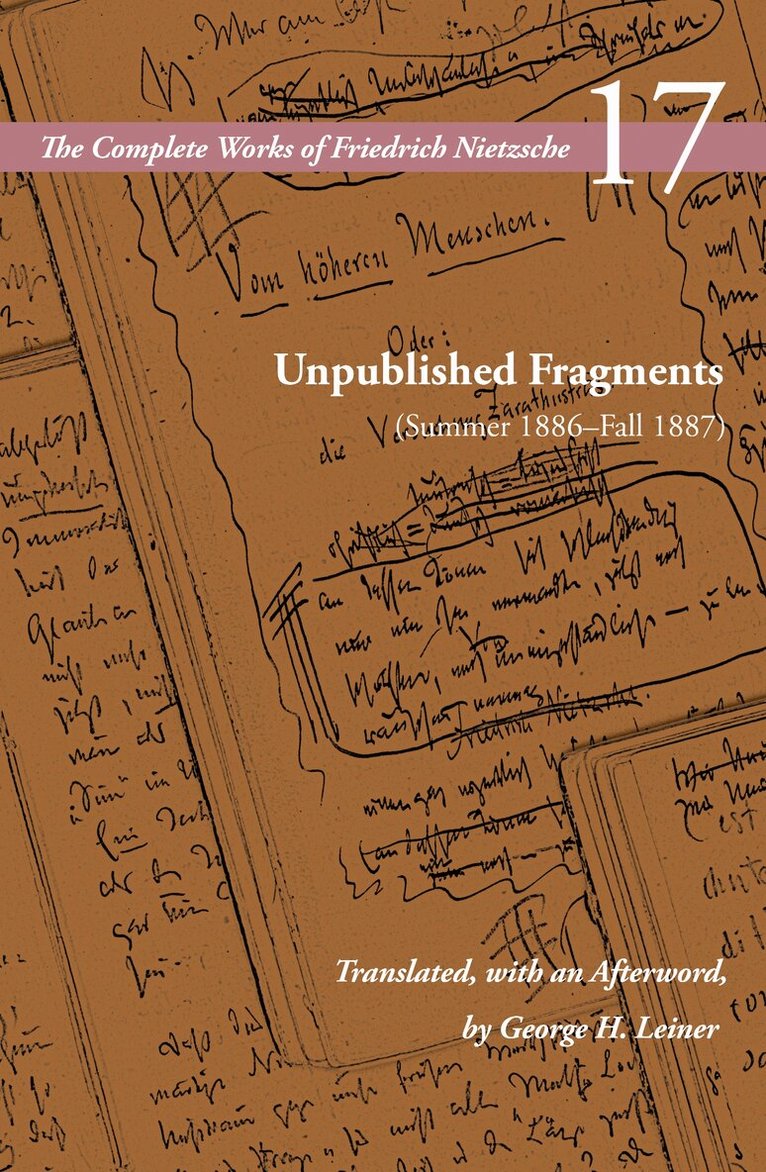
The Complete Works of Friedrich Nietzsche will publish in its entirety, for the first time, an English translation of the full contents of the Kritische Studienausgabe.This volume of the Complete Works provides the first English translation of Nietzsche's unpublished notes from Summer 1886 through Fall 1887. In these writings we find drafts of new prefaces for the second editions of his earlier works, notes for the soon-to-appear On the Genealogy of Morality, and crucially, fragments and plans for an anticipated "master work" under the title "The Will to Power." This projected work, as is now well-known, was never written by Nietzsche; instead, it was fraudulently assembled by his sister Elisabeth Förster-Nietzsche and his friend Heinrich Köselitz (a.k.a. Peter Gast) and published under Nietzsche's name after his death. Only now, with the publication of this volume and the ones that precede and follow it, are English readers able to examine for themselves the full set of unpublished writings of the last creative period of Nietzsche's life. Taking into account the latest editorial work on his final notebooks, and including a detailed account by Mazzino Montinari of Nietzsche's decision not to complete a "master work," this volume documents the evolution of Nietzsche's thinking on such important themes as nihilism, eternal recurrence, and the revaluation of all values as it presents his late Nachlass free from the distortions perpetrated against it over a century ago.
2 113 kr
Skickas inom 10-15 vardagar
The first attempt at assessing the references to interpretation theory in the Nietzschean text.
323 kr
Skickas inom 7-10 vardagar
This volume of The Complete Works provides the first English translation of all Nietzsche's unpublished notes from April 1885 to the summer of 1886, the period in which he wrote his breakthrough philosophical books Beyond Good and Evil and On the Genealogy of Morality. Keen to reinvent himself after Thus Spoke Zarathustra, the philosopher used these unpublished notes to chart his search for a new philosophical voice. The notebooks contain copious drafts of book titles; critical retrospection on his earlier projects; a critique of the feminine; prophetic commentary on Germany; and forays into metaphysics, epistemology, ethics, aesthetics, and language. They also reveal his deep concern for Europe and its future and a burgeoning presence of the Dionysian. We learn what Nietzsche was reading and from whom he borrowed, and we find a considerable portion of notes and fragments from the non-book "Will to Power," though here they are unembellished and unmediated. Richly annotated and accompanied by a detailed translator's afterword, this landmark volume sheds light on the controversy surrounding the Nachlass of the 1880s.
Unpublished Fragments from the Period of Human, All Too Human I (Winter 1874/75–Winter 1877/78)
Volume 12
Häftad, Engelska, 2021
310 kr
Skickas inom 7-10 vardagar
This volume in The Complete Works presents the first English translations of Nietzsche's unpublished notebooks from Winter 1874/1875 through 1878, the period in which he developed the mixed aphoristic-essayistic mode that continued across the rest of his career. These notebooks comprise a range of different materials, including early drafts and near-final versions of aphorisms that would appear in both volumes of Human, All Too Human. Additionally, there are extensive notes for a never-completed Unfashionable Observation that was to be titled "We Philologists," early drafts for the final sections of "Richard Wagner in Bayreuth," plans for other possible publications, and detailed reading notes on philologists, philosophers, and historians of his era, including Friedrich August Wolf, Eugen Dühring, and Jacob Burckhardt. Through this volume, readers gain insight into Nietzsche's emerging sense of himself as a composer of complexly orchestrated, stylistically innovative philosophical meditations—influenced by, but moving well beyond, the modes used by aphoristic precursors such as Goethe, La Rochefoucauld, Vauvenargues, and Schopenhauer. Further, these notebooks allow readers to trace more closely Nietzsche's development of ideas that remain central to his mature philosophy, such as the contrast between free and constrained spirits, the interplay of national, supra-national, and personal identities, and the cultural centrality of the process of Bildung as formation, education, and cultivation. With this latest book in the series, Stanford continues its English-language publication of the famed Colli-Montinari edition of Nietzsche's complete works, which include the philosopher's notebooks and early unpublished writings. Scrupulously edited so as to establish a new standard for the field, each volume includes an Afterword that presents and contextualizes the material it contains.
Unpublished Fragments from the Period of Thus Spoke Zarathustra (Spring 1884–Winter 1884/85)
Volume 15
Häftad, Engelska, 2022
309 kr
Skickas
This volume provides the first English translation of Nietzsche's unpublished notes from the spring of 1884 through the winter of 1884–85, the period in which he was composing the fourth and final part of his favorite work, Thus Spoke Zarathustra. These notebooks therefore provide special insight into Nietzsche's philosophical concept of superior humans,as well as important clues to the identities of the famous nineteenth-century European figures who inspired Nietzsche's invention of fictional characters such as "the prophet," "the sorcerer," and "the ugliest human."In these notebooks, Nietzsche also further explores ideas that were introduced in the first three parts of Thus Spoke Zarathustra: Zarathustra's teaching about the death of God; his proclamation that it is time for humankind to overcome itself and create the superhumans; his discovery that the secret of life is the will to power; and his most profound thought—that the entire cosmos will eternally return.Readers will encounter here a wealth of material that Nietzsche would include in his next book, Beyond Good and Evil, as he engages the ideas of Kant and Schopenhauer, challenges cultural icons like Richard Wagner, and mercilessly exposes the foibles of his contemporaries, especially of his fellow Germans. Readers will also discover an extensive collection of Nietzsche's poetry. Richly annotated and accompanied by a detailed translators' afterword, this volume showcases the cosmopolitanism at work in Nietzsche's multifaceted and critical exploration of aesthetic and cultural influences that transcend national (and nationalist) notions of literature, music, and culture.
Joyful Science / Idylls from Messina / Unpublished Fragments from the Period of the Joyful Science (Spring 1881–Summer 1882)
Volume 6
Häftad, Engelska, 2023
284 kr
Skickas inom 7-10 vardagar
Written on the threshold of Thus Spoke Zarathustra during a high point of social, intellectual and psychic vibrancy, The Joyful Science (frequently translated as The Gay Science) is one of Nietzsche's thematically tighter books. Here he debuts and practices the art of amor fati, love of fate, to explore what is "species preserving" in relation to happiness (Book One); inspiration and the role of art as they keep us mentally fit for inhabiting a world dominated by science (Book Two); the challenges of living authentically and overcoming after the death of God (Book Three); and the crescendo of life affirmation in which Nietzsche revealed the doctrine of eternal recurrence and previewed the figure of Zarathustra (Book Four). Invigorated and motivated by Thus Spoke Zarathustra and Beyond Good and Evil, Nietzsche in 1887 added a new preface, an appendix of poems, and Book Five, where he deepened the critique of science and displayed a more genealogical approach. This volume provides the first English translation of the Idylls from Messina and, more importantly, it includes the first English translation of the notebooks of 1881–1882, in which Nietzsche first formulated the eternal recurrence. Structurally and stylistically, The Joyful Science remains Nietzsche's most effective book of aphorisms, immediately after which he took on the voice and alter ego of Zarathustra in order to push beyond the boundaries of even the most liberating prose.
Unpublished Fragments from the Period of Dawn (Winter 1879/80–Spring 1881)
Volume 13
Häftad, Engelska, 2023
284 kr
Skickas
This volume provides the first English translation of Nietzsche's unpublished notes from late 1879 to early 1881, the period in which he authored Dawn, the second book in the trilogy that began with Human, All Too Human and concluded with The Joyful Science.In these fragments, we see Nietzsche developing the conceptual triad of morals, customs, and ethics, which undergirds his critique of morality as the reification into law or dogma of conceptions of good and evil. Here, Nietzsche assesses Christianity's role in the determination of moral values as the highest values and of redemption as the representation of humanity's highest aspirations. These notes show the resulting tension between Nietzsche's contrasting thoughts on modernity, which he critiques as an unrecognized aftereffect of the Christian worldview, but also views as the springboard to "the dawn" of a transformed humanity and culture. The fragments further allow readers insight into Nietzsche's continuous internal debate with exemplary figures in his own life and culture—Napoleon, Schopenhauer, and Wagner—who represented challenges to hitherto existing morals and culture—challenges that remained exemplary for Nietzsche precisely in their failure. Presented in Nietzsche's aphoristic style, Dawn is a book that must be read between the lines, and these fragments are an essential aid to students and scholars seeking to probe this work and its partners.
322 kr
Skickas
The Complete Works of Friedrich Nietzsche will publish in its entirety, for the first time, an English translation of the full contents of the Kritische Studienausgabe.This volume of the Complete Works provides the first English translation of Nietzsche's unpublished notes from Summer 1886 through Fall 1887. In these writings we find drafts of new prefaces for the second editions of his earlier works, notes for the soon-to-appear On the Genealogy of Morality, and crucially, fragments and plans for an anticipated "master work" under the title "The Will to Power." This projected work, as is now well-known, was never written by Nietzsche; instead, it was fraudulently assembled by his sister Elisabeth Förster-Nietzsche and his friend Heinrich Köselitz (a.k.a. Peter Gast) and published under Nietzsche's name after his death. Only now, with the publication of this volume and the ones that precede and follow it, are English readers able to examine for themselves the full set of unpublished writings of the last creative period of Nietzsche's life. Taking into account the latest editorial work on his final notebooks, and including a detailed account by Mazzino Montinari of Nietzsche's decision not to complete a "master work," this volume documents the evolution of Nietzsche's thinking on such important themes as nihilism, eternal recurrence, and the revaluation of all values as it presents his late Nachlass free from the distortions perpetrated against it over a century ago.