Alberto Bugarin – författare
Visar alla böcker från författaren Alberto Bugarin. Handla med fri frakt och snabb leverans.
4 produkter
4 produkter
Häftad, Engelska, 2006
1 667 kr
Skickas inom 10-15 vardagar
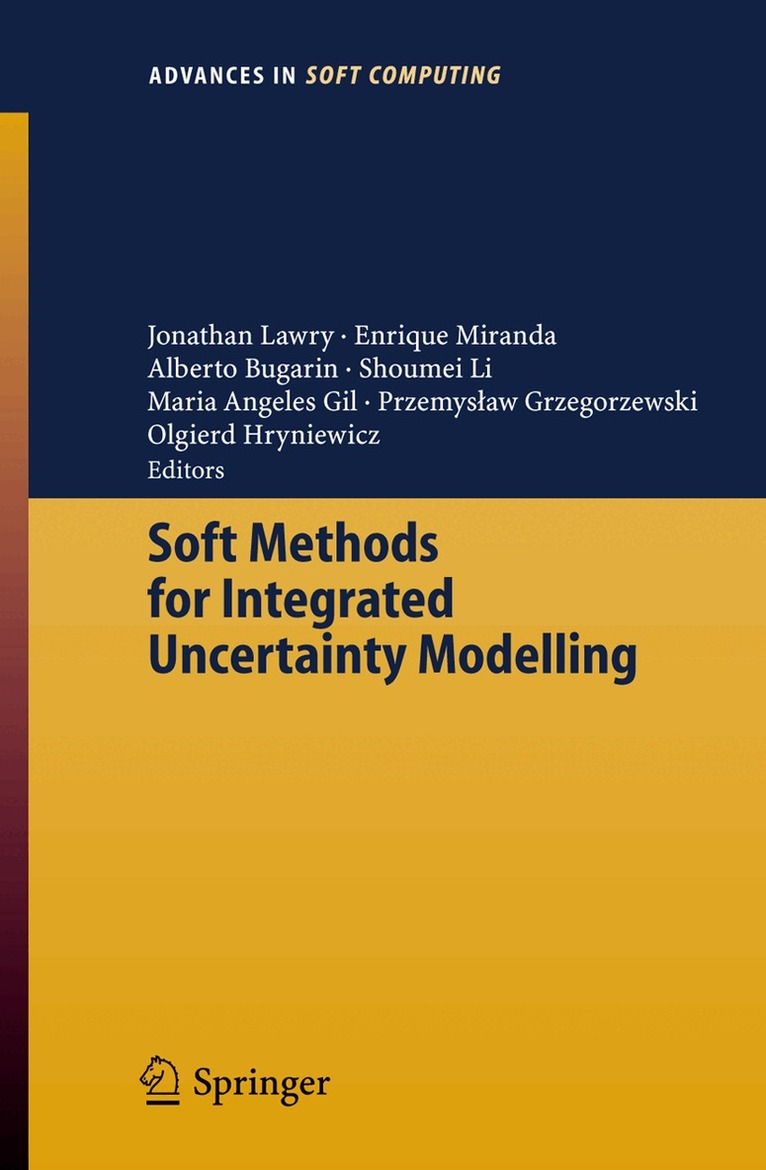
The idea of soft computing emerged in the early 1990s from the fuzzy systems c- munity, and refers to an understanding that the uncertainty, imprecision and ig- rance present in a problem should be explicitly represented and possibly even - ploited rather than either eliminated or ignored in computations. For instance, Zadeh de?ned ‘Soft Computing’ as follows: Soft computing differs from conventional (hard) computing in that, unlike hard computing, it is tolerant of imprecision, uncertainty and partial truth. In effect, the role model for soft computing is the human mind. Recently soft computing has, to some extent, become synonymous with a hybrid approach combining AI techniques including fuzzy systems, neural networks, and biologically inspired methods such as genetic algorithms. Here, however, we adopt a more straightforward de?nition consistent with the original concept. Hence, soft methods are understood as those uncertainty formalisms not part of mainstream s- tistics and probability theory which have typically been developed within the AI and decisionanalysiscommunity.Thesearemathematicallysounduncertaintymodelling methodologies which are complementary to conventional statistics and probability theory.
E-bok
PDF, Engelska, 20071 977 kr
Läs direkt efter köp
The idea of soft computing emerged in the early 1990s from the fuzzy systems c- munity, and refers to an understanding that the uncertainty, imprecision and ig- rance present in a problem should be explicitly represented and possibly even - ploited rather than either eliminated or ignored in computations. For instance, Zadeh de?ned ‘Soft Computing’ as follows: Soft computing differs from conventional (hard) computing in that, unlike hard computing, it is tolerant of imprecision, uncertainty and partial truth. In effect, the role model for soft computing is the human mind. Recently soft computing has, to some extent, become synonymous with a hybrid approach combining AI techniques including fuzzy systems, neural networks, and biologically inspired methods such as genetic algorithms. Here, however, we adopt a more straightforward de?nition consistent with the original concept. Hence, soft methods are understood as those uncertainty formalisms not part of mainstream s- tistics and probability theory which have typically been developed within the AI and decisionanalysiscommunity.Thesearemathematicallysounduncertaintymodelling methodologies which are complementary to conventional statistics and probability theory.
561 kr
Skickas inom 10-15 vardagar
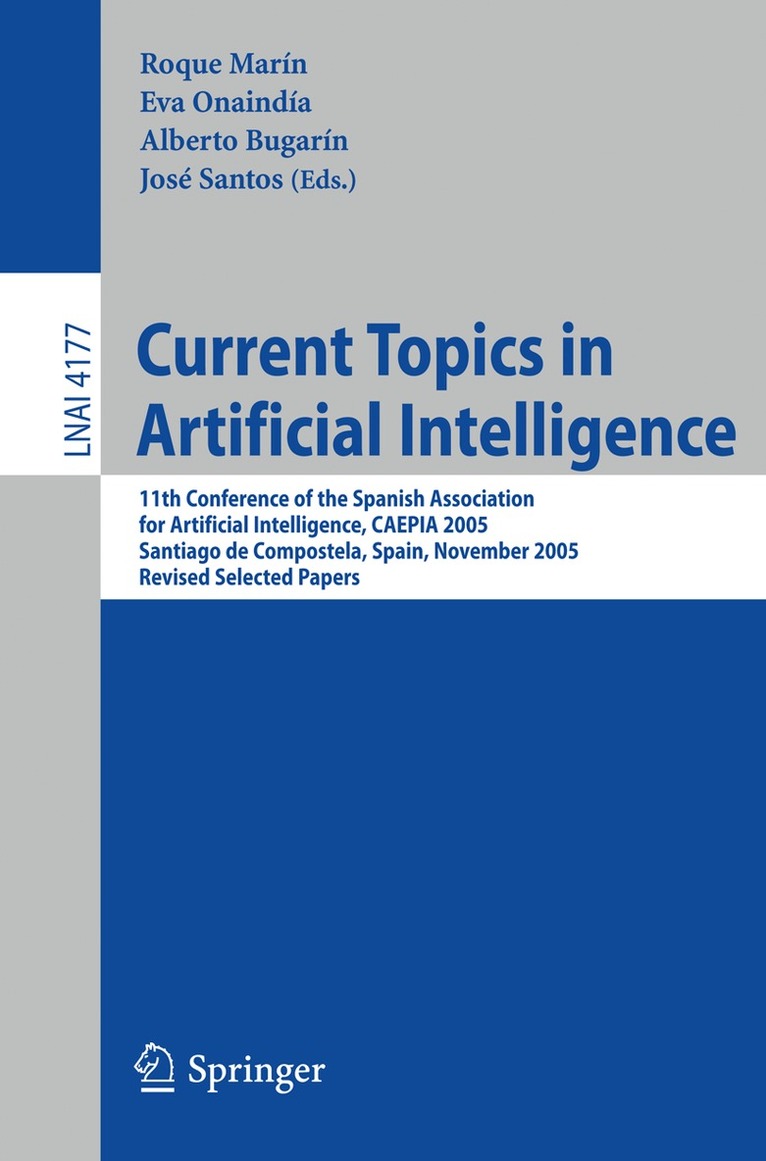
This book constitutes the thoroughly refered post-proceedings of the 11th Conference of the Spanish Association for Artificial Intelligence, CAEPIA 2005, held in Santiago de Compostela, Spain in November 2005. The 48 revised full papers presented together with an invited paper were carefully selected. The papers span the entire spectrum of artificial intelligence from foundational and theoretical issues to advanced applications in various fields.