Alejandro Adem – författare
Visar alla böcker från författaren Alejandro Adem. Handla med fri frakt och snabb leverans.
5 produkter
5 produkter
Del 171 - Cambridge Tracts in Mathematics
Orbifolds and Stringy Topology
Inbunden, Engelska, 2007
1 634 kr
Skickas inom 7-10 vardagar
An introduction to the theory of orbifolds from a modern perspective, combining techniques from geometry, algebraic topology and algebraic geometry. One of the main motivations, and a major source of examples, is string theory, where orbifolds play an important role. The subject is first developed following the classical description analogous to manifold theory, after which the book branches out to include the useful description of orbifolds provided by groupoids, as well as many examples in the context of algebraic geometry. Classical invariants such as de Rham cohomology and bundle theory are developed, a careful study of orbifold morphisms is provided, and the topic of orbifold K-theory is covered. The heart of this book, however, is a detailed description of the Chen-Ruan cohomology, which introduces a product for orbifolds and has had significant impact. The final chapter includes explicit computations for a number of interesting examples.
Del 309 - Grundlehren der mathematischen Wissenschaften
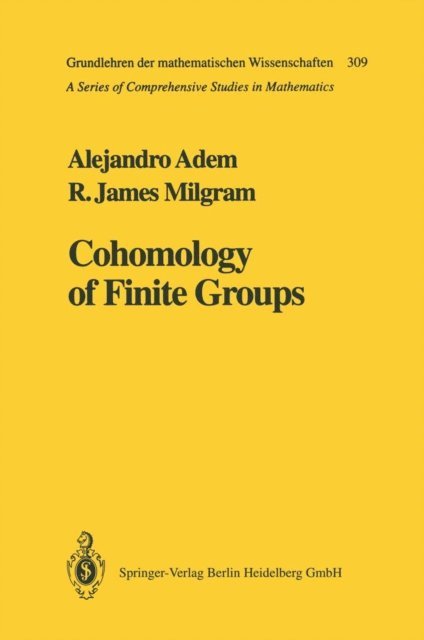
Cohomology of Finite Groups
Inbunden, Engelska, 2003
1 092 kr
Skickas inom 10-15 vardagar
Some Historical Background This book deals with the cohomology of groups, particularly finite ones. Historically, the subject has been one of significant interaction between algebra and topology and has directly led to the creation of such important areas of mathematics as homo logical algebra and algebraic K-theory. It arose primarily in the 1920's and 1930's independently in number theory and topology. In topology the main focus was on the work ofH. Hopf, but B. Eckmann, S. Eilenberg, and S. MacLane (among others) made significant contributions. The main thrust of the early work here was to try to understand the meanings of the low dimensional homology groups of a space X. For example, if the universal cover of X was three connected, it was known that H2(X; A. ) depends only on the fundamental group of X. Group cohomology initially appeared to explain this dependence. In number theory, group cohomology arose as a natural device for describing the main theorems of class field theory and, in particular, for describing and analyzing the Brauer group of a field. It also arose naturally in the study of group extensions, N
Del 309 - Grundlehren der mathematischen Wissenschaften
Cohomology of Finite Groups
Häftad, Engelska, 2010
1 092 kr
Skickas inom 10-15 vardagar
Some Historical Background This book deals with the cohomology of groups, particularly finite ones. Historically, the subject has been one of significant interaction between algebra and topology and has directly led to the creation of such important areas of mathematics as homo logical algebra and algebraic K-theory. It arose primarily in the 1920's and 1930's independently in number theory and topology. In topology the main focus was on the work ofH. Hopf, but B. Eckmann, S. Eilenberg, and S. MacLane (among others) made significant contributions. The main thrust of the early work here was to try to understand the meanings of the low dimensional homology groups of a space X. For example, if the universal cover of X was three connected, it was known that H2(X; A. ) depends only on the fundamental group of X. Group cohomology initially appeared to explain this dependence. In number theory, group cohomology arose as a natural device for describing the main theorems of class field theory and, in particular, for describing and analyzing the Brauer group of a field. It also arose naturally in the study of group extensions, N
E-bok
PDF, Engelska, 20131 416 kr
Läs direkt efter köp
Some Historical Background This book deals with the cohomology of groups, particularly finite ones. Historically, the subject has been one of significant interaction between algebra and topology and has directly led to the creation of such important areas of mathematics as homo logical algebra and algebraic K-theory. It arose primarily in the 1920''s and 1930''s independently in number theory and topology. In topology the main focus was on the work ofH. Hopf, but B. Eckmann, S. Eilenberg, and S. MacLane (among others) made significant contributions. The main thrust of the early work here was to try to understand the meanings of the low dimensional homology groups of a space X. For example, if the universal cover of X was three connected, it was known that H2(X; A. ) depends only on the fundamental group of X. Group cohomology initially appeared to explain this dependence. In number theory, group cohomology arose as a natural device for describing the main theorems of class field theory and, in particular, for describing and analyzing the Brauer group of a field. It also arose naturally in the study of group extensions, N
E-bok
PDF, Engelska, 20131 100 kr
Läs direkt efter köp
This book introduces the most important and useful algebraic and topological techniques for studying and calculating the cohomology of finite groups. Numerous applications are described, to problems in homotopy theory, representation theory, number theory and group actions. Significant calculations are included with complete details and explanations.