Alejandro Enrique Dzul Lopez – författare
Visar alla böcker från författaren Alejandro Enrique Dzul Lopez. Handla med fri frakt och snabb leverans.
5 produkter
5 produkter
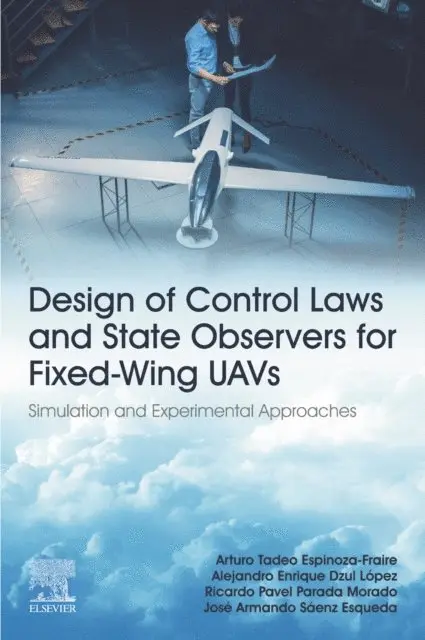
Design of Control Laws and State Observers for Fixed-Wing UAVs
Simulation and Experimental Approaches
E-bok
Engelska, 20222 662 kr
Läs direkt efter köp
Design of Control Laws and State Observers for Fixed-Wing UAVs: Simulation and Experimental Approaches provides readers with modeling techniques, simulations, and results from real-time experiments using linear and nonlinear controllers and state observers. The book starts with an overview of the history of UAVs and the equations of motion applied to them. Following chapters analyze linear and nonlinear controllers, state observers, and the book concludes with a chapter discussing testbed development and experimental results, equipping readers with the knowledge they need to conduct their own stable UAV flights whether in simulation or real-time.- Presents aerodynamic models for fixed-wing UAVs that can be used to design control laws and state observers- Applies linear and nonlinear control theories and state observers to fixed-wing UAVs- Provides real-time flight and simulation test results of fixed-wing UAVs with linear and nonlinear controllers
Inbunden, Engelska, 2012
1 410 kr
Skickas inom 10-15 vardagar
Quad Rotorcraft Control develops original control methods for the navigation and hovering flight of an autonomous mini-quad-rotor robotic helicopter. These methods use an imaging system and a combination of inertial and altitude sensors to localize and guide the movement of the unmanned aerial vehicle relative to its immediate environment. The history, classification and applications of UAVs are introduced, followed by a description of modelling techniques for quad-rotors and the experimental platform itself. A control strategy for the improvement of attitude stabilization in quad-rotors is then proposed and tested in real-time experiments. The strategy, based on the use low-cost components and with experimentally-established robustness, avoids drift in the UAV’s angular position by the addition of an internal control loop to each electronic speed controller ensuring that, during hovering flight, all four motors turn at almost the same speed. The quad-rotor’s Euler angles being very close to the origin, other sensors like GPS or image-sensing equipment can be incorporated to perform autonomous positioning or trajectory-tracking tasks. Two vision-based strategies, each designed to deal with a specific kind of mission, are introduced and separately tested. The first stabilizes the quad-rotor over a landing pad on the ground; it extracts the 3-dimensional position using homography estimation and derives translational velocity by optical flow calculation. The second combines colour-extraction and line-detection algorithms to control the quad-rotor’s 3-dimensional position and achieves forward velocity regulation during a road-following task. In order to estimate the translational-dynamical characteristics of the quad-rotor (relative position and translational velocity) as they evolve within a building or other unstructured, GPS-deprived environment, imaging, inertial and altitude sensors are combined in a state observer. The textgive the reader a current view of the problems encountered in UAV control, specifically those relating to quad-rotor flying machines and it will interest researchers and graduate students working in that field. The vision-based control strategies presented help the reader to a better understanding of how an imaging system can be used to obtain the information required for performance of the hovering and navigation tasks ubiquitous in rotored UAV operation.
E-bok
PDF, Engelska, 20121 214 kr
Läs direkt efter köp
Quad Rotorcraft Control develops original control methods for the navigation and hovering flight of an autonomous mini-quad-rotor robotic helicopter. These methods use an imaging system and a combination of inertial and altitude sensors to localize and guide the movement of the unmanned aerial vehicle relative to its immediate environment. The history, classification and applications of UAVs are introduced, followed by a description of modelling techniques for quad-rotors and the experimental platform itself. A control strategy for the improvement of attitude stabilization in quad-rotors is then proposed and tested in real-time experiments. The strategy, based on the use low-cost components and with experimentally-established robustness, avoids drift in the UAV’s angular position by the addition of an internal control loop to each electronic speed controller ensuring that, during hovering flight, all four motors turn at almost the same speed. The quad-rotor’s Euler angles being very close to the origin, other sensors like GPS or image-sensing equipment can be incorporated to perform autonomous positioning or trajectory-tracking tasks. Two vision-based strategies, each designed to deal with a specific kind of mission, are introduced and separately tested. The first stabilizes the quad-rotor over a landing pad on the ground; it extracts the 3-dimensional position using homography estimation and derives translational velocity by optical flow calculation. The second combines colour-extraction and line-detection algorithms to control the quad-rotor’s 3-dimensional position and achieves forward velocity regulation during a road-following task. In order to estimate the translational-dynamical characteristics of the quad-rotor (relative position and translational velocity) as they evolve within a building or other unstructured, GPS-deprived environment, imaging, inertial and altitude sensors are combined in a state observer. The textgive the reader a current view of the problems encountered in UAV control, specifically those relating to quad-rotor flying machines and it will interest researchers and graduate students working in that field. The vision-based control strategies presented help the reader to a better understanding of how an imaging system can be used to obtain the information required for performance of the hovering and navigation tasks ubiquitous in rotored UAV operation.
Häftad, Engelska, 2016
978 kr
Skickas inom 10-15 vardagar
Quad Rotorcraft Control develops original control methods for the navigation and hovering flight of an autonomous mini-quad-rotor robotic helicopter. These methods use an imaging system and a combination of inertial and altitude sensors to localize and guide the movement of the unmanned aerial vehicle relative to its immediate environment. The history, classification and applications of UAVs are introduced, followed by a description of modelling techniques for quad-rotors and the experimental platform itself. A control strategy for the improvement of attitude stabilization in quad-rotors is then proposed and tested in real-time experiments. The strategy, based on the use low-cost components and with experimentally-established robustness, avoids drift in the UAV’s angular position by the addition of an internal control loop to each electronic speed controller ensuring that, during hovering flight, all four motors turn at almost the same speed. The quad-rotor’s Euler angles being very close to the origin, other sensors like GPS or image-sensing equipment can be incorporated to perform autonomous positioning or trajectory-tracking tasks. Two vision-based strategies, each designed to deal with a specific kind of mission, are introduced and separately tested. The first stabilizes the quad-rotor over a landing pad on the ground; it extracts the 3-dimensional position using homography estimation and derives translational velocity by optical flow calculation. The second combines colour-extraction and line-detection algorithms to control the quad-rotor’s 3-dimensional position and achieves forward velocity regulation during a road-following task. In order to estimate the translational-dynamical characteristics of the quad-rotor (relative position and translational velocity) as they evolve within a building or other unstructured, GPS-deprived environment, imaging, inertial and altitude sensors are combined in a state observer. The textgive the reader a current view of the problems encountered in UAV control, specifically those relating to quad-rotor flying machines and it will interest researchers and graduate students working in that field. The vision-based control strategies presented help the reader to a better understanding of how an imaging system can be used to obtain the information required for performance of the hovering and navigation tasks ubiquitous in rotored UAV operation.
Häftad, Franska, 2010
695 kr
Tillfälligt slut