Aleksander Weron - Böcker
Visar alla böcker från författaren Aleksander Weron. Handla med fri frakt och snabb leverans.
7 produkter
7 produkter
1 466 kr
Skickas inom 10-15 vardagar
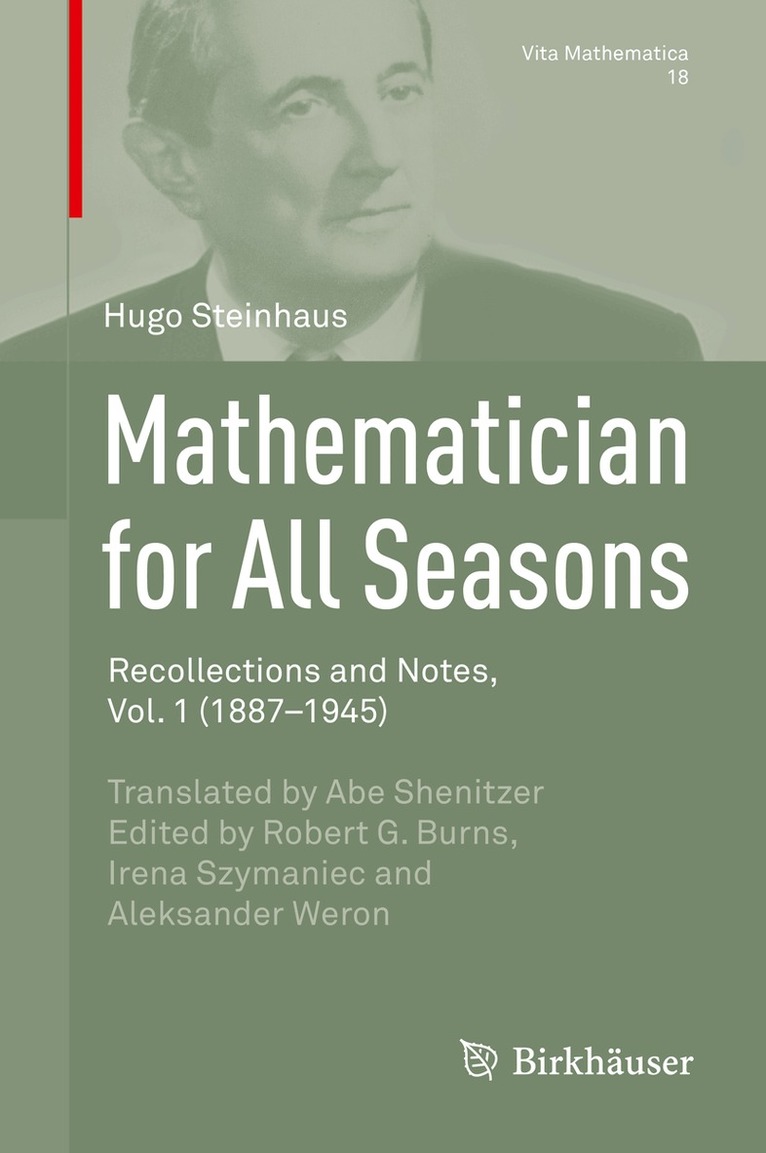
Mathematician for All Seasons
1 381 kr
Skickas inom 10-15 vardagar
This book presents, in his own words, the life of Hugo Steinhaus (1887–1972), noted Polish mathematician of Jewish background, educator, and mathematical popularizer. A student of Hilbert, a pioneer of the foundations of probability and game theory, and a contributor to the development of functional analysis, he was one of those instrumental to the extraordinary flowering of Polish mathematics before and after World War I. In particular, it was he who “discovered” the great Stefan Banach. Exhibiting his great integrity and wit, Steinhaus’s personal story of the turbulent times he survived – including two world wars and life postwar under the Soviet heel – cannot but be of consuming interest. His recounting of the fearful years spent evading Nazi terror is especially moving. The steadfast honesty and natural dignity he maintained while pursuing a life of demanding scientific and intellectual enquiry in the face of encroaching calamity and chaos show him to be truly a mathematician for all seasons.The present work will be of great interest not only to mathematicians wanting to learn some of the details of the mathematical blossoming that occurred in Poland in the first half of the 20th century, but also to anyone wishing to read a first-hand account of the history of those unquiet times in Europe – and indeed world-wide – by someone of uncommon intelligence and forthrightness situated near an eye of the storm.
1 313 kr
Skickas inom 10-15 vardagar
This book presents, in his own words, the life of Hugo Steinhaus (1887–1972), noted Polish mathematician of Jewish background, educator, and mathematical popularizer. A student of Hilbert, a pioneer of the foundations of probability and game theory, and a contributor to the development of functional analysis, he was one of those instrumental to the extraordinary flowering of Polish mathematics before and after World War I. In particular, it was he who “discovered” the great Stefan Banach. Exhibiting his great integrity and wit, Steinhaus’s personal story of the turbulent times he survived – including two world wars and life postwar under the Soviet heel – cannot but be of consuming interest. His account of the years spent evading Nazi terror is especially moving. The steadfast honesty and natural dignity he maintained while pursuing a life of demanding scientific and intellectual enquiry in the face of encroaching calamity and chaos show him to be truly a mathematician for all seasons.The present work will be of great interest not only to mathematicians wanting to learn some of the details of the mathematical blossoming that occurred in Poland in the first half of the 20th century, but also to anyone wishing to read a first-hand account of the history of those unquiet times in Europe – and indeed world-wide – by someone of uncommon intelligence and forthrightness situated near an eye of the storm.
1 313 kr
Skickas inom 10-15 vardagar
This book presents, in his own words, the life of Hugo Steinhaus (1887–1972), noted Polish mathematician of Jewish background, educator, and mathematical popularizer. A student of Hilbert, a pioneer of the foundations of probability and game theory, and a contributor to the development of functional analysis, he was one of those instrumental to the extraordinary flowering of Polish mathematics before and after World War I. In particular, it was he who “discovered” the great Stefan Banach. Exhibiting his great integrity and wit, Steinhaus’s personal story of the turbulent times he survived – including two world wars and life postwar under the Soviet heel – cannot but be of consuming interest. His recounting of the fearful years spent evading Nazi terror is especially moving. The steadfast honesty and natural dignity he maintained while pursuing a life of demanding scientific and intellectual enquiry in the face of encroaching calamity and chaos show him to be truly a mathematician for all seasons.The present work will be of great interest not only to mathematicians wanting to learn some of the details of the mathematical blossoming that occurred in Poland in the first half of the 20th century, but also to anyone wishing to read a first-hand account of the history of those unquiet times in Europe – and indeed world-wide – by someone of uncommon intelligence and forthrightness situated near an eye of the storm.
Del 1391 - Lecture Notes in Mathematics
Probability Theory on Vector Spaces IV
Proceedings of a Conference, held in Lancut, Poland, June 10-17, 1987
Häftad, Engelska, 1989
482 kr
Skickas inom 7-10 vardagar
Chaos — The Interplay Between Stochastic and Deterministic Behaviour
Proceedings of the XXXIst Winter School of Theoretical Physics Held in Karpacz, Poland 13–24 February 1995
Häftad, Engelska, 2013
1 064 kr
Skickas inom 10-15 vardagar
The study of chaotic behaviour of dynamical systems has triggered new efforts to reconcile deterministic and stochastic processes as well as classical and quantum physics. New efforts are made to understand complex and unpredictable behaviour. The papers collected in this volume give a broad overview of these activities. Readers will get a glimpse of the growing importance of Lévy processes for physics. They will find new views on fundamental concepts of quantum physics and will see many applications of chaotic and essentially random phenomena to a number of physical problems.
2 710 kr
Tillfälligt slut
This volume, containing selected papers presented during the COSMEX '89 meeting, provides readers with integrative and innovative articles on many aspects on many aspects of stochastic methods and their applications to experimental sciences. Offering an interdisciplinary presentation on the uses of stochastic methods, this publication discusses the practical applications of stochastic methods to such diverse areas as biology, chemistry, physics, mechanics and engineering. It also discusses computer implementation of theoretically derived algorithms especially for experimental designs.