Aleš Pultr - Böcker
Visar alla böcker från författaren Aleš Pultr. Handla med fri frakt och snabb leverans.
5 produkter
5 produkter
1 381 kr
Skickas inom 10-15 vardagar
This book is the first systematic treatment of this area so far scattered in a vast number of articles. As in classical topology, concrete problems require restricting the (generalized point-free) spaces by various conditions playing the roles of classical separation axioms. These are typically formulated in the language of points; but in the point-free context one has either suitable translations, parallels, or satisfactory replacements. The interrelations of separation type conditions, their merits, advantages and disadvantages, and consequences are discussed. Highlights of the book include a treatment of the merits and consequences of subfitness, various approaches to the Hausdorff's axiom, and normality type axioms. Global treatment of the separation conditions put them in a new perspective, and, a.o., gave some of them unexpected importance. The text contains a lot of quite recent results; the reader will see the directions the area is taking, and may find inspirationfor her/his further work.The book will be of use for researchers already active in the area, but also for those interested in this growing field (sometimes even penetrating into some parts of theoretical computer science), for graduate and PhD students, and others. For the reader's convenience, the text is supplemented with an Appendix containing necessary background on posets, frames and locales.
1 381 kr
Skickas inom 10-15 vardagar
This book is the first systematic treatment of this area so far scattered in a vast number of articles. As in classical topology, concrete problems require restricting the (generalized point-free) spaces by various conditions playing the roles of classical separation axioms. These are typically formulated in the language of points; but in the point-free context one has either suitable translations, parallels, or satisfactory replacements. The interrelations of separation type conditions, their merits, advantages and disadvantages, and consequences are discussed. Highlights of the book include a treatment of the merits and consequences of subfitness, various approaches to the Hausdorff's axiom, and normality type axioms. Global treatment of the separation conditions put them in a new perspective, and, a.o., gave some of them unexpected importance. The text contains a lot of quite recent results; the reader will see the directions the area is taking, and may find inspirationfor her/his further work.The book will be of use for researchers already active in the area, but also for those interested in this growing field (sometimes even penetrating into some parts of theoretical computer science), for graduate and PhD students, and others. For the reader's convenience, the text is supplemented with an Appendix containing necessary background on posets, frames and locales.
641 kr
Skickas inom 10-15 vardagar
Until the mid-twentieth century, topological studies were focused on the theory of suitable structures on sets of points. The concept of open set exploited since the twenties offered an expression of the geometric intuition of a "realistic" place (spot, grain) of non-trivial extent.Imitating the behaviour of open sets and their relations led to a new approach to topology flourishing since the end of the fifties.It has proved to be beneficial in many respects. Neglecting points, only little information was lost, while deeper insights have been gained; moreover, many results previously dependent on choice principles became constructive. The result is often a smoother, rather than a more entangled, theory.No monograph of this nature has appeared since Johnstone's celebrated Stone Spaces in 1983. The present book is intended as a bridge from that time to the present. Most of the material appears here in book form for the first time or is presented from new points of view. Two appendices provide an introduction to some requisite concepts from order and category theories.
853 kr
Skickas inom 10-15 vardagar
After having built on a solid foundation of topology and linear algebra, the text later expands into more advanced topics such as complex analysis, differential forms, calculus of variations, differential geometry and even functional analysis.
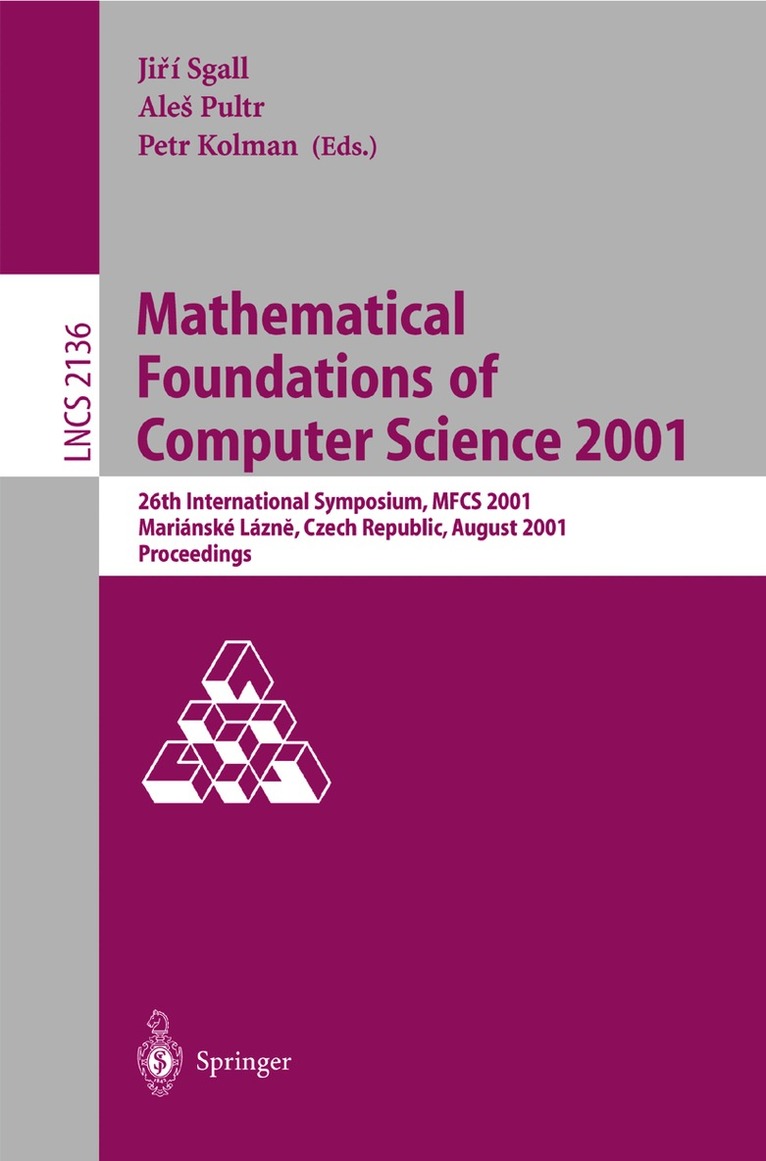
Mathematical Foundations of Computer Science 2001
26th International Symposium, MFCS 2001 Marianske Lazne, Czech Republic, August 27-31, 2001 Proceedings
Häftad, Engelska, 2001
1 096 kr
Skickas inom 10-15 vardagar
This volume contains papers selected for presentation at the 26th International Symposium on Mathematical Foundations of Computer Science - MFCS 2001, held in Mari'ansk'eL'azn?e, Czech Republic, August 27 - 31, 2001. MFCS 2001 was organized by the Mathematical Institute (Academy of S- ences of the Czech Republic), the Institute for Theoretical Computer Science (Charles University, Faculty of Mathematics and Physics), the Institute of C- puter Science (Academy of Sciences of the Czech Republic), and Action M Agency. It was supported by the European Research Consortium for Informatics and Mathematics, the Czech Research Consortium for Informatics and Ma- ematics, and the European Association for Theoretical Computer Science. We gratefully acknowledge the support of all these institutions. The series of MFCS symposia, organized on a rotating basis in Poland, S- vakia, and the Czech Republic, has a well-established tradition. The aim is to encourage high-quality research in all branches of theoretical computer science and bring together specialists who do not usually meet at specialized confer- ? ences.Previous meetings tookplace in Jablonna, 1972; Strbsk'e Pleso, 1973; J- wisin, 1974; Marian ' sk'eL'azn?e, 1975; Gdan 'sk, 1976; Tatransk'a Lomnica, 1977; Za- ? kopane, 1978; Olomouc, 1979; Rydzina, 1980; Strbsk'e Pleso, 1981; Prague, 1984; Bratislava, 1986; Karlovy Vary, 1988; Porabk , a-Kozubnik, 1989; Bansk'aBystrica, 1990; Kazimierz Dolny, 1991; Prague, 1992; Gdan 'sk, 1993; Ko?sice, 1994; Prague, 1995; Krak'ow, 1996; Bratislava, 1997; Brno, 1998; Szklarska Por,eba, 1999; and Bratislava, 2000.