Alessandra Piontelli - Böcker
Visar alla böcker från författaren Alessandra Piontelli. Handla med fri frakt och snabb leverans.
10 produkter
10 produkter
590 kr
Skickas inom 10-15 vardagar
The use of ultrasonic scans in pregnancy makes it possible to observe the fetus undisturbed in the womb. Dr Alessandra Piontelli has done what no one has done before: she observed eleven fetuses (three singletons and four sets of twins) in the womb using ultrasound scans, and then observed their development at home from birth up to the age of four years. She includes a description of the psychoanalytic psychotherapy of one of the research children, and the psychoanalysis of five other very young children whose behaviour in analysis suggested that they were deeply preoccupied with their experience in the womb.Dr Piontelli has discovered what many parents have always thought - that each fetus, like each newborn baby, is a highly individual creature. By drawing on her experience as a child psychotherapist and psychoanalyst as well as on her observational research, she is able to investigate issues relating to individuality, psychological birth and the influence of maternal emotions during pregnancy. Her findings demonstrate clearly how psychoanalytical evidence enhances, deepens and supports observational data on the remarkable behavioural and psychological continuities between pre-natal and post-natal life.

2 037 kr
Skickas inom 10-15 vardagar
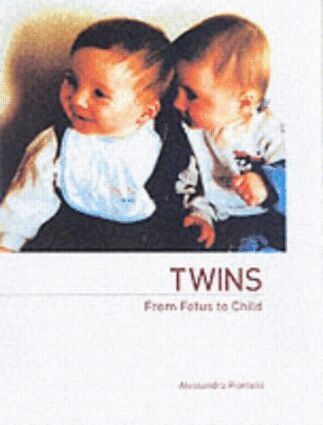
Though much has been written about twins, very little research has been done into their everyday lives, both postnatal and prenatal. In this fascinating new study Alessandra Piontelli follows the development and behaviour of thirty pairs of twins from their early life in the womb through to their third year of childhood. Drawing on detailed ultrasound observations and work with mothers and families in clinical and natural settings, the text traces the subtle ways in which various types of twins live, behave and interact with their unequally shared and unique pre- and postnatal environments.Piontelli shows how from early on distinctive and personal traits can be seen in the behaviour of each member of a twin couple and how these traits continue and strengthen well beyond birth. The book describes not only the behaviour of the twins, but the impact they have on the lives of their family and carers - what family members say, how they react and how the family changes.Scientifically based, but warmly human in content, this unique longitudinal study offers new insight for professionals working with mothers and families of twins and for researchers in human development across a range of disciplines.
635 kr
Skickas inom 10-15 vardagar
Though much has been written about twins, very little research has been done into their everyday lives, both postnatal and prenatal. In this fascinating new study Alessandra Piontelli follows the development and behaviour of thirty pairs of twins from their early life in the womb through to their third year of childhood. Drawing on detailed ultrasound observations and work with mothers and families in clinical and natural settings, the text traces the subtle ways in which various types of twins live, behave and interact with their unequally shared and unique pre- and postnatal environments.Piontelli shows how from early on distinctive and personal traits can be seen in the behaviour of each member of a twin couple and how these traits continue and strengthen well beyond birth. The book describes not only the behaviour of the twins, but the impact they have on the lives of their family and carers - what family members say, how they react and how the family changes.Scientifically based, but warmly human in content, this unique longitudinal study offers new insight for professionals working with mothers and families of twins and for researchers in human development across a range of disciplines.
1 579 kr
Skickas inom 10-15 vardagar
The use of ultrasonic scans in pregnancy makes it possible to observe the fetus undisturbed in the womb. Dr Alessandra Piontelli has done what no one has done before: she observed eleven fetuses (three singletons and four sets of twins) in the womb using ultrasound scans, and then observed their development at home from birth up to the age of four years. She includes a description of the psychoanalytic psychotherapy of one of the research children, and the psychoanalysis of five other very young children whose behaviour in analysis suggested that they were deeply preoccupied with their experience in the womb.Dr Piontelli has discovered what many parents have always thought - that each fetus, like each newborn baby, is a highly individual creature. By drawing on her experience as a child psychotherapist and psychoanalyst as well as on her observational research, she is able to investigate issues relating to individuality, psychological birth and the influence of maternal emotions during pregnancy. Her findings demonstrate clearly how psychoanalytical evidence enhances, deepens and supports observational data on the remarkable behavioural and psychological continuities between pre-natal and post-natal life.
1 416 kr
Skickas inom 10-15 vardagar
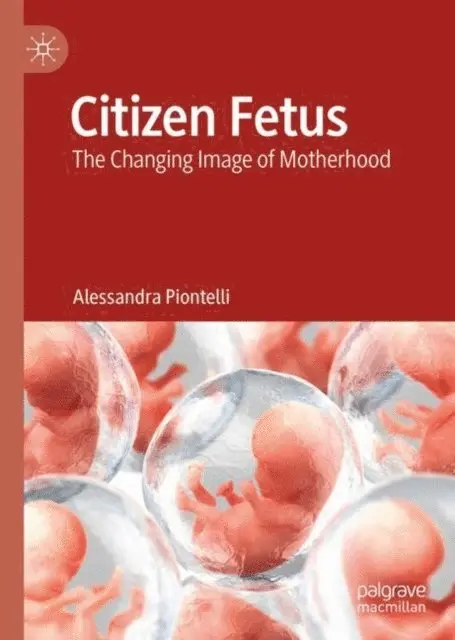
This book discusses many aspects of fetuses and motherhood from fields as wide as sociology and medicine. It examines changing perceptions of the fetus over recent decades, comparing western ideas with those of non-western countries; examining maternal mental health during COVID-19 and charting the ascent of the 'fetus' to a cult phenomenon, which has currently reappeared in the courts. This work, given its multifaceted approach, will be of interest to a varied and wide range of people, from parents to doctors and nurses, to anthropologists and ethnologists, to scientists, to students of various disciplines, to psychologists and psychoanalysts, to lawyers dealing with the topic and to a general public simply interested in these fundamental themes.
1 416 kr
Skickas inom 10-15 vardagar
This book discusses many aspects of fetuses and motherhood from fields as wide as sociology and medicine. It examines changing perceptions of the fetus over recent decades, comparing western ideas with those of non-western countries; examining maternal mental health during COVID-19 and charting the ascent of the 'fetus' to a cult phenomenon, which has currently reappeared in the courts. This work, given its multifaceted approach, will be of interest to a varied and wide range of people, from parents to doctors and nurses, to anthropologists and ethnologists, to scientists, to students of various disciplines, to psychologists and psychoanalysts, to lawyers dealing with the topic and to a general public simply interested in these fundamental themes.
1 091 kr
Skickas inom 10-15 vardagar
This work sees the light for various reasons. There is a general lack of detailed information about the earliest stages of human motor development. The reasons for this are explained more fully in the Introduction; here we may simply state that, apart from their intrinsic interest, earlier phenomena are fundamental to the comprehension of later phenomena rooted in them, whether pathological or normal. This is especially so in the rapidly - veloping young organism. At birth the neonate is catapulted into a profoundly different physical and social envir- ment requiring extremely diverse functioning: suffice it to mention aerial respiration, no longer being fed through the placenta and the cord, and the full impact of gravity on neonatal movements. The neonate generally adapts smoothly to the transition, as it has been equipped to do so during the 9 months of pregnancy. However, the study of the early stages of fetal motor development should not be exclusively directed towards the und- standing of functioning in the neonate.
1 307 kr
Skickas inom 10-15 vardagar
In the later stages of gestation, fetal functions undergo increasing change and development, preparing the fetus for the transition to its postnatal environment. Rapid maturation is witnessed in breathing, swallowing, sensory functions, sleep, and many other processes, with corresponding behavioral changes. By 35 to 40 weeks of gestation, fetuses are capable of living ex utero without support, but it is increasingly appreciated that even infants born at between 35 and 36 weeks can suffer long-term consequences. This book, which complements the author’s previous volume on development of normal fetal movements during the first 25 weeks of gestation, discusses in detail the full range of behavioral phenomena observed during the final 15 weeks of gestation, with careful analysis of their mutual relationships. A key feature is the outstanding photographic material, difficult to obtain at this late stage, and the instructive graphs that are also included. The information provided will alert clinicians to deviations from the norm and to physiologic phenomena that can turn pathologic in infants born prematurely.
1 091 kr
Skickas inom 10-15 vardagar
In the later stages of gestation, fetal functions undergo increasing change and development, preparing the fetus for the transition to its postnatal environment. Rapid maturation is witnessed in breathing, swallowing, sensory functions, sleep, and many other processes, with corresponding behavioral changes. By 35 to 40 weeks of gestation, fetuses are capable of living ex utero without support, but it is increasingly appreciated that even infants born at between 35 and 36 weeks can suffer long-term consequences. This book, which complements the author’s previous volume on development of normal fetal movements during the first 25 weeks of gestation, discusses in detail the full range of behavioral phenomena observed during the final 15 weeks of gestation, with careful analysis of their mutual relationships. A key feature is the outstanding photographic material, difficult to obtain at this late stage, and the instructive graphs that are also included. The information provided will alert clinicians to deviations from the norm and to physiologic phenomena that can turn pathologic in infants born prematurely.
1 199 kr
Skickas inom 10-15 vardagar
This work sees the light for various reasons. There is a general lack of detailed information about the earliest stages of human motor development. The reasons for this are explained more fully in the Introduction; here we may simply state that, apart from their intrinsic interest, earlier phenomena are fundamental to the comprehension of later phenomena rooted in them, whether pathological or normal. This is especially so in the rapidly - veloping young organism. At birth the neonate is catapulted into a profoundly different physical and social envir- ment requiring extremely diverse functioning: suffice it to mention aerial respiration, no longer being fed through the placenta and the cord, and the full impact of gravity on neonatal movements. The neonate generally adapts smoothly to the transition, as it has been equipped to do so during the 9 months of pregnancy. However, the study of the early stages of fetal motor development should not be exclusively directed towards the und- standing of functioning in the neonate.