Alessandra Setti – författare
Visar alla böcker från författaren Alessandra Setti. Handla med fri frakt och snabb leverans.
10 produkter
10 produkter
Inbunden, Engelska, 1997
885 kr
Skickas inom 10-15 vardagar
Inbunden, Engelska, 1999
1 653 kr
Skickas inom 10-15 vardagar
This important new book, covering a wide range of topics, including a discussion of the "state of the art" developments in the field of perception, provides a coherent analysis of the related range of disciplines. From the anatomical and physiological, to the psychological aspects of perception, this volume also investigates the hardware and software for machine perception. Drawing comparisons between these different areas, this work is aimed at stimulating new approaches and debates. Covering five topics: evolution; emergence; attention; creativity and knowledge, this book includes contributions from experts on this subject.
Inbunden, Engelska, 2002
1 105 kr
Skickas inom 10-15 vardagar
The following are the proceedings of the Fourth International Workshop on Human and Machine Perception held in Palermo, Italy, on June 20 -23, 2000, under the auspices of three Institutions: the Cybernetic and Biophysics Group (GNCB) of the Italian National Research Council (CNR) and the two Inter-Department Centers of Cognitive Sciences of Palermo and Pavia University respectively. A broad spectrum of topics are covered in this series, ranging from computer perception to psychology and physiology of perception. The theme of this workshop on Human and Machine Perception was focused on Thinking, Deciding, and Acting. As in the past editions the final goal has been the analysis and the comparison of biological and artificial solutions. The focus of the lectures has been on presenting the state-of-the-art and outlining open questions. In particular, they sought to stress links, suggesting possible synergies between the different cultural areas. The panel discussion has been conceived as a forum for an open debate, briefly introduced by each panelist, and mainly aimed at deeper investigation of the different approaches to perception and strictly related topics. The panelists were asked to prepare a few statements on hot-points as a guide for discussion. These statements were delivered to the participants together with the final program, for a more qualified discussion.
Häftad, Engelska, 2012
1 082 kr
Skickas inom 10-15 vardagar
The following are the proceedings of the Fourth International Workshop on Human and Machine Perception held in Palermo, Italy, on June 20 -23, 2000, under the auspices of three Institutions: the Cybernetic and Biophysics Group (GNCB) of the Italian National Research Council (CNR) and the two Inter-Department Centers of Cognitive Sciences of Palermo and Pavia University respectively. A broad spectrum of topics are covered in this series, ranging from computer perception to psychology and physiology of perception. The theme of this workshop on Human and Machine Perception was focused on Thinking, Deciding, and Acting. As in the past editions the final goal has been the analysis and the comparison of biological and artificial solutions. The focus of the lectures has been on presenting the state-of-the-art and outlining open questions. In particular, they sought to stress links, suggesting possible synergies between the different cultural areas. The panel discussion has been conceived as a forum for an open debate, briefly introduced by each panelist, and mainly aimed at deeper investigation of the different approaches to perception and strictly related topics. The panelists were asked to prepare a few statements on hot-points as a guide for discussion. These statements were delivered to the participants together with the final program, for a more qualified discussion.
Häftad, Engelska, 2012
1 619 kr
Skickas inom 10-15 vardagar
The following are the proceedings of the Third International Workshop on Human and Machine Perception held in Pavia, Italy, on September 14 -17, 1998. This edition has been under the auspices of two Institutions: the Cybernetic and Biophysics Group (GNCB) of the Italian National Research Council (CNR), the Centro Interdipartimentale di Scienze Cognitive, of Pavia University and the Centro Interdipartimentale Tecnologie della Conoscenza, of Palermo University. A wide spectrum of topics is covered in this series, ranging from computer perception to psychology and physiology of perception, for analysing and comparing biological and artificial approaches. The theme of this workshop was focused on "Emergence, Attention and Creativity". The workshop structure consisted of five modules each one composed of two invited lectures (dealing with solutions in nature and machines respectively) and a panel discussion. The lectures focused on presenting the state-of-the-art and outlining open questions. In particular, they sought to stress links, suggesting possible synergies between different cultural areas. The panel discussion was conceived as a forum for an open debate, briefly introduced by each panellist, and mainly aimed at deeper investigation for the different approaches and strictly related topics. The panellists were asked to prepare a few statements on hot-points, which were delivered in advance to the participants as a guide for a qualified discussion.
Häftad, Engelska, 2012
529 kr
Skickas inom 10-15 vardagar
Proceedings of the Second International Workshop held in Trabia, Italy, July 21-25, 1996
E-bok
PDF, Engelska, 20121 367 kr
Läs direkt efter köp
The following are the proceedings of the Fourth International Workshop on Human and Machine Perception held in Palermo, Italy, on June 20 -23, 2000, under the auspices of three Institutions: the Cybernetic and Biophysics Group (GNCB) of the Italian National Research Council (CNR) and the two Inter-Department Centers of Cognitive Sciences of Palermo and Pavia University respectively. A broad spectrum of topics are covered in this series, ranging from computer perception to psychology and physiology of perception. The theme of this workshop on Human and Machine Perception was focused on Thinking, Deciding, and Acting. As in the past editions the final goal has been the analysis and the comparison of biological and artificial solutions. The focus of the lectures has been on presenting the state-of-the-art and outlining open questions. In particular, they sought to stress links, suggesting possible synergies between the different cultural areas. The panel discussion has been conceived as a forum for an open debate, briefly introduced by each panelist, and mainly aimed at deeper investigation of the different approaches to perception and strictly related topics. The panelists were asked to prepare a few statements on hot-points as a guide for discussion. These statements were delivered to the participants together with the final program, for a more qualified discussion.
E-bok
PDF, Engelska, 20121 977 kr
Läs direkt efter köp
The following are the proceedings of the Third International Workshop on Human and Machine Perception held in Pavia, Italy, on September 14 -17, 1998. This edition has been under the auspices of two Institutions: the Cybernetic and Biophysics Group (GNCB) of the Italian National Research Council (CNR), the Centro Interdipartimentale di Scienze Cognitive, of Pavia University and the Centro Interdipartimentale Tecnologie della Conoscenza, of Palermo University. A wide spectrum of topics is covered in this series, ranging from computer perception to psychology and physiology of perception, for analysing and comparing biological and artificial approaches. The theme of this workshop was focused on "Emergence, Attention and Creativity". The workshop structure consisted of five modules each one composed of two invited lectures (dealing with solutions in nature and machines respectively) and a panel discussion. The lectures focused on presenting the state-of-the-art and outlining open questions. In particular, they sought to stress links, suggesting possible synergies between different cultural areas. The panel discussion was conceived as a forum for an open debate, briefly introduced by each panellist, and mainly aimed at deeper investigation for the different approaches and strictly related topics. The panellists were asked to prepare a few statements on hot-points, which were delivered in advance to the participants as a guide for a qualified discussion.
E-bok
PDF, Engelska, 2012668 kr
Läs direkt efter köp
The following are th€:" proceedings of the Second International Workshop on Human and Machine Perception held in Trabia, Italy, on July 21~25, 1996, under the auspices of two Institutions: the Cybernetic and Biophysics Group (GNCB) of the Italian National Research Council (CNR) and the ''Centro Interdipartimentale di Tecnologie della Conoscenza'' ofPalenno University. A broad spectrum of topics are covered in this series, ranging from computer perception to psychology and physiology of perception (visual, auditory, tactile, etc.). The theme of this workshop was: "Human and Machine Perception: Information Fusion". The goal of information and sensory data fusion is to integrate internal knowledge with complementary and/or redundant information from many sensors to achieve (and maintain) a better knowledge of the environment. The mechanism behind the integration of information is one of the most difficult challenges in understanding human and robot perception. The workshop consisted of a pilot phase of eight leCtures introducing perception sensorialities in nature and artificial systems, and of five subsequent modules each consisting of two lectures (dealing with solutions in nature and machines respectively) and a panel discussion.
Inbunden, Engelska, 2005
1 869 kr
Skickas inom 5-8 vardagar
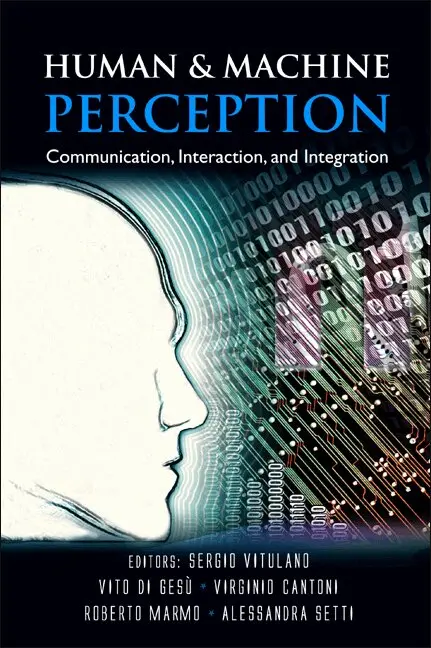
The theme of this book on human and machine perception is communication, interaction, and integration. For each basic topic there are invited lectures, corresponding to approaches in nature and machines, and a panel discussion. The lectures present the state of the art, outlining open questions and stressing synergies among the disciplines related to perception. The panel discussions are forums for open debate. The wide spectrum of topics allows comparison and synergy and can stimulate new approaches.