
Alessandro Conti – författare
Visar alla böcker från författaren Alessandro Conti. Handla med fri frakt och snabb leverans.
3 produkter
3 produkter
1 027 kr
Skickas inom 10-15 vardagar
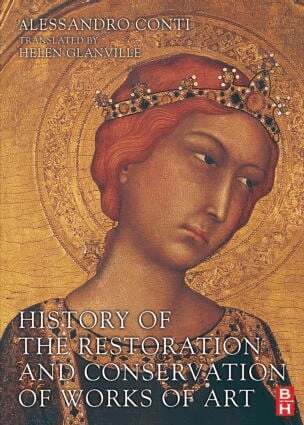
At times controversial and uncompromising, always intellectually honest, Alessandro Conti’s book is - astonishingly – the only attempt to comprehensively chart in time, the changing impact of man’s desire to preserve for future generations the materials, meaning and appearances of works of art. Remarkable in its meticulous research of source material and breadth of scope, History of the Restoration and Conservation of Works of Arts, translated by Helen Glanville, charts the practices and underlying philosophies of conservation and ‘restored’ works of art from the Middle Ages to the end of the nineteenth century.In English-speaking countries, a lack of foreign language skills leaves many unable to consult a wealth of both published and unpublished historical documentation. Developments in conservation have therefore tended toward the scientific and analytical. Access to such documentation leads to better understanding of the present appearance of works of art and of their changing aspect and perception over time. Recent publications indicate that there is a great need for people writing on the subject to be aware of material which is not in their mother tongue: approaches presented as ‘new’ are in fact merely ‘contemporary’, and have been discussed or practiced in other centuries and countries.Just as knowledge of practices and effects of art conservation and restoration should form an integral part of History of Art Degrees, the more theoretic, abstract and historical aspects, should also be part of the training. This book is an invaluable source for academic and public institutions, art historians as well as practicing conservators and lovers of art.
2 202 kr
Skickas inom 10-15 vardagar
At times controversial and uncompromising, always intellectually honest, Alessandro Conti’s book is - astonishingly – the only attempt to comprehensively chart in time, the changing impact of man’s desire to preserve for future generations the materials, meaning and appearances of works of art. Remarkable in its meticulous research of source material and breadth of scope, History of the Restoration and Conservation of Works of Arts, translated by Helen Glanville, charts the practices and underlying philosophies of conservation and ‘restored’ works of art from the Middle Ages to the end of the nineteenth century.In English-speaking countries, a lack of foreign language skills leaves many unable to consult a wealth of both published and unpublished historical documentation. Developments in conservation have therefore tended toward the scientific and analytical. Access to such documentation leads to better understanding of the present appearance of works of art and of their changing aspect and perception over time. Recent publications indicate that there is a great need for people writing on the subject to be aware of material which is not in their mother tongue: approaches presented as ‘new’ are in fact merely ‘contemporary’, and have been discussed or practiced in other centuries and countries.Just as knowledge of practices and effects of art conservation and restoration should form an integral part of History of Art Degrees, the more theoretic, abstract and historical aspects, should also be part of the training. This book is an invaluable source for academic and public institutions, art historians as well as practicing conservators and lovers of art.
Del 41 - Brill's Companions to the Christian Tradition
Companion to Walter Burley
Late Medieval Logician and Metaphysician
Inbunden, Engelska, 2013
4 713 kr
Skickas inom 3-6 vardagar
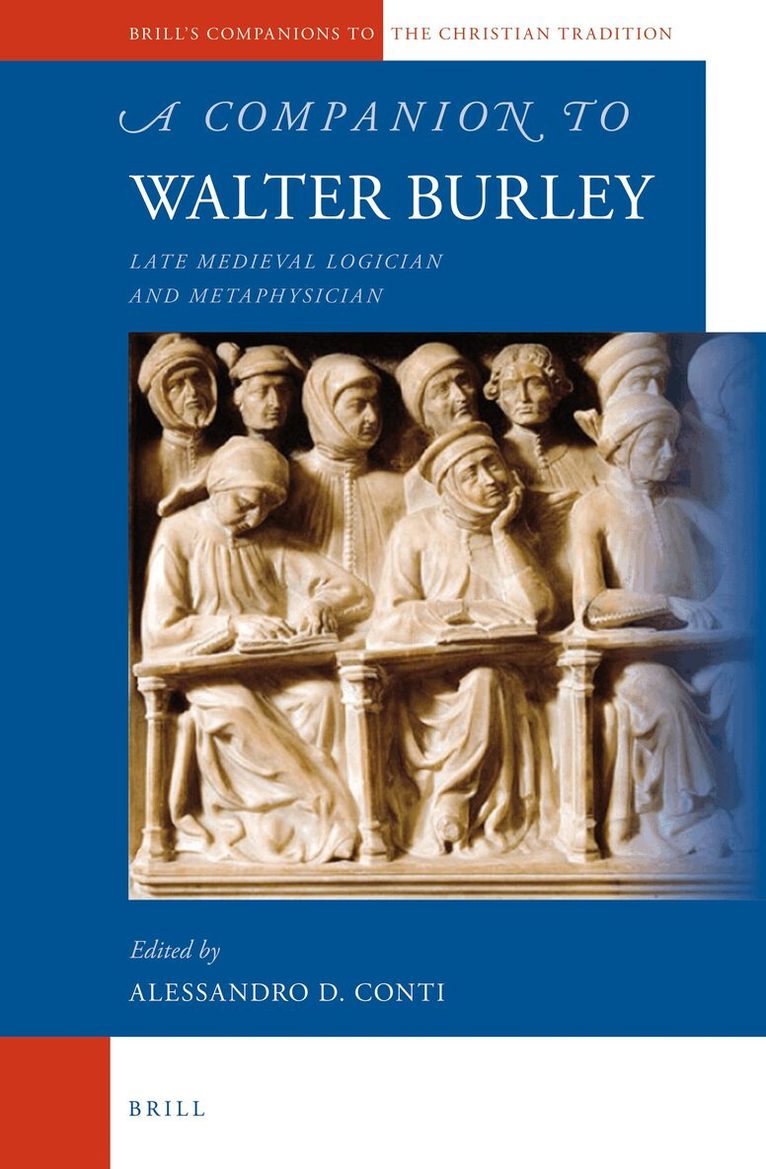
Until some thirty years ago, medieval scholars and historians of philosophy have not generally done justice to Walter Burley (ca. 1275-after 1344). On the one hand, he was been misconstrued as holding a mere variation of more moderate realist positions – something that is true only for the first part of his career (before 1324). On the other hand, very often his ideas were studied simply as a means to a better understanding Ockham’s theories, so dwarfing the worth and interest of Burley’s doctrines. On the contrary, in terms of rigour, originality, and influence, Burley was one of the most prominent logicians and metaphysicians of the Middle Ages. This volume, which contains thirteen substantial essays on Burley's philosophy, tries to rectify that situation. It aims to reconstruct Burley’s thought and the role it played in the development of late medieval philosophy, to situate it definitely within its historical and intellectual context, and to clarify its internal evolution.Contributors include: Fabrizio Amerini, E. Jennifer Ashworth, Laurent Cesalli, Alessandro D. Conti, Iacopo Costa, Catarina Dutilh Novaes, Marek Gensler, Elżbieta Jung, Roberto Lambertini, Cecilia Trifogli, Marta Vittorini, and Hans-Ulrich Wöhler.