Alessandro Sarti - Böcker
Visar alla böcker från författaren Alessandro Sarti. Handla med fri frakt och snabb leverans.
9 produkter
9 produkter
1 381 kr
Skickas inom 10-15 vardagar
This book describes about unlike usual differential dynamics common in mathematical physics, heterogenesis is based on the assemblage of differential constraints that are different from point to point.
1 381 kr
Skickas inom 10-15 vardagar
This book describes about unlike usual differential dynamics common in mathematical physics, heterogenesis is based on the assemblage of differential constraints that are different from point to point. The construction of differential assemblages will be introduced in the present study from the mathematical point of view, outlining the heterogeneity of the differential constraints and of the associated phase spaces, that are continuously changing in space and time. If homogeneous constraints well describe a form of swarm intelligence or crowd behaviour, it reduces dynamics to automatisms, by excluding any form of imaginative and creative aspect. With this study we aim to problematize the procedure of homogeneization that is dominant in life and social science and to outline the dynamical heterogeneity of life and its affective, semiotic, social, historical aspects. Particularly, the use of sub-Riemannian geometry instead of Riemannian one allows to introduce disjointed and autonomous areas in the virtual plane. Our purpose is to free up the dynamic becoming from any form of unitary and totalizing symmetry and to develop forms, action, thought by means of proliferation, juxtaposition, and disjunction devices. After stating the concept of differential heterogenesis with the language of contemporary mathematics, we will face the problem of the emergence of the semiotic function, recalling the limitation of classical approaches (Hjelmslev, Saussure, Husserl) and proposing a possible genesis of it from the heterogenetic flow previously defined. We consider the conditions under which this process can be polarized to constitute different planes of Content (C) and Expression (E), each one equipped with its own formed substances. A possible (but not unique) process of polarization is constructed by means of spectral analysis, that is introduced to individuate E/C planes and their evolution. The heterogenetic flow, solution of differential assemblages, gives rise to forms that are projected onto the planes, offering a first referring system for the flow, that constitutes a first degree of semiosis.
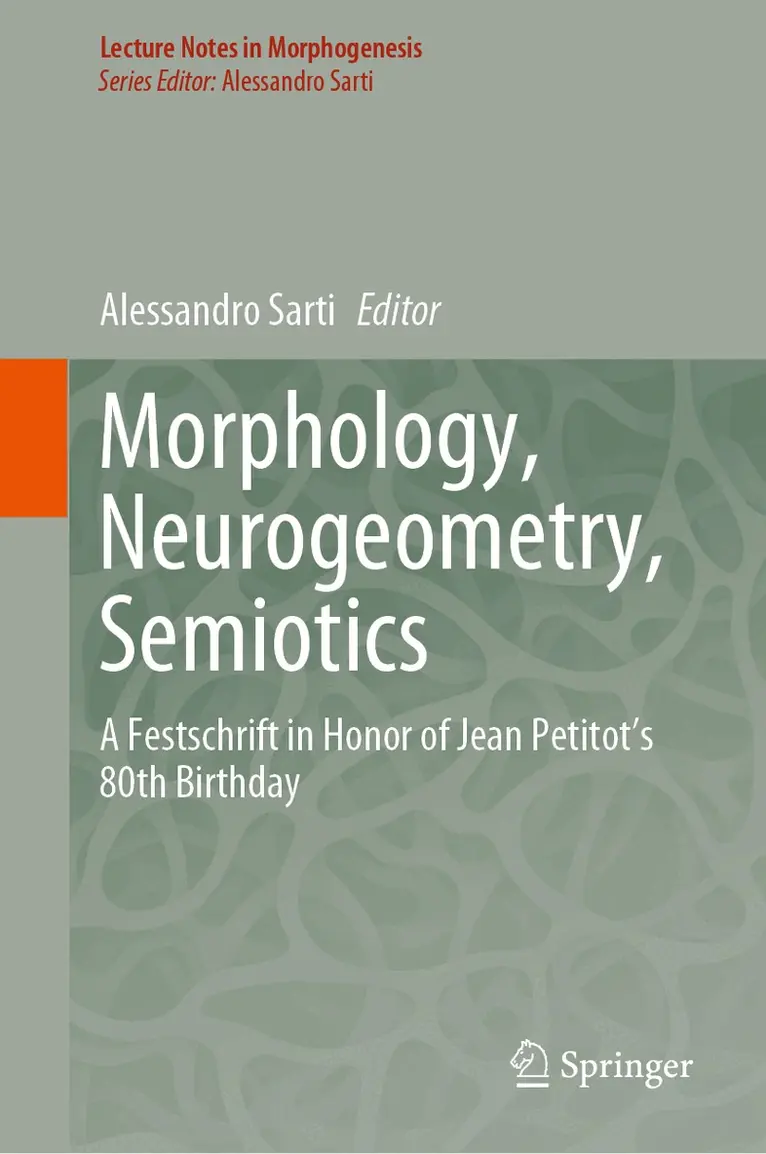
Morphology, Neurogeometry, Semiotics
A Festschrift in Honor of Jean Petitot 's 80th Birthday
Inbunden, Engelska, 2024
1 892 kr
Skickas inom 10-15 vardagar
Jean Petitot is a polyhedric thinker whose contributions has been fundamental in a number of disciplines, such as epistemology, morphodynamics, differential geometry, structural semiotics, neurogeometry, phenomenology, linguistics, cognitive grammars, the theory of catastrophes, social sciences, literary studies, and aesthetics.
Morphology, Neurogeometry, Semiotics
A Festschrift in Honor of Jean Petitot 's 80th Birthday
Häftad, Engelska, 2025
1 892 kr
Skickas inom 10-15 vardagar
Jean Petitot is a polyhedric thinker whose contributions has been fundamental in a number of disciplines, such as epistemology, morphodynamics, differential geometry, structural semiotics, neurogeometry, phenomenology, linguistics, cognitive grammars, the theory of catastrophes, social sciences, literary studies, and aesthetics. This book is a homage to his huge contribution about the main concepts of morphogenesis and meaning that constitute the center of gravity around which Petitotian reflection revolves and returns.The scientific path of Jean Petitot develops between these two poles, topology and meaning. At stake it was to challenge the hiatus separating the exact sciences from the humanities that was the main point of the Petitot seminar of EHESS Epistemology of Models. By designing the appropriate qualitative dynamics between the two poles, form and meaning, it is possible to understand the Saussurian sign in structural semiotics, or the Greimasian semiotic square fordeep narrative structures or even the canonical formula of the myth of Lévi Strauss in structural anthropology. These are just few results in applying the theory of catastrophes to the emergence of meaning. The book is a collection of testimonies by distinguished authors who worked extensively with Jean Petitot in the different fields of Mathematics, Neurogeometry, Semiotics, Aesthetics, and Epistemology. An extensive bibliography of Petitot’s work is also presented.
271 kr
Skickas inom 10-15 vardagar
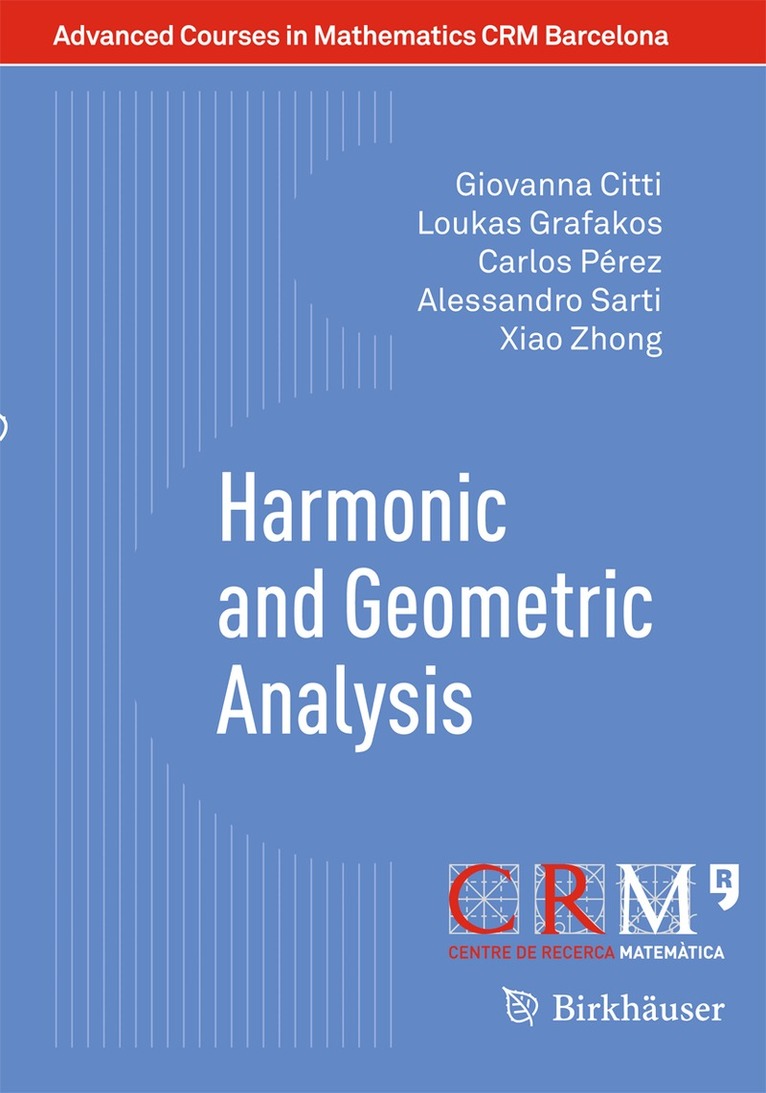
This book contains an expanded version of lectures delivered by the authors at the CRM in Spring of 2009. It contains four series of lectures. The first one is an application of harmonic analysis and the Heisenberg group to understand human vision. The second and third series of lectures cover some of the main topics on linear and multilinear harmonic analysis. The last one is a clear introduction to a deep result of De Giorgi, Moser and Nash on regularity of elliptic partial differential equations in divergence form.
1 064 kr
Skickas inom 10-15 vardagar
This contributed volume aims to reconsider the concept of individuation, clarifying its articulation with respect to contemporary problems in perceptual, neural, developmental, semiotic and social morphogenesis. The authors approach the ontogenetical issue by taking into account the morphogenetic process, involving the concept of individuation proposed by Gilbert Simondon and Gilles Deleuze. The target audience primarily comprises experts in the field but the book may also be beneficial for graduate students. The challenge of the genesis and constitution of “units” has always been at the center of philosophical and scientific research. This ontogenetical issue is common to every discipline but it is articulated in different ways: in phenomenology of perception the constitution of perceptual units is at the base of gestalt field theories, in theoretical neuroscience synchronized neural assemblies are considered as correlates of conscious processes, in developmental embryogenesis the constitution of organs is the principle outcome of morphodynamic evolution while in social morphogenesis the constitution of coherent units is common to segmentary, gerarchic and functional differentiation.
1 064 kr
Skickas inom 10-15 vardagar
This contributed volume aims to reconsider the concept of individuation, clarifying its articulation with respect to contemporary problems in perceptual, neural, developmental, semiotic and social morphogenesis. The authors approach the ontogenetical issue by taking into account the morphogenetic process, involving the concept of individuation proposed by Gilbert Simondon and Gilles Deleuze. The target audience primarily comprises experts in the field but the book may also be beneficial for graduate students. The challenge of the genesis and constitution of “units” has always been at the center of philosophical and scientific research. This ontogenetical issue is common to every discipline but it is articulated in different ways: in phenomenology of perception the constitution of perceptual units is at the base of gestalt field theories, in theoretical neuroscience synchronized neural assemblies are considered as correlates of conscious processes, in developmental embryogenesis the constitution of organs is the principle outcome of morphodynamic evolution while in social morphogenesis the constitution of coherent units is common to segmentary, gerarchic and functional differentiation.
1 096 kr
Skickas inom 10-15 vardagar
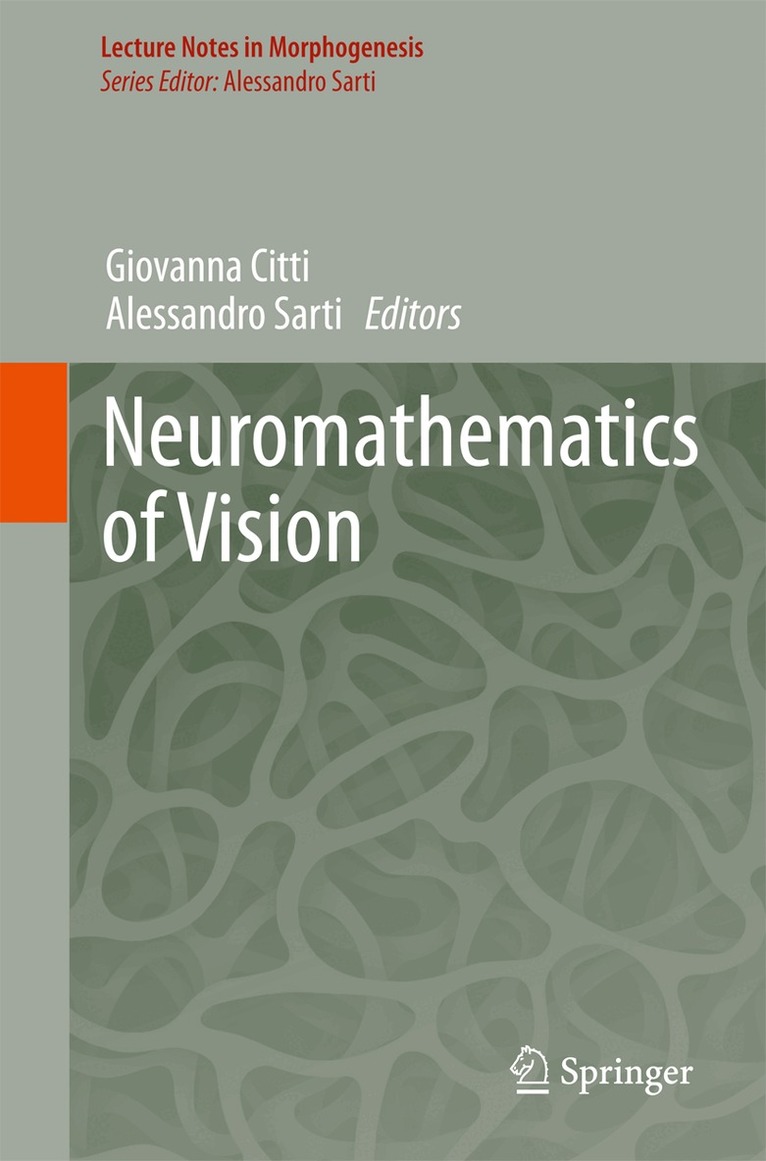
This book is devoted to the study of the functional architecture of the visual cortex. Its geometrical structure is the differential geometry of the connectivity between neural cells. This connectivity is building and shaping the hidden brain structures underlying visual perception. The story of the problem runs over the last 30 years, since the discovery of Hubel and Wiesel of the modular structure of the primary visual cortex, and slowly cams towards a theoretical understanding of the experimental data on what we now know as functional architecture of the primary visual cortex.Experimental data comes from several domains: neurophysiology, phenomenology of perception and neurocognitive imaging. Imaging techniques like functional MRI and diffusion tensor MRI allow to deepen the study of cortical structures. Due to this variety of experimental data, neuromathematematics deals with modelling both cortical structures and perceptual spaces.From the mathematical point of view, neuromathematical call for new instruments of pure mathematics: sub-Riemannian geometry models horizontal connectivity, harmonic analysis in non commutative groups allows to understand pinwheels structure, as well as non-linear dimensionality reduction is at the base of many neural morphologies and possibly of the emergence of perceptual units. But at the center of the neurogeometry is the problem of harmonizing contemporary mathematical instruments with neurophysiological findings and phenomenological experiments in an unitary science of vision.The contributions to this book come from the very founders of the discipline.
1 096 kr
Skickas inom 10-15 vardagar
This book is devoted to the study of the functional architecture of the visual cortex. Its geometrical structure is the differential geometry of the connectivity between neural cells. This connectivity is building and shaping the hidden brain structures underlying visual perception. The story of the problem runs over the last 30 years, since the discovery of Hubel and Wiesel of the modular structure of the primary visual cortex, and slowly cams towards a theoretical understanding of the experimental data on what we now know as functional architecture of the primary visual cortex.Experimental data comes from several domains: neurophysiology, phenomenology of perception and neurocognitive imaging. Imaging techniques like functional MRI and diffusion tensor MRI allow to deepen the study of cortical structures. Due to this variety of experimental data, neuromathematematics deals with modelling both cortical structures and perceptual spaces.From the mathematical point of view, neuromathematical call for new instruments of pure mathematics: sub-Riemannian geometry models horizontal connectivity, harmonic analysis in non commutative groups allows to understand pinwheels structure, as well as non-linear dimensionality reduction is at the base of many neural morphologies and possibly of the emergence of perceptual units. But at the center of the neurogeometry is the problem of harmonizing contemporary mathematical instruments with neurophysiological findings and phenomenological experiments in an unitary science of vision.The contributions to this book come from the very founders of the discipline.