Alexander Moreira-Almeida - Böcker
Visar alla böcker från författaren Alexander Moreira-Almeida. Handla med fri frakt och snabb leverans.
5 produkter
5 produkter
1 092 kr
Skickas inom 5-8 vardagar
Religiosity and spirituality (R/S) represent a very important factor of daily life for many individuals across different cultures and contexts. It is associated with lower rates of depression, suicide, mortality, and substance abuse, and is positively correlated with well-being and quality of life. Despite growing academic recognition and scientific literature on these connections this knowledge has not been translated into clinical practice.Part of the expanding Oxford Cultural Psychiatry series, Spirituality and Mental Health Across Cultures is a timely exploration of the implications of R/S on mental health. Written and edited by 38 experts in the fields of spirituality and mental health from 11 countries, covering a wide range of cultural and geographical perspectives, this unique resource assesses how mental health relates to world religions, agnosticism, atheism, and spiritualism unaffiliated with organised religion, with a practical touch.Across 25 chapters, this resource provides readers with a succinct and trustworthy review of the latest research and how this can be applied to clinical care. The first section covers the principles and fundamental questions that relate science, history, philosophy, neuroscience, religion, and spirituality with mental health. The second section discusses the main beliefs and practices related to world religions and their implications to mental health. The third reviews the impact of R/S on specific clinical situations and offers practical guidance on how to handle these appropriately, such as practical suggestions for assessing and integrating R/S in personal history anamnesis or psychotherapy.
1 064 kr
Skickas inom 10-15 vardagar
The conscious mind defines human existence. Many consider the brain as a computer, and they attempt to explain consciousness as emerging at a critical, but unspecified, threshold level of complex computation among neurons. The brain-as-computer model, however, fails to account for phenomenal experience and portrays consciousness as an impotent, after-the-fact epiphenomenon lacking causal power. And the brain-as-computer concept precludes even the remotest possibility of spirituality. As described throughout the history of humankind, seemingly spiritual mental phenomena including transcendent states, near-death and out-of-body experiences, and past-life memories have in recent years been well documented and treated scientifically. In addition, the brain-as-computer approach has been challenged by advocates of quantum brain biology, who are possibly able to explain, scientifically, nonlocal, seemingly spiritual mental states.Exploring Frontiers of the Mind-Brain Relationship argues against the purely physical analysis of consciousness and for a balanced psychobiological approach. This thought-provoking volume bridges philosophy of mind with science of mind to look empirically at transcendent phenomena, such as mystic states, near-death experiences and past-life memories, that have confounded scientists for decades. Representing disciplines ranging from philosophy and history to neuroimaging and physics, and boasting a panel of expert scientists and physicians, including Andrew Newberg, Peter Fenwick, Stuart Hameroff, Mario Beauregard, Deepak Chopra, and Chris Clarke the book rigorously follows several lines of inquiry into mind-brain controversies, challenging readers to form their own conclusions—or reconsider previous ones. Key coverage includes: Objections to reductionistic materialism from the philosophical and the scientific tradition.Phenomena and the mind-brain problem.The neurobiologicalcorrelates of meditation and mindfulness.The quantum soul, a view from physics.Clinical implications of end-of-life experiences.Mediumistic experience and the mind-brain relationship. Exploring Frontiers of the Mind-Brain Relationship is essential reading for researchers and clinicians across many disciplines, including cognitive psychology, personality and social psychology, the neurosciences, neuropsychiatry, palliative care, philosophy, and quantum physics.“This book … brings together some precious observations about the fundamental mystery of the nature of consciousness … It raises many questions that serve to invite each of us to be more aware of the uncertainty of our preconceptions about consciousness … This book on the frontiers of mind-body relationships is a scholarly embodiment of creative and open-minded science.”C. Robert Cloninger, MDWallace Renard Professor of Psychiatry, Genetics, and Psychology,Washington University School of MedicineSt. Louis MO
1 064 kr
Skickas inom 10-15 vardagar
The conscious mind defines human existence. Many consider the brain as a computer, and they attempt to explain consciousness as emerging at a critical, but unspecified, threshold level of complex computation among neurons. The brain-as-computer model, however, fails to account for phenomenal experience and portrays consciousness as an impotent, after-the-fact epiphenomenon lacking causal power. And the brain-as-computer concept precludes even the remotest possibility of spirituality. As described throughout the history of humankind, seemingly spiritual mental phenomena including transcendent states, near-death and out-of-body experiences, and past-life memories have in recent years been well documented and treated scientifically. In addition, the brain-as-computer approach has been challenged by advocates of quantum brain biology, who are possibly able to explain, scientifically, nonlocal, seemingly spiritual mental states.Exploring Frontiers of the Mind-Brain Relationship argues against the purely physical analysis of consciousness and for a balanced psychobiological approach. This thought-provoking volume bridges philosophy of mind with science of mind to look empirically at transcendent phenomena, such as mystic states, near-death experiences and past-life memories, that have confounded scientists for decades. Representing disciplines ranging from philosophy and history to neuroimaging and physics, and boasting a panel of expert scientists and physicians, including Andrew Newberg, Peter Fenwick, Stuart Hameroff, Mario Beauregard, Deepak Chopra, and Chris Clarke the book rigorously follows several lines of inquiry into mind-brain controversies, challenging readers to form their own conclusions—or reconsider previous ones. Key coverage includes: Objections to reductionistic materialism from the philosophical and the scientific tradition.Phenomena and the mind-brain problem.The neurobiologicalcorrelates of meditation and mindfulness.The quantum soul, a view from physics.Clinical implications of end-of-life experiences.Mediumistic experience and the mind-brain relationship. Exploring Frontiers of the Mind-Brain Relationship is essential reading for researchers and clinicians across many disciplines, including cognitive psychology, personality and social psychology, the neurosciences, neuropsychiatry, palliative care, philosophy, and quantum physics.“This book … brings together some precious observations about the fundamental mystery of the nature of consciousness … It raises many questions that serve to invite each of us to be more aware of the uncertainty of our preconceptions about consciousness … This book on the frontiers of mind-body relationships is a scholarly embodiment of creative and open-minded science.”C. Robert Cloninger, MDWallace Renard Professor of Psychiatry, Genetics, and Psychology,Washington University School of MedicineSt. Louis MO
325 kr
Skickas inom 5-8 vardagar
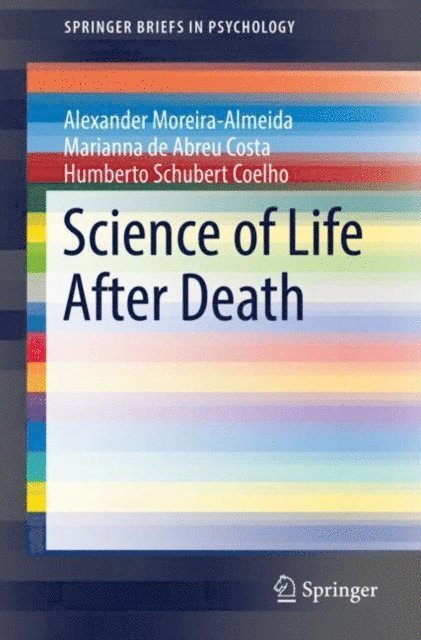
This book examines the best available empirical evidence regarding one of the most challenging and pervasive questions throughout ages, cultures, and religions: the survival of human consciousness after death. It begins with a contextual overview of belief in personal survival and refutes misguided historical and epistemological arguments against the notion of survival after death (e.g., irrational, purely religious, impossible to be addressed by science, that has been proved false by neuroscience). The book provides an overview of the scientific evidence regarding the survival of human consciousness after death, focusing on studies on mediumship, near-death and out-of-body experiences, and reincarnation.Featured topics of coverage include:The belief in life after death in the contemporary world as well as in the history of religions and philosophy.The key misguided arguments and prejudices against the academic study of afterlife survival.What constitutes empirical evidence for survival after death?The main explanatory hypotheses alternative to survival after death.The chief cultural barriers to a fair examination of the available evidence for survival of consciousness after death.Science of Life After Death is an essential resource for researchers, professors, and graduate students as well as clinicians, therapists, and other professionals in developmental and clinical psychology; spirituality, religious. and consciousness studies; psychiatry; neuroscience / neurology; phenomenology / philosophy; complementary and alternative medicine; and all interrelated disciplines.
600 kr
Skickas inom 10-15 vardagar
Dieses Buch untersucht die besten verfügbaren empirischen Beweise für eine der schwierigsten und allgegenwärtigsten Fragen in allen Zeitaltern, Kulturen und Religionen: das Überleben des menschlichen Bewusstseins nach dem Tod. Es beginnt mit einem kontextuellen Überblick über den Glauben an ein persönliches Überleben und widerlegt fehlgeleitete historische und erkenntnistheoretische Argumente gegen die Vorstellung eines Überlebens nach dem Tod (z. B. irrational, rein religiös, wissenschaftlich unmöglich, von der Neurowissenschaft als falsch erwiesen). Das Buch gibt einen Überblick über die wissenschaftlichen Beweise für das Fortleben des menschlichen Bewusstseins nach dem Tod und konzentriert sich dabei auf Studien über Medialität, Nahtoderfahrungen, außerkörperliche Erfahrungen und Reinkarnation.Zu den behandelten Themen gehören:Der Glaube an ein Leben nach dem Tod in der heutigen Welt sowie in der Geschichte der Religionen und der Philosophie.Die wichtigsten fehlgeleiteten Argumente und Vorurteile gegen die wissenschaftliche Erforschung des Überlebens nach dem Tod.Was sind empirische Beweise für ein Überleben nach dem Tod?Die wichtigsten alternativen Erklärungshypothesen für das Überleben nach dem Tod.Die wichtigsten kulturellen Hindernisse für eine faire Untersuchung der verfügbaren Beweise für das Weiterleben des Bewusstseins nach dem Tod.Science of Life After Death ist ein unverzichtbares Hilfsmittel für Forscher, Professoren und Doktoranden sowie für Kliniker, Therapeuten und andere Fachleute in den Bereichen Entwicklungs- und klinische Psychologie, Spiritualität, Religions- und Bewusstseinsforschung, Psychiatrie, Neurowissenschaft/Neurologie, Phänomenologie/Philosophie, Komplementär- und Alternativmedizin und allen damit verbundenen Disziplinen.